Majority/Minority Politics in South Asia: Series Introduction
Natasha Raheja and Mohsin Alam Bhat
“Majority/Minority Politics in South Asia” is an essay collection, co-edited by Mohsin Bhat and Natasha Raheja, that moves beyond nation-specific frameworks to foster comparative, cross-disciplinary, and cross-border inquiry into how majoritarianism takes shape across South Asia. The collection illuminates shared mechanisms of majoritarian rule and the varied forms of opposition they provoke, thus advancing critical scholarship on democratic erosion while contributing to public debates on resisting authoritarianism and rebuilding democratic futures.
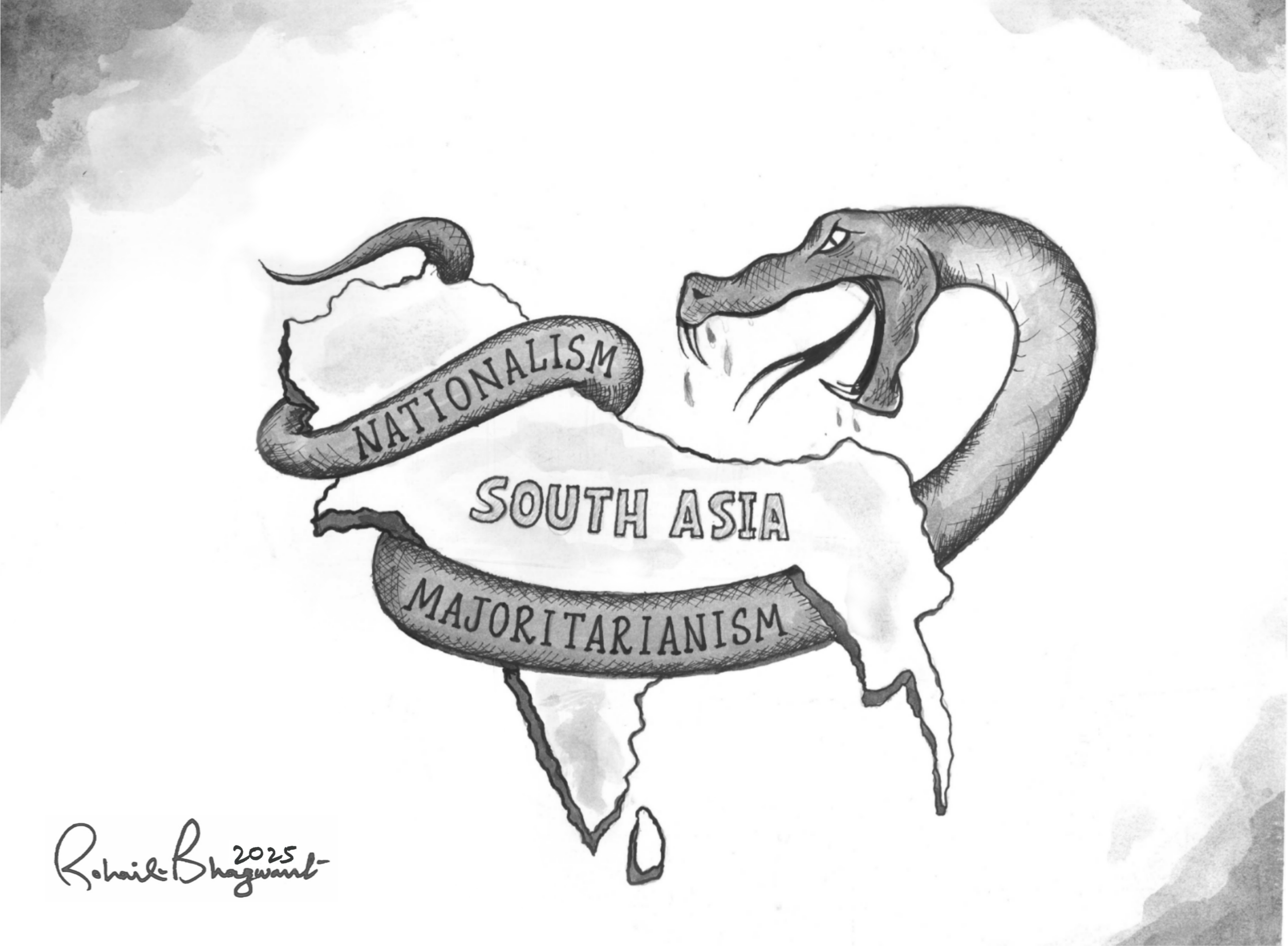
Political cartoon by Rohait Bhagwant.
Democracy is facing new forms of retreat across the world. In South Asia, as elsewhere, this crisis is increasingly driven by ethnic and religious majoritarianism. Governments across the region are consolidating permanent majorities and institutionalizing exclusion through legal, political, and economic mechanisms. Yet shifting electoral coalitions, mass protests, and emergent civic movements underscore that these projects of domination remain deeply contested. This collection moves beyond nation-specific frameworks to foster a comparative, cross-disciplinary, and cross-border inquiry into how majoritarianism takes shape across Bangladesh, India, Nepal, Pakistan, and Sri Lanka. The conversations that unfold across these essays consistently return to a shared set of questions: What does it mean to be a “majority” or a “minority”? How are these categories produced, stabilized, and contested? And what kinds of political, legal, and cultural work go into sustaining them?
The categories of majority and minority are a salient political taxonomy in today’s world. They appear to describe demographic reality—a simple arithmetic of numbers—but they are, in fact, political constructions: products of specific historical processes that include colonial census-making, the territorialization of sovereignty in the nation-state, and the codification of group differences in constitutional and international legal frameworks. The modern career of the majority and minority as political categories is connected to the liberal democratic tradition and nation-state governance, which has organized the legitimacy of governance around numerical majorities while simultaneously generating anxieties, and protections, for those left outside the dominant count. Yet the framework has always harbored a productive tension: majority rule promises popular sovereignty, but if unmediated, it threatens to become permanent domination of some by others, compelling the elaboration of rights, guarantees, and institutions designed to check exactly the arithmetic logic it also celebrates.
This tension took on a distinctive shape through the history of colonialism and nation-state formation. Colonial powers were themselves prolific producers of majority and minority categories, through censuses, personal law systems, communal electorates, and ethnographic knowledge, encoding difference into the administrative structure of plural societies in ways that both reflected and intensified social divisions. In South Asia, British colonial governance transformed more fluid, contextual, and overlapping social identities into legible, enumerable, and distinct communities. The partition of the Indian subcontinent in 1947 was, in one sense, a culmination of this logic: a reorganization of territory around religious majorities and minorities that produced new nations. States across South Asia have inherited majority-minority frameworks that were shaped by colonial knowledge and administrative practice, and then reworked in the crucible of nationalist politics and postcolonial state-building.
International human rights law emerged in the postwar moment that witnessed the proliferation of newly independent nation-states, and it developed partly in response to the catastrophes of majoritarian nationalism that had excluded minorities across Europe. Yet the international human rights framework was itself organized around the primacy of the nation-state as the guarantor, and primary violator, of rights, producing an enduring tension between the universalism it proclaimed and the state-centric architecture through which it operated. In South Asia, this tension has been especially sharp. Constitutional framings of minority rights are contested terrains of nation-building, in which the definition of who counted as a protected minority, and against what, was inseparable from contested visions of national identity. Decades later, the region's minorities invoke human rights frameworks with increasing frequency, even as those frameworks have proven limited in their capacity to restrain the majoritarian projects that now animate governments across South Asia. Understanding this gap between the formal architecture of rights and the lived experience of minoritization is a central task for comparative inquiry into majority-minority politics in the region today.
Rather than treating majority and minority as self-evident demographic facts, the contributions gathered here thus approach them as political forms—constructed, reiterated, and governed through law, media, memory, infrastructure, and everyday practices of state power. A central insight that emerges is that majoritarianism, premised on a politics of numbers and demographic calculus, is fundamentally a lived and mediated experience. This necessitates the qualitative, humanistic, and ethnographic methods that shape the collection, which attend to how majoritarian power is enacted and negotiated across routine and exceptional contexts–through procedures and discretion, as much through mundane and spectacular ways.
The essays document majoritarianism across diverse sites: from roads and checkpoints in Nepal to textbooks and political rallies in Bangladesh, from shrines and temples in Pakistan to documentary and biometric regimes in India, and to the body and intimate life as sites of recognition, regulation, and exclusion. These varied sites reveal that there is no single directionality or fixed equation of majoritarian domination. Groups are differently positioned as agents, stakeholders, targets, and unwitting participants in statecraft. Majoritarianism, in this sense, is best understood as a relational phenomenon. It emerges through specific attachments, identifications, and institutional practices, rather than as a stable attribute of any one group. Even within a given nation-state, the essays resist monolithic framing: for example, the India-focused contributions alone move across Punjab, Assam, and the national constitutional arena, each revealing distinct configurations of majoritarian power that unsettle the nation as a unit of analysis.
Consequently, majority-minority configurations are marked by a persistent politics of inversion. Groups that appear dominant in one register may be rendered vulnerable in another, while claims to marginality can themselves become instruments of political consolidation. This fluidity is not an anomaly but a constitutive feature of majority–minority relations. Religion remains a salient axis across the region, yet it is continually refracted through caste, class, region, and other social formations, producing layered and sometimes contradictory configurations of power. Even within ostensibly homogeneous settings, internal differentiations generate new forms of majoritarian assertion and minoritization. These dynamics unfold not only within nation-states but across borders and contested territories, unsettling the assumption that majority–minority relations are contained within the bounded space of the nation. In this sense, demographic arithmetic operates as a political technology—one that is mobilized, reinterpreted, and re-scaled across contexts rather than simply given.
Several contributions push this insight further by showing that the distinction between majority and minority is itself an object of political struggle. Anneeth Kaur Hundle's account of the Sikh and Panjabi ethos similarly demonstrates how majority status in a state-level administrative unit coexists with minority status at the national and transnational scale, unsettling any straightforward demographic arithmetic. Natasha Raheja’s account of “conversions” across the India–Pakistan border reveals how mobility, affiliation, and desire unsettle the apparent fixity of religious majorities and minorities, exposing their dependence on territorial and national imaginaries. Mona Bhan’s work, in a different register, demonstrates how claims to belonging and exclusion in Kashmir are reworked through competing narratives of protection, security, and entitlement, complicating any straightforward alignment between demographic strength and political power. Suryakant Waghmore, meanwhile, shows how even historically dominant groups such as upper-caste Brahmins can recast themselves as vulnerable minorities—an affective and political move that not only reframes claims to injury but also underwrites the consolidation of caste-inflected majoritarian nationalism under Hindutva.
Across these analyses, majority and minority emerge not as pre-political facts but as effects of ongoing contestation—produced through law, governance, and everyday practices, and continually reconfigured through struggles over recognition, resources, and legitimacy. An understanding of majority and minority as contested constructions foregrounds the multiple modalities through which they are produced. Law and governance are central among these. Courts, commissions, and administrative regimes actively constitute majority-minority distinctions. Mohsin Bhat’s essay, for instance, shows how judicial and bureaucratic practices through the constitutionalisation of suspicion rework the boundaries of belonging. Where Bhat focuses on the "constitutionalisation of suspicion," Radhika Mongia analyzes how concrete bureaucratic and legislative mechanisms: documentary regimes and electoral roll deletions reverse burdens of proof. Yathursha Ulakentheran and Ahilan Kadirgamar similarly highlight how militarisation, environmental regulation, and development policy in Sri Lanka operate through legal and administrative techniques that reorganize vulnerability across groups. These analyses show how citizenship deprivation operates through routinized documentary regimes as well as overt exclusions that presume noncitizenship. Across these contexts, law does not merely fail to restrain majoritarianism; it is frequently one of the means through which it is enacted.
A second set of concerns running through the collection centres on memory, forgetting, and the politics of history. Majoritarian projects do not merely rewrite the past; they actively produce hierarchies of remembrance and erasure. Hana Shams Ahmed’s analysis of democratic mobilization in Bangladesh demonstrates how national symbols, historical narratives, and public discourse are mobilized to consolidate dominant imaginaries while marginalising alternative histories and forms of belonging. The appropriation of the “spirit of 1971” by competing political forces marginalizes Adibasi histories and other forms of belonging that do not neatly align with nationalist narratives. Similarly, Sana Batool shows how public culture of representation in Pakistan reframes, depoliticizes, and renders episodic anti-Shia violence in Pakistan. This obscures long histories of targeting, exclusion, and minoritization of the community. In this process, collective histories of disadvantage may be displaced or reconfigured, giving way to individualized or dehistoricized accounts of difference. Memory thus becomes a key terrain on which majority–minority relations are stabilized and contested.
Closely related to this is the paradox of visibility and erasure. Minorities are often rendered hyper-visible as problems—objects of regulation, suspicion, or reform—while simultaneously being denied political voice and recognition as rights-bearing subjects. In some cases, as Salman Hussain argues in relation to Khwajasara in Pakistan, visibility itself is conditioned on the performance of vulnerability, where recognition is granted only insofar as subjects conform to moralized scripts of suffering, backwardness, or incapacity. In others, as Salah Punathil shows for precarious citizens in Assam (India), invisibility is produced through bureaucratic exclusion, as populations are effectively erased from systems of welfare, finance, and governance. Across these varied forms, visibility and erasure operate together as techniques of majoritarian power. Sadia Mahmood's ethnographic account of Sikh gurdwaras and Hindu temples in Pakistan shows how sacred sites function as liminal spaces, where minority presence is rendered conditional on trust, compliance, and bureaucratic negotiation. These dynamics exceed liberal scripts of minority rights and inclusion. Minoritized struggle may not always take the form of claims for recognition within existing categories; it often involves reworking or rejecting those categories altogether.
Shaunna Rodrigues proposes that democratic societies navigate majority-minority structures not only through legal reform or political mobilization but through aesthetic identification—the capacity to recognize oneself within others' struggles—as a mode of inhabiting difference without erasing it. In Bhat’s account of Pasmanda Muslims in India, marginalized groups seek to reconstitute political majorities as cross-cutting coalitions grounded in shared experiences of subordination, rather than religious or ethnic identity. Ulakentheran and Kadirgamar show how resistance in Sri Lanka emerges through alliances that traverse established boundaries, linking communities through common exposure to dispossession and precarity. Still others articulate alternative political imaginaries; in Tashi Ghale’s account of Indigenous politics in Nepal rooted in sovereignty, infrastructure, or collective life that challenge the very terms through which minority status is defined.
Taken together, the essays in this collection invite a rethinking of majority and minority as relational, contested, and historically produced forms. They reveal how majoritarianism operates through subtle and ordinary practices as much as through overt violence, and how it adapts to democratic pressures. At the same time, they point toward insurgent possibilities—ways of unsettling dominant grammars of belonging and recovering more egalitarian visions of justice, citizenship, and political community. It is these tensions, between consolidation and contestation, erasure and remembrance, governance and resistance, that animate the conversations gathered here.
This collection emerged from a Cornell-Queen Mary University London Global Hubs collaboration, supported by the Cornell Center on Global Democracy, and US Department of Education National Resource Center Program. The workshop brought together scholars, journalists, practitioners, and organizers to reflect about the politics of majoritarianism and minoritization in South Asia at a time of deepening authoritarianism and societal divisions. The discussions underscored the importance of connecting academic inquiry with public debate, a commitment that informs the decision to publish these essays in an accessible, short-form format. We thank Daniel Bass, Gloria Lemus Chavez, Parijat Jha, Rachel Riedl, Sebnem Ozkan, Micha Rahder, Antara Chakrabarti, Mishaal Mahmood, Beena Sarwar, Aman Bardia, and Irum Ali, for their support of the workshop collaboration and essay collection.
Contributors:
Ahilan Kadirgamar and Yathursha Ulakentheran - Workings of Power and Alliances of Resistance in Sri Lanka
Anneeth Kaur Hundle - Majoritizing the Minor: The Sikh and Panjabi Ethos Today
Hana Shams Ahmed - The July Uprising and Bengali-Muslim Majoritarian Hegemony in Bangladesh
Mohsin Alam Bhat - Reserving the Majority
Mona Bhan - Caste Minoritization and the Politics of Settler Colonialism in Kashmir
Natasha Raheja - Conversions across the India–Pakistan Border
Radhika Mongia - Citizenship Deprivation and Majoritarianism
Salah Punathil - Border, Citizenship, and the Minority Question in Contemporary India
Salman Hussain - A Cut in Time: Thinking “Backwardness” Through Khwajasara Difference in Pakistan
Syeda Sana Batool - Media Erasure, Anti-Shia Violence, and Counter-Narratives in Pakistan
Shaunna Rodrigues - Self-Respect, Civilization, and the Conditions of Fraternity in India
Suryakant Waghmore - A Nation Without Minorities?
Tashi Tewa - Indigenous Resurgence Against the Hindu Caste Nationalism in Dolpo, Nepal