Self-Respect, Civilization, and the Conditions of Fraternity in India
Shaunna Rodrigues
“Majority/Minority Politics in South Asia” is an essay collection, co-edited by Mohsin Bhat and Natasha Raheja, that moves beyond nation-specific frameworks to foster comparative, cross-disciplinary, and cross-border inquiry into how majoritarianism takes shape across South Asia. The collection illuminates shared mechanisms of majoritarian rule and the varied forms of opposition they provoke, thus advancing critical scholarship on democratic erosion while contributing to public debates on resisting authoritarianism and rebuilding democratic futures.
“He sat in a far-off corner in the four-anna class. He looked about: not a single student in the whole theatre. All the students of the town were near the Senate House, waiting for their results. Iswaran felt very unhappy to be the only student in the whole theatre. Somehow, fate seemed to have isolated him from his fellow beings in every respect. He felt very depressed and unhappy. He felt an utter distaste for himself.
Soon the lights went out, and the show started—a Tamil film with all the known gods in it. He soon lost himself in the politics and struggles of gods and goddesses; he sat rapt in the vision of a heavenly world which some film director had chosen to present.”
- R. K. Narayan, “Iswaran”, Malgudi Days
Iswaran’s solitude in the theatre captures a problem that runs quietly through the political life of modern societies: how do individuals who feel isolated within inherited social structures come to recognize themselves as participants in a larger moral and political world?
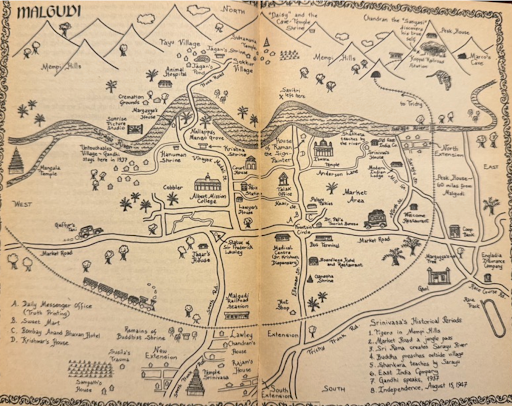
A map of the fictional southern Indian village of Malgudi, invented by R.K. Narayan, and rendered into a map by Dr. James M. Fennely, published in the 1982 edition of Malgudi Days. (Image by the author)
I. Civilizational Thought and The Knowledge of Structures
This essay examines how civilizational structures shape the political imaginary of majority/minority in India. It treats India as a stable constitutional democracy whose constitution was assembled from deeply varied and often contradictory structures of civilizational traditions across South Asia. These structures are shaped not only by colonial rules and norms but also by precolonial linguistic, geographic, religious, and ethnic understandings of what civilization is and should be in the Indian subcontinent.
India, its various groups, and their worldviews have been the source of global debates in modernity about civilization and its capacity to produce a collective consciousness. Given this, what forms of structural knowledge should modern politics adopt to understand the majority and minority in South Asia? What theoretical framework can effectively interrogate the vocabularies, everyday resistances, and concepts through which many of India’s majority and minority communities sustain a democratic polity that respects and esteems plural conceptions of civilization?
In exploring the knowledge of structures about majority/minority in India/South Asia, this essay expands the focus of these questions from their usual disciplinary sites in the social sciences to a broader, interdisciplinary terrain of civilizationism. The question of majority/minority has been pursued by historians of modern South Asia by asking how political actors or movements in colonial/anti-colonial India developed the conception of the minority as they shifted from a critique of empire, imperialism, and colonialism to a justification of democratic, pluralistic constitutionalism in the Subcontinent in the first half of the 20th century. The same majority/minority axis has been explored by scholars of religion, anthropology, and sociology in two primary ways: first, by assessing how the concept of the minority was extended to various national minorities within the most numerically dense region of the world, amidst the transfer of power from the British Empire to modern, partitioned nation-states in South Asia. And second, by justifying or critiquing such extensions through the reconstruction of Indic worldviews by leading South Asian political actors between 1905 and 1990.
Political scientists have assessed the majority/minority question by exploring their accommodation and inclusion in Indian democracy through its post-colonial institutions that also simultaneously seek to democratically reform civilizationally entrenched social structures. The justification they provide for such a reformist approach to inclusion and participation in civilizational reconstruction is a minority’s capacity to shape knowledgeable, progressive, and self-respecting architectures for common life in India, and translate these architectures into the moral grammar of public life from the social margins. In many ways, these capacities have allowed for the greater democratization of Indian society and its varied minorities. These theories explain why the state is so important to those who are truly on the margins of social and public life, like Schedule Tribes and Schedule Caste groups, as well as minorities like Sikhs and Christians, who have often used constitutional guarantees and rights to come to the fore of common political life, often to lead it.
Legal theorists have often held Indian constitutionalism responsible for enabling such a transformative departure from the customary pasts that shaped majority/minority relationships towards more liberal, inclusive, just, and stable forms of social cooperation in postcolonial Indian democracy. However, the emphasis on constitutionalism alone undermines the role that other institutions of the state, like the bureaucracy, and civil society institutions like the People’s Union for Civil Liberties, play in shaping and enabling the democratic participation of minorities in Indian public life.
Despite an accommodative and progressive approach towards minority inclusion in decolonial knowledge-creation, India has struggled to shape inclusive majority/minority relations. This struggle has primarily been shaped by the majority, its majoritarianism, and its inability to shape fraternity as a primary virtue of democratic life in India, where fraternity implies recognizing the majority’s good in the good of minorities, or including the latter in the former. This struggle has done a great deal of damage to the self-respect that Indians, whether they belong to or identify as a majority or minority community, have and gain from India’s process of decolonization and democratization in India.
This article argues that India’s majority/minority problem cannot be understood only through constitutionalism or liberal institutional categories because democratic life in South Asia is also shaped by the reconstruction of inherited civilizational structures of intelligibility. Democratic societies like India have to decide on which inheritances to preserve, reinterpret, or reform if these structures are to become intelligible as forces of democratic progress in India. It theorizes a ‘Knowledge of Structures Solution’ (KSS) to name this process of reflective reconstruction, assessing it according to its capacity to produce self-respect and inhabit plurality without erasing difference.
II. The Knowledge of Structures Solution
Despite the refined presence of progressive ethics and self-respect throughout South Asia’s numerous movements of disobedience against modern political regimes, Indian democracy has conserved and often enabled socially hierarchical aspects of its civilizational pasts. In fact, it has done so in ways that challenge conventional theories of democratization, enabling majoritarianism and exclusive ideas of political membership under narrow forms of civilizational nationalism. While India has founded a constitutionally assembled federal state that has, despite its problems, democratized the present and futures of Indian peoples both within South Asia, and across the globe, the knowledge of premodern, often contested pasts, and their structures of political community, social ties, majority-minority relations continues to severely impact how South Asians make social difference mutually intelligible to each other.
I call the conditions of possibility emerging from such contested civilizational pasts the Knowledge of Structures Solution (KSS). Once a democratic society recognizes that it possesses multiple intellectual inheritances not limited to its own contested histories but also drawn from other societies and their pasts, it has to deliberate and collectively reconstruct which of those knowledges it should use and remake to disclose itself as a polity to its own participants. This knowledge of structures is an epistemic approach to the past, the present, and the future, disclosed not only by how the state transforms social relations but also by the socio-political relations that Indians build with each other and with other South Asians. This knowledge of structures is what minority leaders in South Asia, both before and after the multiple Partitions of India, had to articulate as they reconstructed thought in/of the various traditions of South Asia in the anticolonial movement that shaped the region in the 20th century.
In his introductions to the History of Philosophy, Eastern and Western, Maulana Abul Kalam Azad, the first Minister of Education of India, and a major representative of Indian Muslims, India’s most numerically significant religious minority, argued that the “supreme achievements of the Indian mind” in shaping such a knowledge of structures were undeniable. Worldviews that figures like Bhim Rao Ambedkar described as revolutionary in Ancient India, such as Buddhism, contained comprehensive doctrines that were deeply critical of dominant Vedantic worldviews and their Smriti, through which hierarchical social structures like caste in India were justified. According to Azad, these revolutionary doctrines could not have emerged if the grounds and environment for a revolution had not been created by earlier critiques of the Vedantic worldviews, such as Cārvaka, Samkhya, and Nyaya.
This led Azad, one of the most famous and articulate Muslim and minority leaders in India, to make an interesting epistemic argument: progress in philosophical and civilizational traditions did not proceed through the simple addition of more knowledge but through the refinement in the apprehension of such knowledge, both internally (i.e., within a worldview) and publicly, within and across every generation. Civilizational pluralism in postcolonial India, according to him, would have to rely not only on dominant forms of knowledge, such as the Vedantic Smritis, but also internal contestations to such structures of knowledge coming from other Indic schools of thought.
For Abul Kalam Azad, the groundwork for this Knowledge of Structures Solution involved three related tasks: first, bringing arguments from worldviews that colonial bureaucrats categorized as religion, but liberal thinkers categorized as just different worldviews, into the public domain. Second, it required making public, mutually intelligible distinctions between different forms of arguments within such worldviews, such as (i) religious commands from religious texts, (ii) theological or moral doctrines that depended on interpreting revelation or things considered holy by those who adhered to these doctrines, (iii) theological or moral doctrines that did not depend on the interpretation of revelation or holy injunctions, (iv) juridical debates emerging from historical contestations within the worldview such as in religious or customary law (v) literary arguments from premodern texts that were seen as belonging to a worldview, (vi) poetic arguments about the nature of human life and relationality to non-anthropomorphic forms of life.
Third, democratic societies had to choose which of these arguments ought to shape public political reason, in the same way as modern political philosophy chooses between teleological, deontological, or utilitarian frameworks. For Azad, Indian democratic life would be shaped by the choices it made after empire, on which of its various civilizational forms it would use to produce not only philosophical reasoning in/from South Asia, but also refined techniques of knowledge, intelligibility, cognition, and categorization to understand its own society and remake it for future generations.
To enable a groundwork for The Knowledge of Structures Solution (KSS), several thinkers of and on India in the mid twentieth century argued that the participant who experienced and partook in KSS needed (1) to understand the true nature of the relation of the observer of KSS to the objects within the structure it produced. For. ex. the nature of the entire Indian public and its civilizational burdens and possibilities to the concept of the minority within such a complex structure; (2) the subjective conditions that the observer or actor interpreting the minority’s experience of KSS manages to capture in and, oddly enough, for the minority; (3) a layered examination of which mental faculties are operative in the development of the observers understanding of the minority (emotional, physical, psychic, pedagogical, etc.); and (4) a temporary suspension of pure individuality, and an individualist/temporal understanding of the world, so that the relationship between group identities – majority and minority alike – could be understood more clearly.
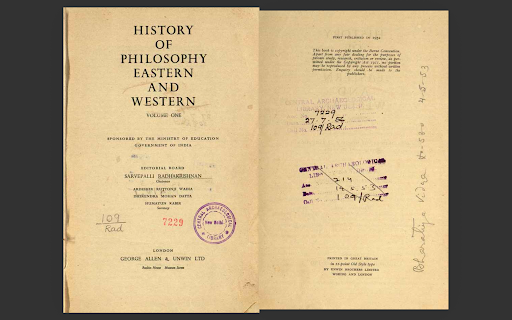
The title page to The History of Philosophy: Eastern and Western, a multi-volume project on global philosophy sponsored by the Ministry of Education of India, headed by Abul Kalam Azad, in the early 1950s. (Image by the author)
Through the first fifty years of Indian independence, such a groundwork for the Knowledge of Structures Solution or KSS was considered a principled and contextual solution to the worldmaking and the word-disclosures of the majority and minorities. If reforms had to be carried out within the worldview of the majority (say, for the dominant religious majority in India via the Hindu code Bill) or among minorities, then one structure within that world, and its civilizationalist aspirations, such as personal or customary laws, was chosen for reform, and a public debate around that structure developed within the group shaped by its accompanying worldview. The real struggle after that would be the translation of that reform into something that is mutually intelligible to other groups and the larger public domain in India. While internal debate was considered essential before a reform of that structure was undertaken by the state, what the Indian state has consistently struggled with is translating the internal logic of this reform to groups that do not adhere to the worldview under reform.
In the last twenty-five years, several theorists of/on India have asked if this groundwork for KSS has become too static in its conception of the majority/ minority, shaped through ascriptive group identities and fixed structures of customary/personal laws. Further, if one were to accept that the relationship between the majority and the minority is, more often than not, dynamic, would such a groundwork for KSS produce a moral or ethical improvement in the individual, group, and civilizational consciousnesses of the majority/minority or simply embed an inherited knowledge of structures as timeless? Would individuals, whether they belong to the minority or majority, have no option but to either exercise fractured agency within structures that are difficult to reform?
An important site from which this questioning has taken place is from the perspective of self-respect. Shaped as (i) the idea of a self that gains respect by developing excellences that allow it to participate with credibility in associational life, and (ii) as a self that is able to develop sociality beyond inherited structures, writing on self-respect in the recent past has allowed one to question the static knowledge of structures through which the state, and others in India, have sought to reform civilizational worldviews in India.
III. Self-Respecting Structures of Knowing
The Knowledge of Structures Solution suggests that democratic societies must continuously decide which elements of their civilizational inheritance will structure public life. Nowhere is this problem more visible than in the South Asian encounter between deeply embedded social knowledge and the rise of democratic constitutionalism that seeks to reform such knowledge to make it more legible to modern institutions of the state.
Despite the lived and regularly debated presence of pre-modern social structures and all their complexities that shape South Asian social relations, the significant submission of South Asian intelligibility to democratic constitutionalism in India is a challenge to modern theories of democratization. Modern theories of democratization and their categories of majority/minority often require an institutional transformation of social structures, like caste. This transformation normally involves a dismantling of hierarchy to pave the way for the greater participation of marginalized groups in democratic institutions.
But the application of such theories of democratization to Indian political life often leaves behind a question: Why is it that a people who have civilizational justifications for social reform, sustain architectures of political power that entrench deeply categorized forms of social knowledge (such as a permanent idea of minorities)? The answer to this question cannot simply be that India inherited incorrect Eurocentric knowledges of civilizationist structures, which eventually go on to shape social relations in India, though this has been the dominant argument for the persistence of entrenched forms of hierarchy and exclusion in India.
Further, modern categories of majority/minority and the cleavages they produce do not always explain why, even when we do not understand each other’s languages, or religious/ethnic belongings, we can understand several other forms of non-discursive rules that dictate our individual and collective possibilities and limitations, such as caste, especially when it is being critiqued. Social science writing on India has struggled to explain the persistence of otherization in Indian society, particularly of religious minorities like Muslims, beyond drawing on psychological ideas of hate internalized by the majority against the minority. This raises a tense, resentful, and self-demeaning question for all South Asians, no matter their nationality, or specific majority/minority identities—what explains the utter disagreement over the inclusion of religious minorities and their worldviews, particularly when it comes to Muslims, despite constitutional guarantees for their protection in post-independent South Asia?
The most persuasive answers to this question from the liberal-democratic world are the legal/constitutional state-driven answers that have been established by Indian constitutionalism since the debates that shaped the Government of India (GoI) Acts from the turn of the 20th century. These answers are rooted in a Hobbesian justification for political life: all social structures have to be transformed if they are to be ruled by successful and stable modern political structures. If social structures aren’t reordered by political structures of rule, then the justifications that modern political systems establish for their existence—those of knowing the populations they govern, of protecting their populations from external enemies, of enabling progress and the increase in the value of their territorial resources, and thereby enabling the self-respect of their individual and collective subjects will be irrelevant. Without social transformation, the legitimacy of the political system will be weak.
Modern South Asian History, and the knowledge generated around it, are quite central to the valence of the above argument: Some of the world’s most widely read historians of South Asia have argued that the Partition of India led to the creation of a Muslim Zion in South Asia. With the demand for the Partition of the Subcontinent came an accompanying idea that a spatially abstract demand for a national homeland could be an effective political solution for the othering and marginalization of minorities in the region. If they faced a threat from a perceived majority, their creation of a secessionist demand for a new nation-state would be sufficient to threaten the unity that all modern nation-states need to be stable.
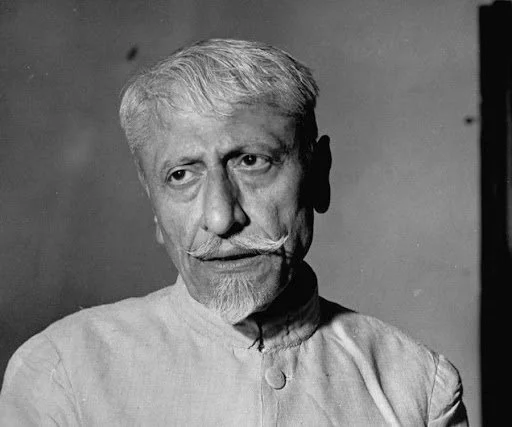
Abul Kalam Azad, India’s first Minister of Education. Photographed in 1946 by the American photographer, Margaret Bourke-White for LIFE Magazine’s November 3rd, 1947 issue, and accessed at the Nehru Memorial Museum and Library by the author (renamed the Prime Minister’s Museum and Library), New Delhi.
Such an argument provided a refutational force to the democratic constitutional experiment in India. It acted as an oppositionary concept to the idea of a federalist democratic rights-driven constitution in India with a strong reformist center, which would succeed in bringing diverse religious and linguistic groups, hundreds of semi-independent principalities, and thousands of ethnic groups into one consolidated nation-state and socially reform them in ways that liberal British imperialism never could.
Against such nationalist models, constitutional democracy, scientifically governed by its bureaucracies, rationally adjudicated by its judiciaries, and representatively ruled by its legislatures elected through universal franchise, could legitimately emerge as a structure of governance that would be normatively better than a liberal modern empire only if it could guarantee minorities' rights and allow for minorities to shape public discourse. However, in this latter model, the social knowledge shaped by minorities—their systems of trade, of religious life, of art and architecture–was not politically necessary for ascertaining how minorities should and do shape public discourse.
It is because of the sidelining of this social knowledge of structures that all minorities have of the larger society that they are part of that constitutional democracy has failed to democratically repair the mutual distrust across different identities in India after Partition. Minority oriented political knowledge of the structures of modern governance, and their categorization of these structures into normatively good or bad solutions for peaceful coexistence, has not been studied or taken seriously as constitutional solutions to common problems. While liberal solutions to minority questions are celebrated, their limitations in the understanding of minority knowledge of structures have been sidelined to make the provision of minority rights a normatively preferred model for majority/minority relations.
Seen from the perspective of the Knowledge of Structures Solution (KSS), this model represents a way of reorganizing inherited social knowledge that privatizes it. From the perspective of Azad’s framework for refining civilizational knowledge, such a privatization prevents the reflective refinement of inherited knowledge that a postcolonial democracy should enable. It also prevents the translation of worldviews that minorities adhere to into a public discourse that is mutually intelligible to everyone else.
According to Azad, enabling self-respect in postcolonial India required contesting the epistemic inferiority in our precolonial intellectual inheritances introduced by colonialism. It required accepting that tradition, no matter which diverse source it was drawn from, was capable of producing moral reasoning capable of rational achievement amidst other kinds of civilizational knowledge. Unlike revivalists, Azad did not want to preserve tradition unchanged, but wanted to advance it through reconstruction, allowing for the mature criticism of religion in ways that were sufficient to revise inheritance without abandoning it.
Further, according to Azad, civilizational exclusivism would undermine self-respect, not only of minorities but of all Indians, as it undermines the idea that civilizational flourishing is tied to its capacity to produce coexistence and pluralism. Thus, self-respect emerged when formerly colonized subjects learned to apprehend themselves as participants in a public domain shaped by plural moral worlds. The knowledge of structures that he required civilizational pluralism to have depended on self-respecting subjects capable of reflexively inhabiting inherited structures without being imprisoned by them. Self-respect for Azad, thus, was the cultivated capacity to participate in democratic life with confidence in one’s inheritances while remaining open to their reinterpretation.
Azad believed that the institutionalization of federalism as an alternative to centralized nationalism would enable localized governance structures to carry out such a refinement of India’s diverse worldviews. Rather than dissolving older social formations, federalism would reorganize them within a layered architecture of authority in which village institutions, regional governments, and central administrative bodies each participate in the management of social transformation through an engagement with local knowledges.
Long after Azad was gone, and as independent India adopted federalism despite Partition, the Indian state’s federal-bureaucratic structure continued to expand its reformist functions. The result was not the withdrawal of the state from the reform of civilizationist worldviews but a more complex partnership between its institutions and their capacity to make intelligible the diverse traditions that shape Indian social life. The significance of this partnership lay in the way it extended India’s democratic project beyond formal state institutions, allowing for non-institutional languages to come to the fore of public life in India.
Rather than taking an institutional or economic route to understand these self-respecting structures of knowing that figures like Azad wanted to shape Indian public life with after empire, the Knowledge of Structures Solution (KSS) suggests that we must turn to aesthetic traditions to develop a systematic understanding of moral identification that makes knowledge, progress, and self-respect intelligible within the majority/minority architectures of democratic life in India.
IV. Spectatorship, Aesthetics, and Democratic Recognition
From the philosophical thought that Azad glorified amidst India’s civilizationalist inheritances, also comes systematic thought in the domain of drama, arts, aesthetics, and spectatorship. Across South Asia, aesthetic traditions have long served as a space where moral worlds encounter one another. These traditions draw on a wide range of sources, from which advances from all South Asians’ confluential love for the abstraction of the Upanishads, the moral extremities of Indic epics, the universality of Mathematics, and our common, unimagined, often global, fear of Revelation(s) and the Gods. This drama is ancient (Ādi), essential (Sāratas), and never sufficient (Ālam) enough to bracket the rage, rhythm, or even the rasa, with which South Asians enable a convergence of their highly divergent ways of life, hustle, ethics, morality, and interests.
Understanding the phenomenal bracketing of this convergence requires a cohabitative maturity beyond normal, self-respecting lifespans; forms of dwelling and lineages of consideration that are truly, madly, and savagely educated; and a willingness to step down from the lofty peaks of one’s civilizationalist intelligence and embrace the humility and depths of humiliation that come with feigned ignorance. This is why aesthetic theory, and its capacity to produce dramatic effect, not just in Bollywood, or in the murals that adorn India’s temples, but in all of India’s diverse forms of communication, association, social osmosis, beauty, and humble progress, surrounds pluralist forms of contemporary civilization in India.
The aims of such aesthetic theory, according to Bharata’s Natyā-Sāstra, and diligently reproduced by K.C. Pandey in the History of Philosophy Eastern and Western, are “the moral improvement of the spectator, not through a direct transmission of knowledge, but through the indirect ways in which spectators experience the goodness of the virtuous path through identification with the focus of the dramatic situation.” The identification of pleasure, or even pain, with a dramatic situation, like the violent exclusion of minorities from political belonging in India, constitutes only the starting-point. What matters is the capacity of spectators, whether they belong to the majority or the minority, to recognize themselves within the moral struggles presented to them.
As spectators come to recognize themselves within the experiences of others, they develop an intelligibility that is required for fraternity, which depends on the recognition of one’s good in the good of others. In plural societies, this aesthetic identification becomes one of the subtle mechanisms through which majority and minority communities perceive themselves as participants in a shared political world.
The spectator does not need to erase difference. Rather, aesthetic experience cultivates the capacity to live within multiplicity. It is the necessary subjective conditions of the aesthetic experience that allow the spectator to identify themselves with the focus of the presented, or, for this essay, the minority and majority, on a highly networked stage. This does not lead to unity in diversity, but a unity in (and despite) multiplicity—a mulya (basic) state of mind, which binds together different groups in a human setting that together can be raised to prominence. It is what allows us to recognize that divergent histories of a minority nevertheless unfold within the same moral and social field as the majority’s in a post-colonial democracy like India.
What Bharata describes for aesthetic theory returns us, in a modest but revealing way, to the solitary spectator from the Malgudi Days with whom this essay began. Sitting alone in the cinema hall, Iswaran does not resolve the structures that isolate him from his fellow students. The hierarchies of examination results, the anxieties of comparison, and the silent rules that govern his social world remain intact. Yet through the aesthetic experience of drama, he momentarily inhabits a wider field of struggle and the conditions of possibility that emerge from it. The conflicts of gods and goddesses become intelligible to him as part of a shared human condition. In this moment of spectatorship, isolation gives way not to unity, but to a recognition of participation in a larger drama of life.
The Knowledge of Structures Solution suggests that democratic societies operate in a similar way. They inherit dense civilizational archives that organize social life into structures of majority and minority, belonging and exclusion. Self-respect allows individuals to question, reconstruct, and refine these inheritances. But it is through aesthetic identification—through the capacity to see oneself reflected in the struggles of others—that citizens learn to inhabit those structures together. Like Iswaran in the theatre, the spectator of democratic life discovers that the stage on which political conflicts unfold is never empty. It is populated by the histories, traditions, and imaginations through which societies continually learn how to live together despite their differences.
Dr. Shaunna Rodrigues is a Lecturer at Columbia University’s Core Curriculum. She has a Ph.D. from the Department of Middle Eastern, South Asian, and African Studies, Columbia University; an M.A. and M.Phil. in Political Studies from Jawaharlal Nehru University; and a B.A. in Economics (Honours) from St. Stephen’s College, New Delhi. She is currently working on her book Justification After Empire: Knowledge, Progress, and Self-Respect in India.
Prepared with the editorial assistance of Mishaal Mahmood.