Conversions across the India–Pakistan Border
Natasha Raheja
“Majority/Minority Politics in South Asia” is an essay collection, co-edited by Mohsin Bhat and Natasha Raheja, that moves beyond nation-specific frameworks to foster comparative, cross-disciplinary, and cross-border inquiry into how majoritarianism takes shape across South Asia. The collection illuminates shared mechanisms of majoritarian rule and the varied forms of opposition they provoke, thus advancing critical scholarship on democratic erosion while contributing to public debates on resisting authoritarianism and rebuilding democratic futures.
In 2022, then Pakistani Prime Minister Imran Khan inaugurated the UN’s first International Day to Combat Islamophobia. Some of his constituents found his gesture hypocritical. A sign at a 2024 minority-rights protest in Karachi read “Pakistan is like Israel for religious minorities (this is coming from an ashamed Muslim since that matters).”
In 2019, a Hindu nationalist Member of Indian Parliament from the Bharatiya Janata Party (BJP) addressed an audience of Hindu migrants from Pakistan as brothers and sisters. He assured them refuge under India’s Citizenship Amendment Act on the basis of their minority status.
In both instances, officials in religious majoritarian states invoked co-religionists’ minoritization elsewhere as part of their projects to consolidate religious nationalist rule.
This essay considers how national majorities come to think of themselves as minorities. Drawing from long-term fieldwork on the Pakistani state’s minoritization of Hindus and their selective welcome by Indian state, I argue that the religious minority form in South Asia exceeds national borders and nears permanence. I contend that the minority form does majoritarian work, that is, that majorities constitute themselves through the minority form.
Popular invocations of majority-minority politics typically reference a national context, idealizing a given nation as a discrete whole. In contrast, I posit the minority-majority dialectic as a flexible, interchangeable cross-border phenomenon that maintains the nation-state order. By the dialectics of the majority-minority, I mean a co-constitutive equation in which majority and minority function as relational fraction composing an indeterminate whole. This is a shifting, procedural equation in liberal democratic theory, and increasingly fixed in nation-state practice.
Moreover, I propose a theory of conversion to convey how majoritarianism is a linked, cross-border issue in South Asia. The concept invokes both the mathematical conversion of units and the religious conversion of confessional identity to understand how the majority-minority dialectic blends political philosophy, politics, math, and social justice.
This dialectic appears not only in religious majoritarian officials’ rhetoric, but also in everyday immigration and citizenship bureaucracy. On a cool afternoon in the desert city of Jodhpur in November 2019, Jeet, an immigration officer, was reviewing Pakistani applications for Indian citizenship. Pakistani citizens could become Indian citizens after twelve years of living in India. Between cups of chai, Jeet sorted the application files into two stacks: one for "Minority" and another for "Majority" applicants. Hovering his mouse above two corresponding radio buttons on a computer screen, Jeet clicked on the word "Minority" to enter a Hindu woman's application details. I wondered, how do Hindus come to be recognized as a minority in India, an ostensibly majority-Hindu country? What do these terms, majority and minority, have to do with citizenship?
When I asked, "Aren't Hindus a majority in India?" Jeet offered two words of clarification: "Neighboring country." He was referring to Pakistan, India's northwestern neighbor, which has largely erased Hindus and Sikhs and subjected those remaining to chronic, systematic political violence. In Pakistan, Muslims are made to comprise a majority and Hindus, a minority. A "non-Muslim" religious minority, Hindus in Pakistan are made exilic, external and ghair (other) to the national-body politic. Hailing them as religious brethren, a Hindu nationalist Indian government welcomes Pakistani Hindus to India and expedites their access to citizenship.
In offering citizenship to Hindus on the basis of their minoritized status in Pakistan, the Indian government identifies Hindus, a putative majority in India, as a minority.
Majority-Minority Conversion
After the mass displacement of the Partition, Hindus and Muslims came to dually occupy the status of majority and minority. Per a pre-Partition 1941 Census, Muslims comprised 25% of British India and Hindus, 73%. Per Pakistan's 2017 Census, Muslims comprise 96% and Hindus, 2% of the national population. And as of India's 2011 Census, Hindus comprise 80% and Muslims 14%. Today, two national peoples are composed through flipped majority and minority parts.
A cognate term across arithmetic and religion, conversion implies a stark change, a transformation. In math, conversion is a mechanism for moving between different units of measurement or units of reference for the same quantity, enabling a transformation between categories. Arithmetic conversion yields an interchangeability between distinct, and seemingly mutually exclusive, registers—like meters and yards or volume and weight. Religious conversion similarly entails transformation: individuals and groups adopt and affiliate with a particular religious tradition. In South Asia, mass conversion has also served as a form of political dissent, particularly among marginalized communities, revealing the entanglement of religion, counting, and the state
In this sense, conversion is a technology of commensuration. It makes possible the translation of identities and values across asymmetrical values and boundaries, including majority-minority ones. Through such processes of transformation and recalibration, groups that constitute majorities in one national context can come to appear as minorities in another.
Liberal democratic logics of numbers and nationalist logics of parts and wholes rely on mathematical notions of counting, units, fractions, and divisible sums. In a numerical sense, the minority is principally quantitative, relative to a majority in terms of size. When arithmetic counting intersects with social classifications, peoples can be divided into moving parts. Indeed, Hindi's bahusankya (majority) and alpsankhya (minority) literally translate to "big number" and "little number," and Urdu's aksariyat (majority) and aqliyat (minority) translate to "the many" and "the less," pointing to how the dialectic relies on relational counting—the parts are relative to both each other and the idealized whole that they together comprise.
In the nationalist equation, the lesser (minoritized) and greater (majoritarian) sum of parts equals a national whole. But the referential whole for national majorities is not stable; it shifts across scales, across borders, and through time. By shifting scales and converting units, a group of people can simultaneously be both more and less than half of a total: At the scale of India, Hindus are a majority. Taking Pakistan as a unit or the globe as a scale, Hindus are a minority. Cross-border majority-minority conversion evinces the intertextuality and hypertextuality of nationalist discourses and policies between sovereign states, indexing an interconnected nation-state system rather than a set of discrete units.
By manufacturing relational majorities and minorities, the modern nation-state resolves difference through national sameness. State exercises like censuses and bureaucratic documents like passports do this work of the nation, sorting people into exclusive categories. Conversion is accomplished in practice by everyday state actions, especially bureaucratic ones like the immigration officer sorting citizenship applications into minority and majority piles.
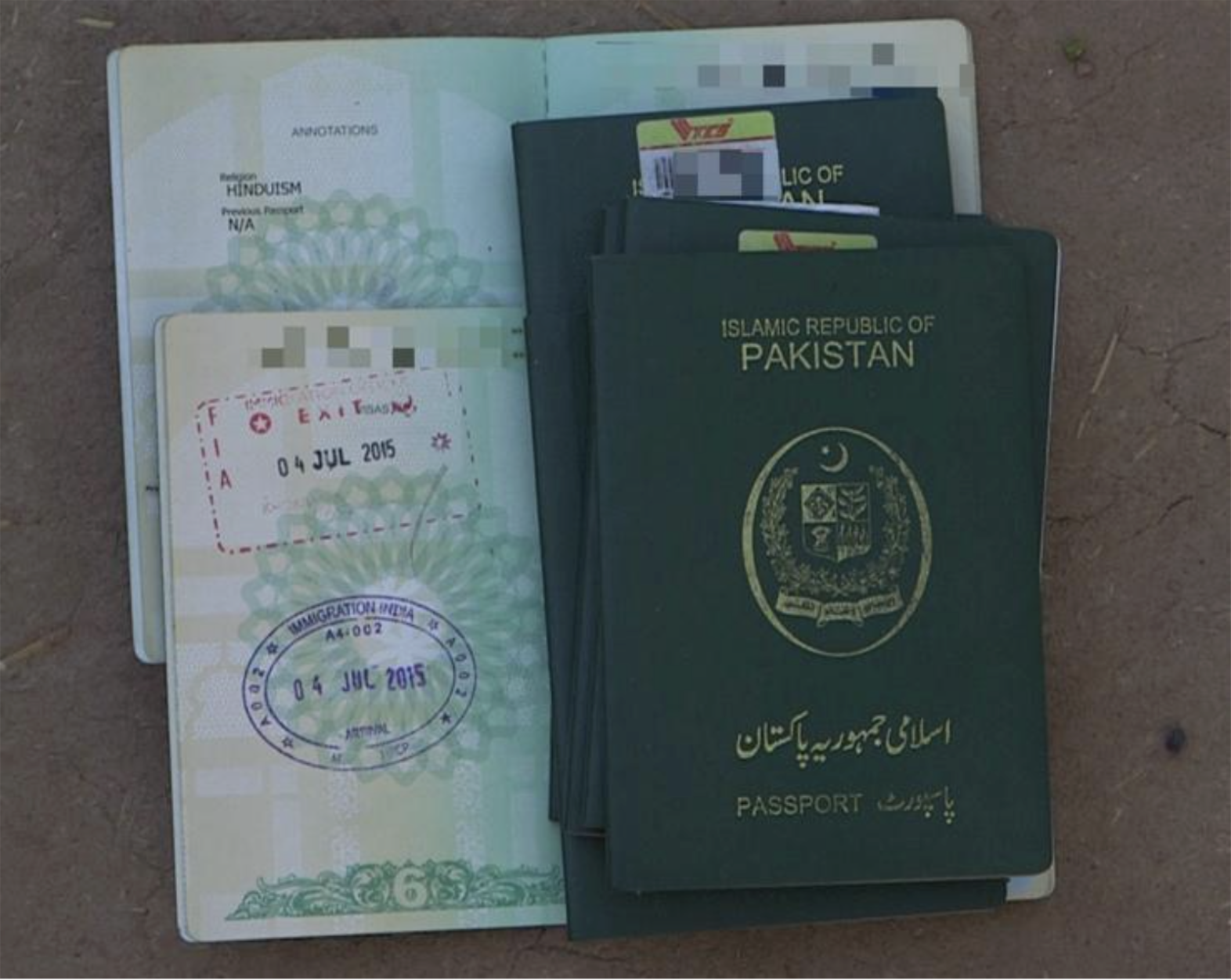
Pakistani Hindu passports with Pakistani Exit and Indian Arrival Stamps, dated July 2015. Photo by author, October 2019.
Yet the disaggregation of the state (i.e., the central government vs. local bureaucracy) also means that parts of the state can work against each other, sometimes at odds with nationalist visions. India's national security agency, for example, has objected to the central government's passing of legislation welcoming Hindus from Pakistan.
Conversion underscores the mutual reliance and slippages between seemingly discrete categories and units. The permeability between the minority and majority helps explain why terms like naturalization, incorporation, or recognition—commonly used in studies of migration and citizenship—are not adequate to capture majority-minority dynamics. These terms suggest absorption, where X turns into Y, assuming unidirectionality and a progressive linearity.
In contrast, conversion keeps in sight two seemingly discrete units (e.g., two nation-states, or the "majority" and "minority") that are inter-referential. It highlights bidirectional processes that can go either way—majority into minority and minority into majority. The lack of absorption of one into another is not desired, observed, or imposed. Conversion is a frame to make sense of the simultaneity of and equivalence between majorities and minorities as features of the interconnected nation-state order.
The Minority Form's Majoritarian Work
The conversion of majority into minority is a hallmark of majoritarian regimes. It is also a liberal democratic phenomenon.
Originating in colonial governance, the minority form is a category of liberal democracy and international human rights governance that is premised on the former's quantitative principle of numbers and the latter's qualitative one of social discrimination. While one can shift in and out of a minority political opinion in idealized liberal democracy, the designation of a group as a national minority is permanent.
In the nation-state, these forms empirically converge. Leveraging identity alongside the logic of numbers converts procedural minorities and majorities into substantive ones, yielding majoritarian rule. On the flip side, the electoral calculus of liberal democratic nation-states flattens people with different histories of subjugation into commensurable numerical fractions. The minority form converges the liberal politics of counting with the nationalist politics of the discountable.
These convergences between the quantitative and qualitative mean that the idealized alterability of the minority in democratic theory and the permanence of the minority in democratic practice cannot be conceptually separated. As such, the minority collapses the binaries of civic/ethnic, demos/ethnos, procedural/substantive, and quantitative/qualitative. Minority is a political term, not a neutral descriptor.
In India and Pakistan, the colonial legacy of divide and rule has yielded to incorporative political strategies that elide differences within groups to forge electoral majorities and promote "faith-based citizenship." With Hindu nationalism in India, this means widening the definition of the unmarked Hindu citizen to include Jains, Buddhists, Parsis, Adivasis, and Dalits. In Pakistan, Islamization, as part of a Muslim national project, aims to unite heterogenous units across sectarian, ethnic, and caste divides within an ideal-type "upper-caste" Sunni Muslim citizen. Such demographic projects limit people to "material for electoral arithmetic rather than subjects of collective self-making."
Despite its unmarked pretenses, citizenship in practice is a site for marking who comprises the nation's people, a right of sovereign states. Citizenship thus sutures the nation and the state and—with technologies like the border and the proliferation of documentary regimes attempting to identify who is NOT a citizen—is an apt site to apprehend the way lines are drawn around who is in and who is out.
Attending to how a given religious identity comes to be privileged in the administrative citizenship apparatuses of liberal democracies complicates characterizations of majoritarianism as illiberal. The centrality of religious identification for Pakistani Hindu migrants in their claims to Indian citizenship points to how the Pakistani and Indian states approach religion as a social category to distinguish between groups, affording mobility and belonging to some over others. The tyranny of the majority and anti-minority violence prevail because of norms such as enumeration, majority rule, private property, civility, and proceduralism, not their lack.
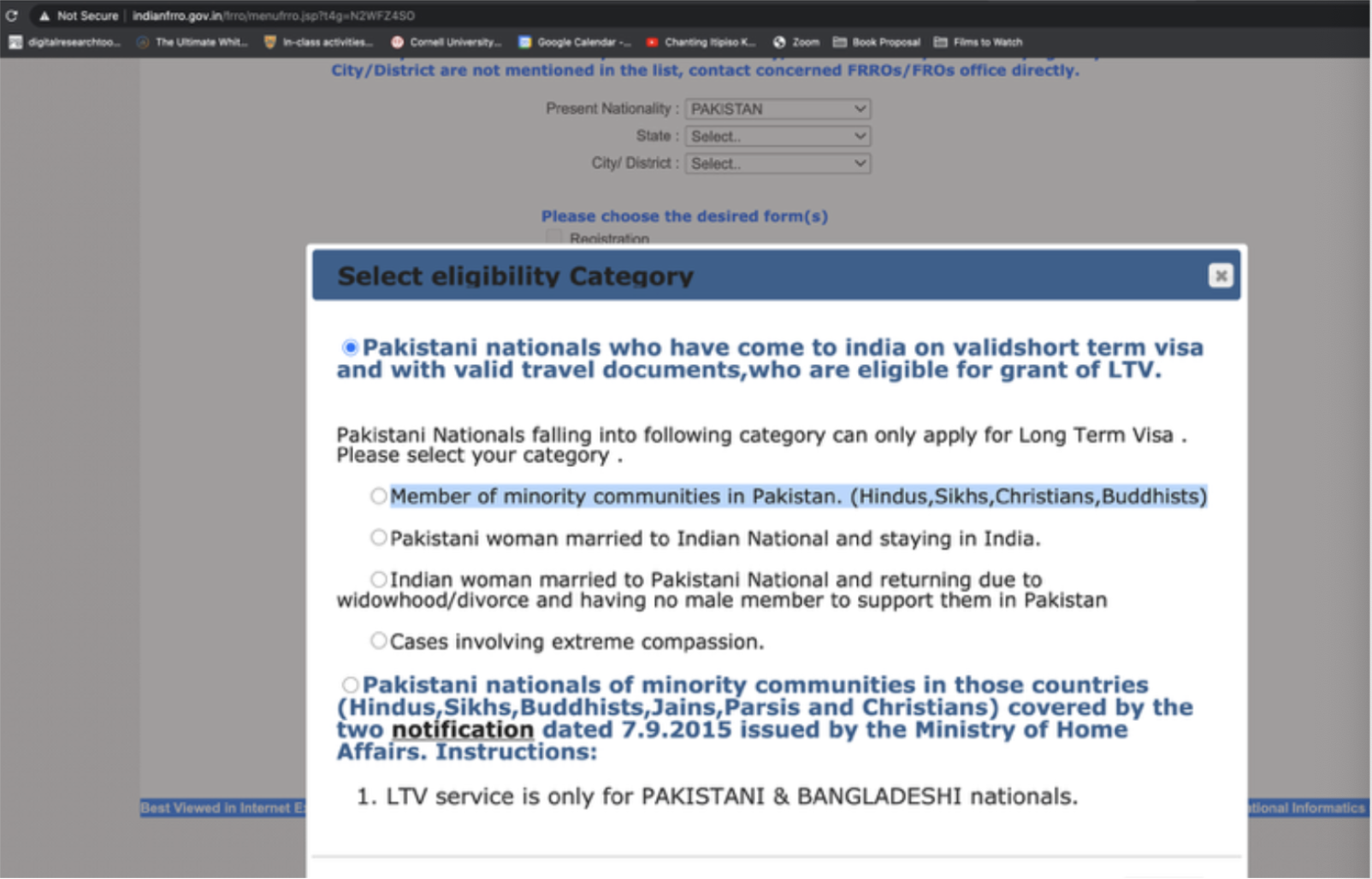
Indian Long-Term Visa Application Portal for Members of Minority Communities in Pakistan. Screenshot by author, December 2022.
Beyond the Nation-State
In generic form, the minority question is concerned with the way groups are rendered vulnerable by their ethnic, gendered, religious, or linguistic profile in relation to the alleged profile of a majority. The iterability of the minority question as the Jewish Question, the Muslim question, the “non-Muslim” question, and so on over the past century reveals this category's limits and foreclosures.
Minoritized groups across South Asia have categorically rejected the "minority tag" across multiple national contexts. Kapil Dev, a prominent minority rights activist in Sindh, advocates for equal citizenship instead of minority recognition for "non-Muslim" religious groups. In a July 2019 tweet, he wrote:
"August 11 should be celebrated as National Equal Citizenship Day rather [than] National Minority Day because our #Quaid M. Ali Jinnah had promised #EqualCitizenship to #Hindus, #Christians, #Sikhs, & believers of other faiths. Word "minority" minoritizes & otherises us. #PakistanForAll"
This rejection extends to Bangladesh, where journalist Bishakha Devnath wrote in The Daily Star:
"I reject the minority tag. Here is why." She explained how the minority label itself reinforces marginalization rather than enabling equality.
I posit the minority question as a nation-state question that is irresolvable within its terms. Majorities constitute themselves through the minority form by crossing borders; a majority is a minority in another context or scale. The minority-majority dialectic is recursive, recombining indefinitely to produce permanent majorities and minorities.
Yet ethnographic attention to lived experiences reveals the "remainders" of conversion—aspects of identity and belonging that exceed state categories. Moving from one social category to another is not an exact, zero-sum process. Hindus from Pakistan in India who move between majority and minority status are neither wholly in either category. Once in India, Hindus from Pakistan stay partly minor. Even after being naturalized as Indian citizens, caste and regional affiliations complicate their absorption into a majority.
Maintaining such gaps of otherness or foreignness is, in some ways, essential to the majoritarian work of the minority form. Essentialized incongruence is necessary for conversion to work. National security practices maintain this essentialized difference by preventing the complete incorporation of Pakistanis into India, which could threaten the majoritarian project's reliance on anxiety of incompletion (a dynamic I examine in more detail in my forthcoming book).
Unlike the neat picture of whole numbers at national and global scales, these remainders point to forms of attachment and belonging that challenge nation-states and their borders. While marginal in relation to the power of nation states, the individual scale and its remainders suggest the possibility of seeking ways to be seen outside of majority-minority conversion—they offer a potential alter politics. In this way, my use of remainder resonates with Bonnie Honig's, which points to the democratic value and emancipatory potential of disruptions to the political order. The stories of Hindus from Pakistan who have moved to India challenge the binary logics of nation-states, pointing to forms of relatedness that predate and outlast borders.
To understand the rise of majoritarian politics globally, we must attend to the particularities of national regimes while decentering their borders. The nation-state itself is the problem, not its incorrect realization. By provincializing the nation and embracing the remainders of conversion, we might imagine political possibilities beyond the majority-minority framework—one that acknowledges the interconnectedness of struggles and the contingency of contemporary borders.
As Prem Bhil, a Pakistani Hindu migrant in India, remarked: “God made the world, not nations.” His words remind us that the nation-state is not ordained, but a colonial formation whose borders are both recent and fragile.
The task ahead is to envision forms of recognition and belonging that transcend the arithmetic of majority and minority.
Natasha Raheja is an Assistant Professor of Anthropology and Performing & Media Arts at Cornell University. She is the author of the forthcoming book The People, in Parts: the Majoritarian Work of the Minority Form and is director of the films, Cast in India and A Gregarious Species.
Prepared with the editorial assistance of Mishaal Mahmood.