Managing the Sacred: Liminality and the Minoritization of Sikhs in Punjab and Hindus in Sindh, Pakistan
Sadia Mahmood
“Majority/Minority Politics in South Asia” is an essay collection, co-edited by Mohsin Bhat and Natasha Raheja, that moves beyond nation-specific frameworks to foster comparative, cross-disciplinary, and cross-border inquiry into how majoritarianism takes shape across South Asia. The collection illuminates shared mechanisms of majoritarian rule and the varied forms of opposition they provoke, thus advancing critical scholarship on democratic erosion while contributing to public debates on resisting authoritarianism and rebuilding democratic futures.
This comparative essay examines the governance of minority sacred sites associated with Hindu and Sikh traditions in postcolonial Pakistan. The creation of Pakistan in 1947, grounded in the Two-Nation Theory, did not merely seek to safeguard a Muslim minority in South Asia. It also initiated a prolonged and uneven process of minoritization for Hindus and Sikhs who remained in their ancestral lands. [1] For Sikhs in Punjab, this transformation occurred immediately following the Partition of Punjab when the mass exodus from western Punjab fundamentally altered the demographic and institutional landscape of Sikh life in the region. Today, Pashtun Sikhs constitute the core of the Sikh community in Pakistani Punjab, and many of the major functioning gurdwaras are maintained and served by members of this community. In contrast, the minoritization of Sindh’s Hindus developed over several decades, as legislative measures, electoral restructuring, and the everyday politics of the postcolonial state gradually reshaped the terms of belonging and citizenship for Hindu communities in the province.
By referring to Sikh and Hindu sacred places here, I do not intend to reproduce the rigid binaries of modern religious identities. The devotional landscape of South Asia has historically been structured through porous and overlapping religious boundaries. In Sindh, for example, Nanakpanthis, many of whom today identify as Hindus, continue to visit gurdwaras in Punjab as part of their devotional practices. Such practices complicate any straightforward classification of religious belonging on the ground and underscore how the lived realities of shared sacred spaces often exceed the political and legal frameworks through which the postcolonial state seeks to order religious life.
Drawing on ethnographic encounters at minority sacred sites in Punjab, I explore how Hindu and Sikh communities assert ownership while remaining subject to bureaucratic regulation by the nation-state. I argue that religious spaces serve as critical arenas where the boundaries of majoritarian power are both enforced and contested. I use Victor Turner’s concept of liminality as an analytical lens to describe zones where minorities are neither fully included in nor entirely excluded from the national fold. In Pakistan, functioning Hindu and Sikh religious sites—particularly those administered by Hindu communities and the Evacuee Trust Property Board (ETPB)—exemplify such liminal spaces: the state cannot fully penetrate them, yet it does not relinquish control. These religious sites therefore function simultaneously as archives of collective history (and memory) and as sites of surveillance, where liminality, ownership, and the everyday negotiation of belonging intersect.
Through ethnographic encounters at sacred sites such as Gurdwara Panja Sahib, Gurdwara Dera Sahib, Gurdwara Kartarpur Sahib in Punjab, and Ratneswar Mandir and the shrine of Udero Lal in Sindh, I examine how the category of minority is experienced, negotiated, and navigated in everyday life within contemporary Pakistan’s Muslim-majoritarian context. These encounters show that Hindu and Sikh identities in Pakistan are dynamic and multifaceted; they are continually produced, contested, and redefined through the interplay between state regulation and community self-governance. In these settings, liminality appears as both a spatial and political condition, shaped by the intersection of majoritarian pressures and community strategies of negotiation, resistance, and control.
Sikh Sacred Sites: Panja Sahib, Dera Sahib and Kartarpur
Gurdwara Panja Sahib in Hasan Abdal, Gurdwara Dera Sahib Sri Guru Arjan Dev in Lahore, and Gurdwara Darbar Sahib, Kartarpur are three religious sites where histories, sacredness, and surveillance intersect. These sites possess profound religious and historical significance for the global Sikh community. Since the 1960s, the Evacuee Trust Property Board (henceforth ETPB) has administered Sikh properties in Pakistan, acting as both custodian and regulator of religious sites and festivals. According to the ETPB’s official website, “‘ETPB was established in 1960 with its HQ in Lahore to look after the Evacuee Trust Properties / Land left over by the Sikhs and Hindus who migrated to India during Partition in 1947–48.”’ In addition to maintenance of Gurudwaras and Mandirs, ETPB oversees the management of Hindu and Sikh yatris, both foreign and local. [2]
Located in Hasan Abdal, Gurdwara Panja Sahib is associated with a visit by and a miracle attributed to Guru Nanak. The site contains a sacred boulder bearing his handprint, which, according to Sikh tradition, was formed when Wali Qandhari, a Muslim saint who refused Guru Nanak’s request for water, hurled a rock toward the town. Guru Nanak intercepted the rock with his hand, leaving the imprint and causing a spring to emerge that continues to flow along the borders of the main sanctum today.
In 1920, Akali reformers, as part of the Sikh reform movement aimed at reclaiming gurdwaras from Hindu mahants and establishing representative Sikh management, occupied the Gurdwara on behalf of the Shiromani Gurdwara Parbandhak Committee (SGPC), the central body responsible for administering Sikh gurdwaras. This takeover was part of a broader gurdwara reform movement that contested both colonial authority and the prevailing custodial control over Sikh religious institutions. In 1922, the site became a significant center of Sikh resistance when Sikhs lay on railway tracks to halt a train transporting prisoners from Guru ka Bagh to Attock Jail and subsequently provided food to the detained Sikhs. The gurdwara building was reconstructed in a fortress style in 1932, but was closed following the mass exodus of Sikhs from the region in 1947. A large bell, once installed atop the gurdwara’s residential quarters to announce the preparation of langar, a communal meal, no longer calls neighbors together to eat. Non-Sikh visitors are permitted only under strict conditions.
While the main sanctum sits at the heart of the complex, surrounded by residential quarters, the complex reveals multiple layers of state presence. One wing houses ETPB offices staffed by both Muslims and Sikhs, which oversee operations. In the main ETPB office, where guests are received, portraits of Pakistani government officials are prominently displayed. The langar hall, located apart from the main complex, greets visitors with a striking painting (donated by a Pakistani Muslim artist) commemorating the 1922 train incident—a moment embedded in Sikh collective memory as an act of defiance and solidarity. To the left of the kitchen door, portraits of the Ghadari Babas evoke another lineage of anti-colonial struggle. [3] These observations prompt fundamental questions: Who exercises control within the complex? How do the community and the state negotiate authority?
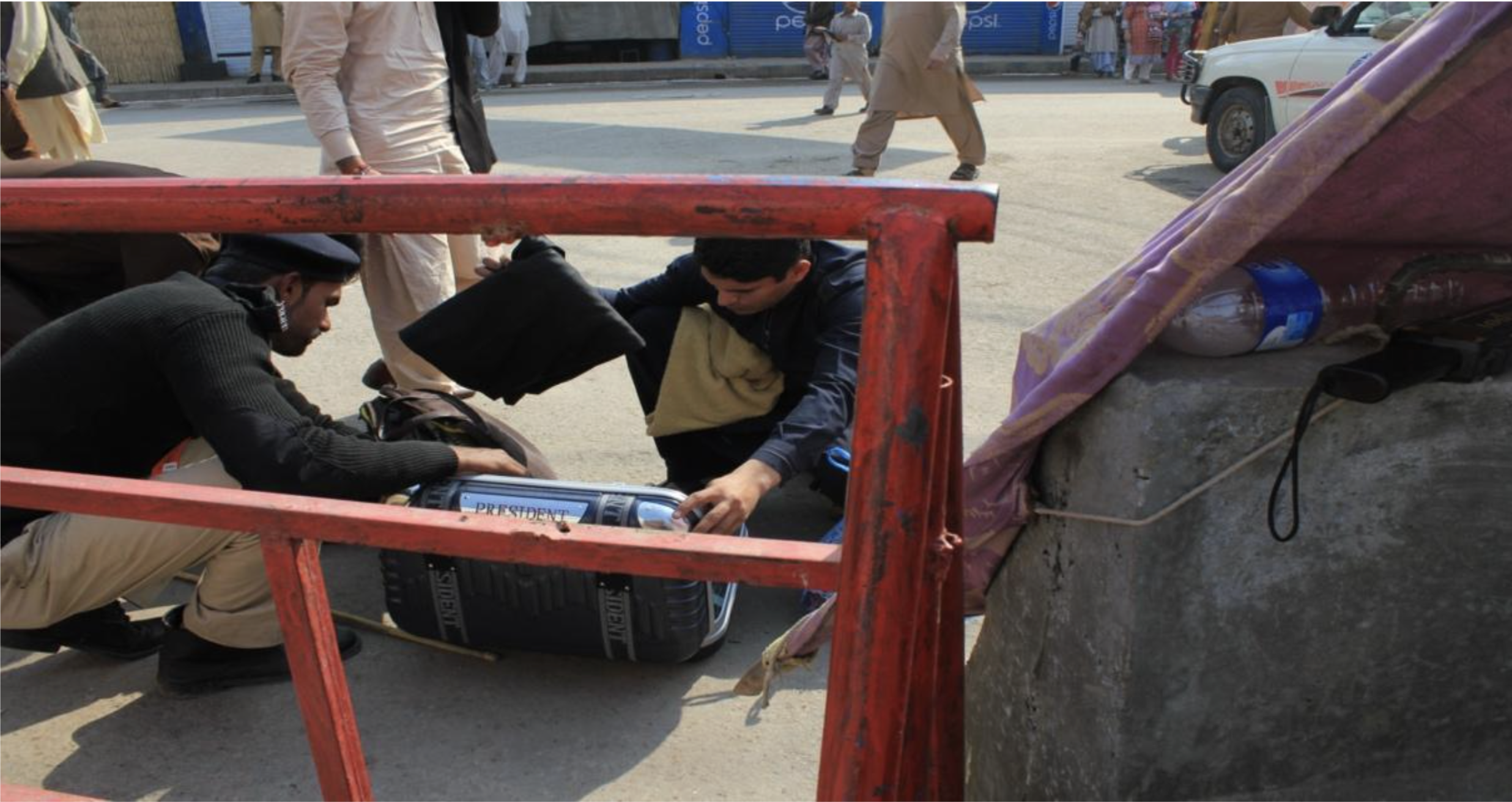
Police checks belongings of a local devotee at the entrance of Nankana Sahib, 2016. (Photo by the author)
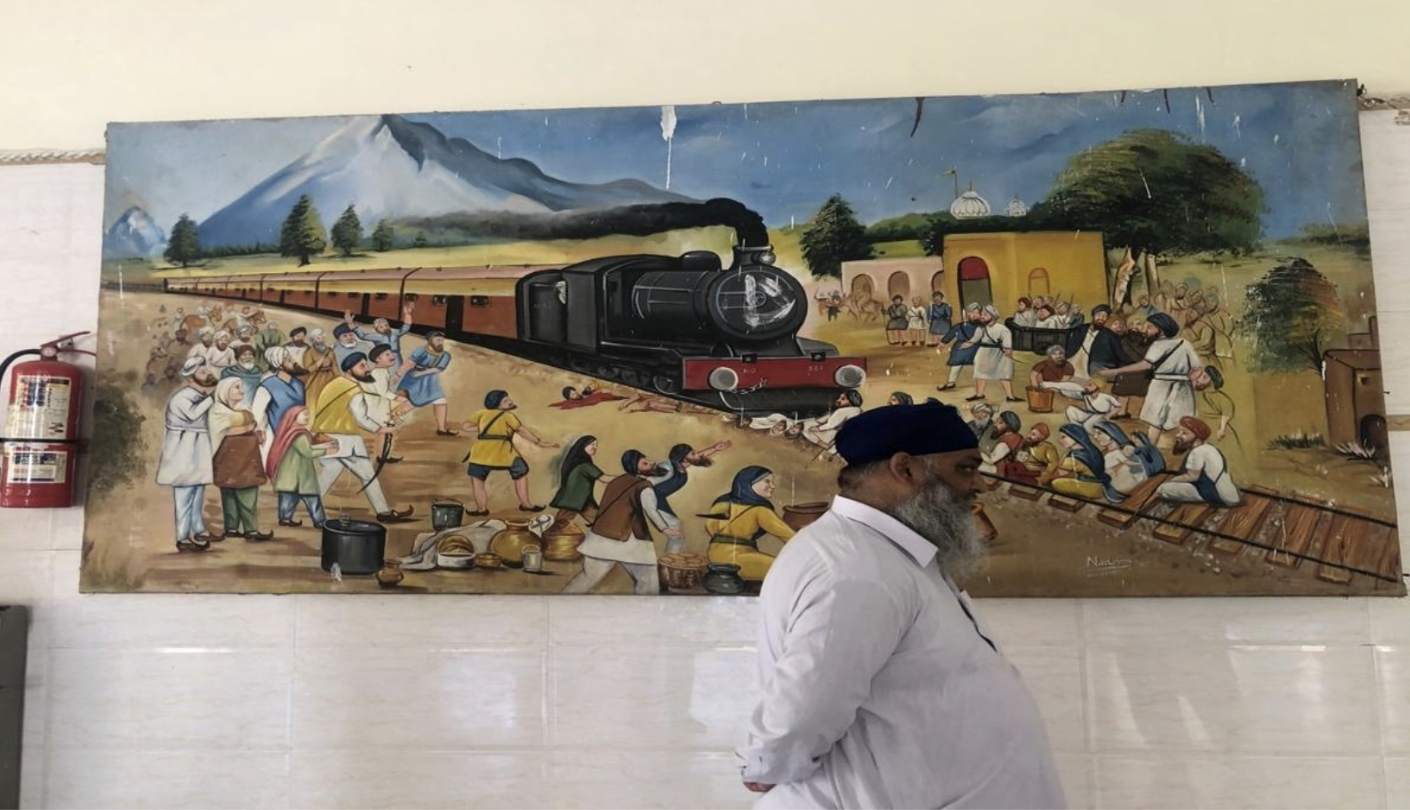
The current Granthi in front of the painting at the Langar Ghar, Gurdwara Panja Sahib, 2024. (Photo by the author)
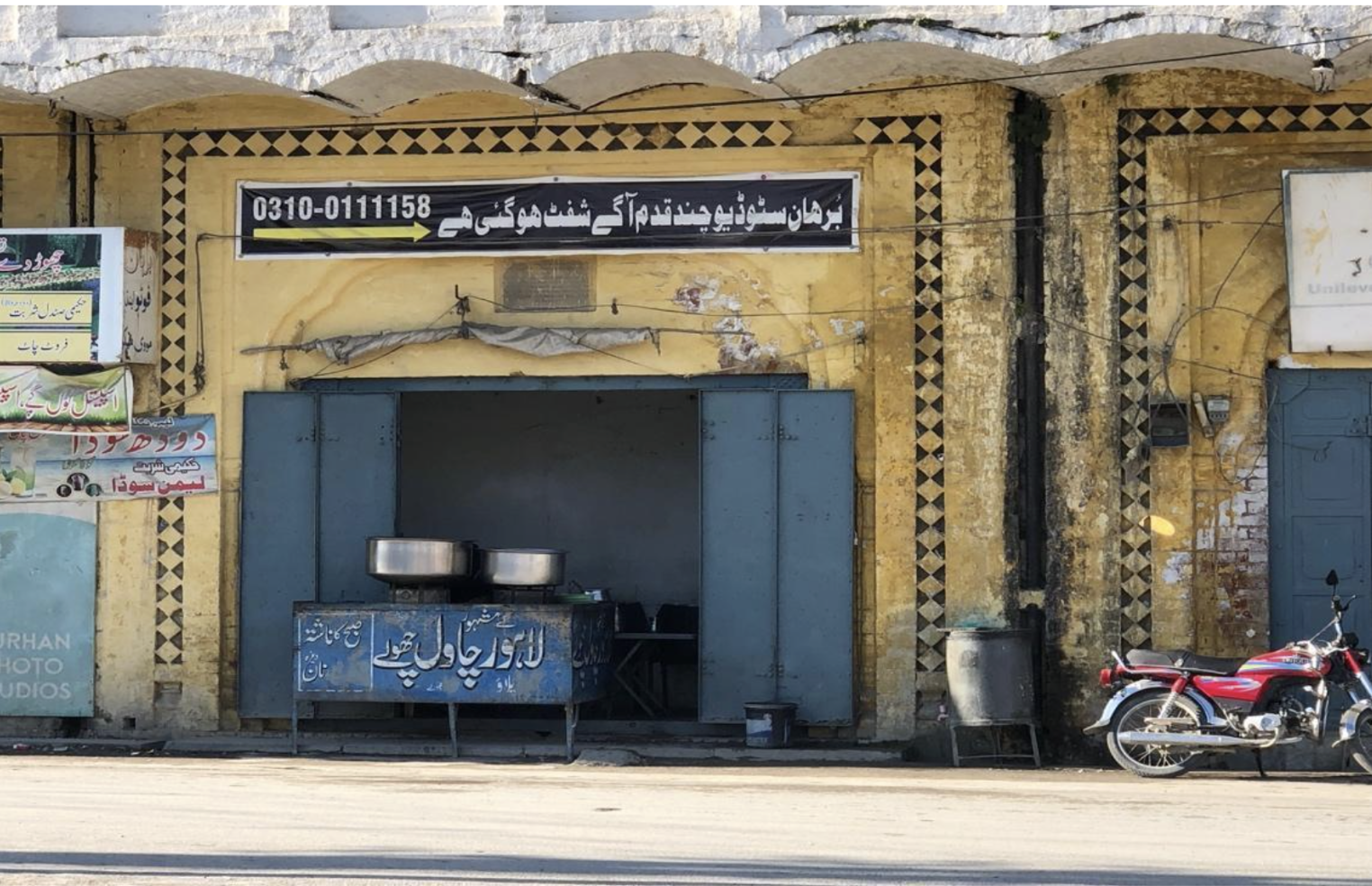
A shop located along the outer perimeter of Gurdwara Panja Sahib, managed by the Evacuee Trust Property Board (ETPB), 2024. (Photo by the author)
Despite the establishment of the Pakistan Sikh Gurdwara Prabandhak Committee in 1999, Panja Sahib’s management remains divided between the community and ETPB. Major events transform Hasan Abdal into a securitized bubble—cordons restrict local movement, yatris are shuttled in sealed trains and buses, and the site is enclosed by layers of monitoring. Post-9/11 security intensified this choreography; entry for non-Sikhs/Hindus required repeated negotiation with guards and was often met with, “You are not allowed.”
When I arranged a 2023 university visit for my students, Sikh interlocutors advised: “Get official permission from the ETPB. We cannot guarantee entry for a big group.” We called a few offices and were referred to more phone numbers. Finally, a deputy director, approved the visit. Yet the community set additional terms via WhatsApp: “Visit only after ardas (prayers). Cover your heads. Make and post no reels on social media. Aur hamari auraton ko naheen ghoorna— (male students will not stare at our women).” I pushed back on the first and last points, assuring them my students came to engage with the community, not merely the building. Inside, government staff shadowed our movements. One staffer cautioned: “please do not interact with the women. The community doesn’t like that.” Meanwhile, some Pashtun students bypassed the official gaze by using ethnic connections with the head granthi, allowing spontaneous mingling.
Questions regarding the ownership of the Gurdwara and its associated properties arise in various contexts. According to an ETPB official, a Sikh applicant recently requested that the ‘Guru’s shops’ located along the gurdwara’s outer walls be transferred to the community so that their revenue could support impoverished Sikhs or the gurdwara itself. The ETPB denied this request, stating, “ According to our law, the revenue must be deposited into the treasury. We are the ones who pay the electricity and natural gas bills. They only run the kitchen (langar); they cannot demand the shops from us.”
These interactions illustrate how Panja Sahib functions as a liminal site where state custodianship and community autonomy intersect and often conflict. Access remains conditional, negotiated through bureaucratic protocols and moral boundaries established by the state and the community. During major festivals, these dynamics become more pronounced, and Hasan Abdal is transformed into a highly securitized area. Security cordons restrict local movement, and the site is surrounded by multiple layers of monitoring. Pilgrims are transported in special trains and buses along cordoned routes designed to prevent unsanctioned interactions. The trains travel along partitioned track lines, serving as a material reminder of the cartographic exodus of 1947. Local vendors are prohibited from approaching the Gurdwara premises, and other Pakistani citizens are denied access to smaller stations. In 2024, an Indian YouTube vlogger described Pakistani children locked out of a station as qaidi bacchey, or ‘prisoner kids,’ a description that inadvertently reveals how such scenes are read by the visitors: surveillance appears less as an administrative necessity and more as confinement. Despite these tightly controlled conditions, pilgrims and locals exchange waves and greetings across barriers, brief gestures that challenge the state’s choreography.
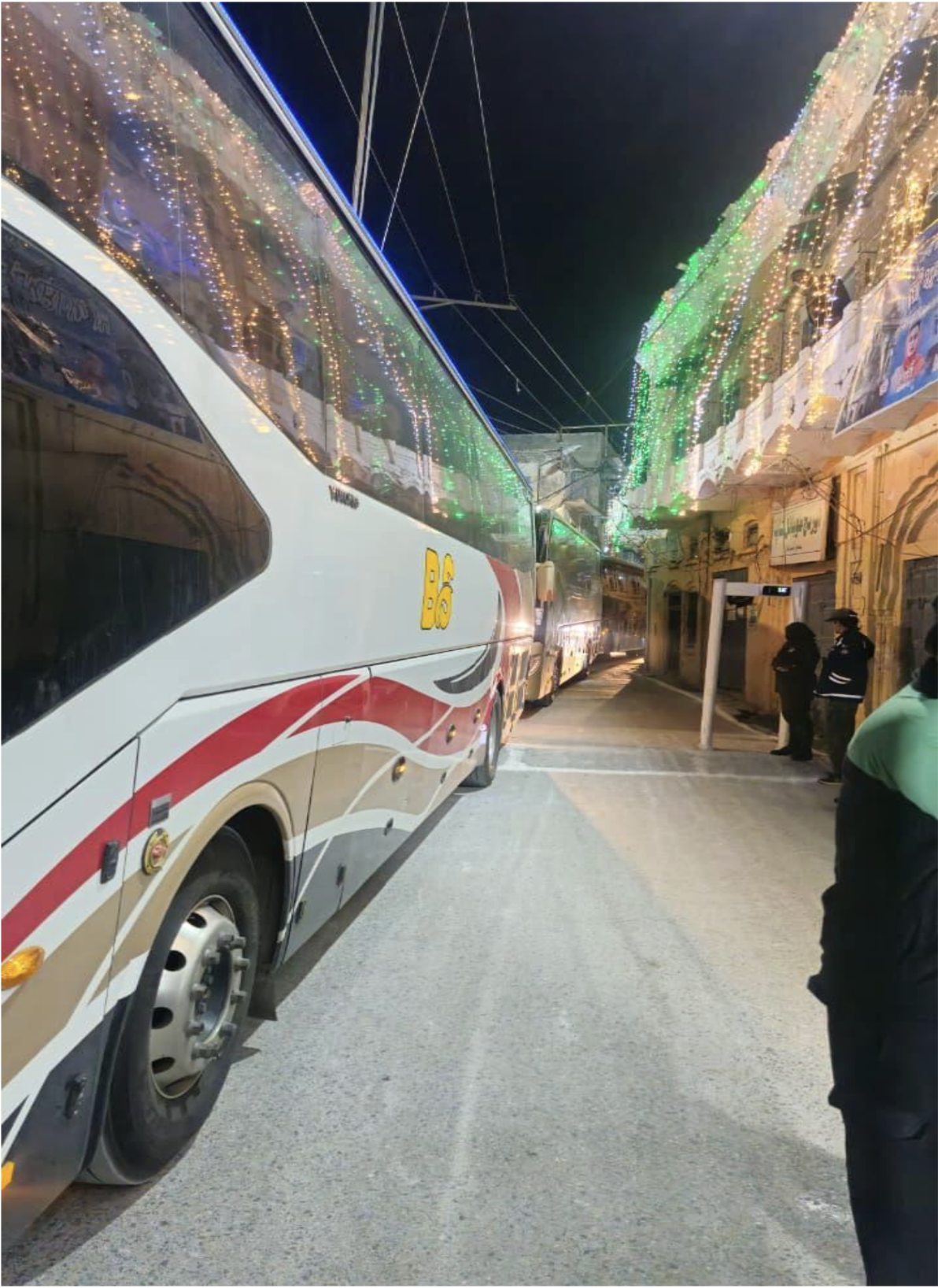
Buses carrying Indian Sikh yatris line up outside Gurdwara Panja Sahib, 2025.
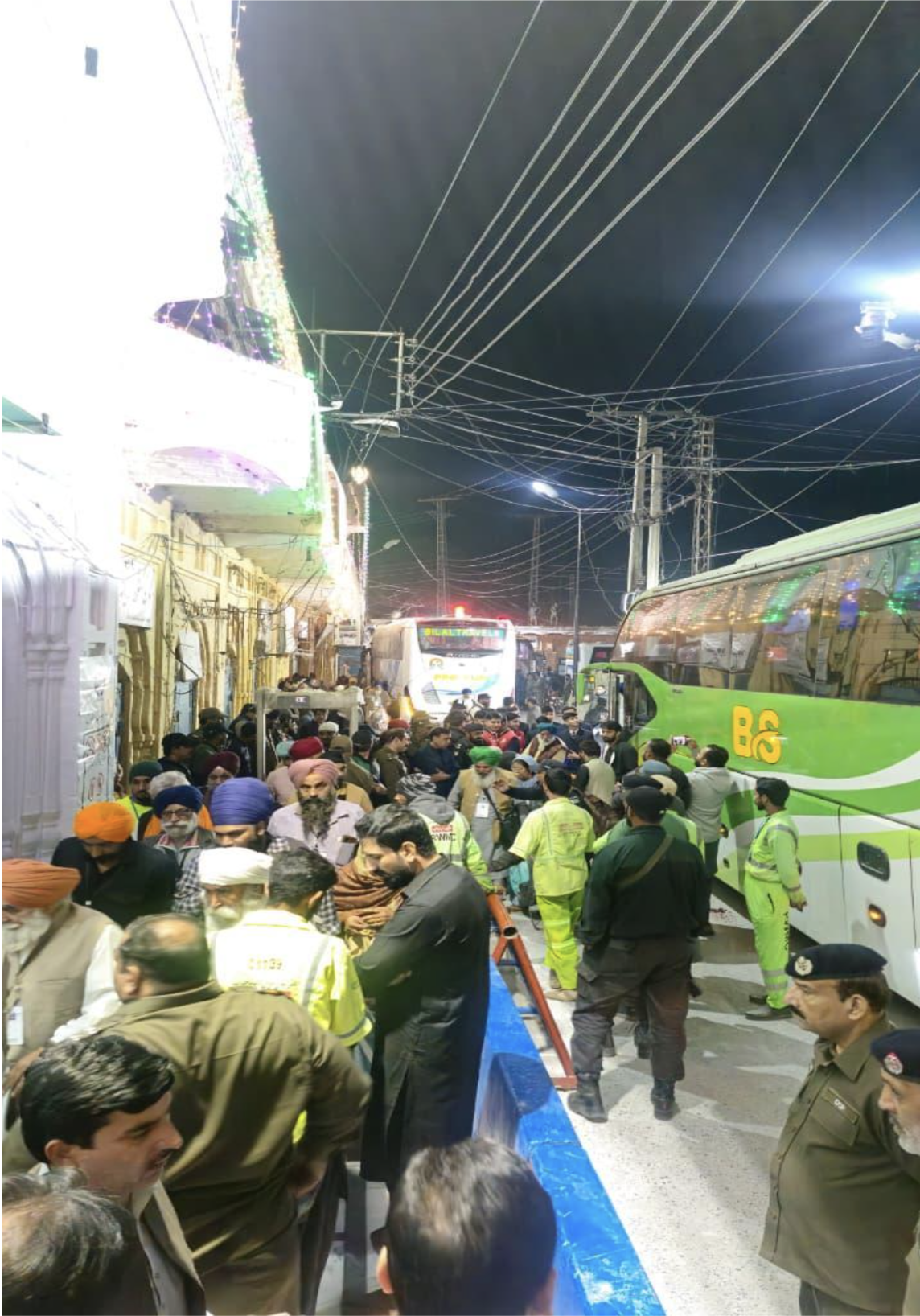
Indian Sikh yatris disembark from special buses outside Gurdwara Panja Sahib. Police, a metal-detecting security gate and a small boundary wall are visible in the photo. 2025.
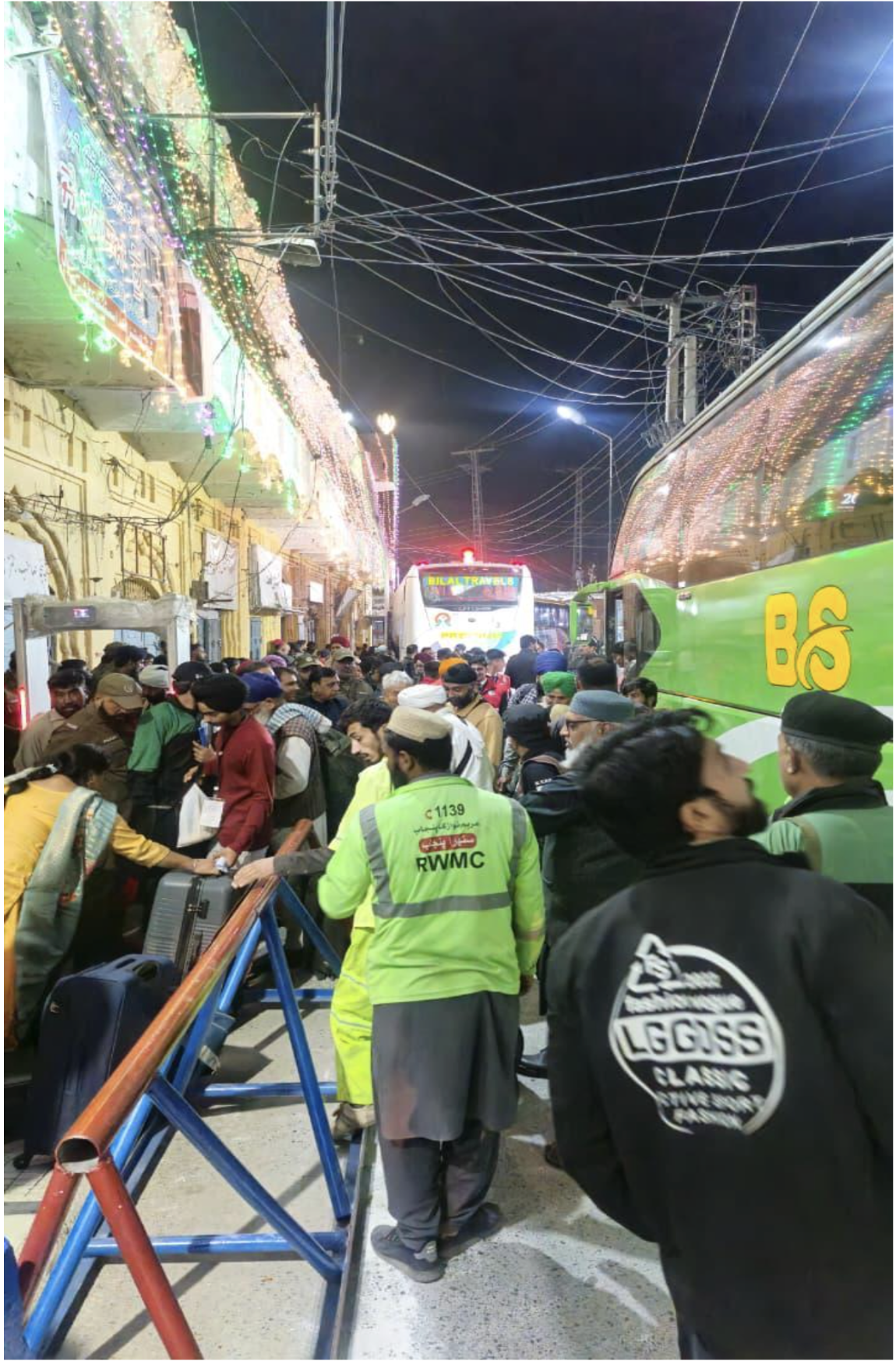
Indian Sikh yatris disembark from special buses outside Gurdwara Panja Sahib and pass through a metal-detecting security gate to enter the shrine complex; a security barricade is also visible. 2025.
In Lahore, Gurdwara Dera Sahib houses Maharaja Ranjit Singh’s samadhi and commemorates the martyrdom of Guru Arjan in the Ravi River in 1606 by the Mughals. Located within the Lahore Fort complex directly facing the Mughal-era Badshahi Masjid, the gurdwara now stands as a minor religious monument and a minor political statement. Mughal history and architecture are firmly claimed and curated by the Pakistani state, while Sikh history and heritage remain peripheral and largely unattended.
I was invited along with my students by the community to visit, but our late arrival led ETPB officials to block our entry. Thirty minutes of negotiation by community members yielded no result until the elder brother of the head granthi from Hasan Abdal appeared at the entrance. After fifteen more minutes of heated argument, he secured permission for us to enter. The ETPB officials recorded our names and national identification numbers in the visitors’ register, and our hosts led us inside. We were able to visit the samadhi area, but the gurdwara itself remained closed: “Woh band hai. Aap dobara aana” (“It’s closed. You’ll have to come again.”). In an unexpected reversal, this time it was the community—not the state—that denied us further access.
Perhaps the most striking example of this liminality, not only in Muslim-majority Pakistan but in postcolonial South Asia more broadly, is Kartarpur Sahib, a gurdwara where Guru Nanak, the founder of Sikh dharm, spent the last eighteen years of his life and which is now located in a Pakistani border town. Prior to the opening of the Kartarpur Corridor, Sikhs on the Indian side of the border would catch a glimpse of the gurdwara with the help of binoculars, which is located approximately 4.5 kilometers from the international border. The Indian segment of the Sri Kartarpur Sahib corridor includes a 4.1-kilometer four-lane highway from Dera Baba Nanak to the international border and a Passenger Terminal Building constructed at the crossing point.
The website of India’s Ministry of Home Affairs highlights that “after several years of efforts, the Government of India has succeeded in facilitating pilgrimage of devotees to Sri Kartarpur Sahib,” thereby claiming credit for the opening of the corridor. The page features maps locating Kartarpur Sahib and outlines procedures and guidelines for pilgrims seeking to apply for entry permits. Pilgrims may carry no more than 7 kg of belongings, including drinking water. Since the opening of the corridor in 2019, yatris from both countries have been able to visit and mingle within the Gurdwara complex, even as the space remains carefully regulated by the security and bureaucratic regimes of the two nation-states. At present, however, the website notes that “considering the extant security scenario, the services of the Kartarpur Sahib Corridor are suspended until further directions,” hinting at India–Pakistan military clashes in May 2025. Kartarpur thus embodies the paradox of postcolonial sacred geographies: a space that enables cross-border devotional mobility while remaining tightly regulated by the security regimes and bureaucratic infrastructures of the nation-state.
The ETPB’s webpage for the Kartarpur Corridor celebrates “Pakistan is a Holy land for the Sikh religion” and notes that up to 5,000 yatris may enter daily through the corridor from India to visit Kartarpur Sahib. Whereas the Indian government’s webpage foregrounds the Passenger Terminal Building and the infrastructure developed to facilitate the pilgrimage, the Pakistani page highlights the expansion and upkeep of the gurdwara complex. Together, these representations reveal how both states narrate the corridor through competing claims of stewardship and infrastructural provision, even as access to the gurdwara remains tightly regulated in the name of security.
Away from the Gurdwara complex, Sikh communities on both sides of the border also gather at the Kartarpur Zero Point on the India–Pakistan border to jointly perform Rehras Sahib, the evening prayer. Here, the ritual resembles a kind of border-crossing without crossing, signaling continuity across a geography violently severed in 1947.
At the same time, this gathering reflects not only the rupture of Partition, but also the persistence of Sikh religious worlds across a volatile border. It conveys longing, loss, and partial access.
This zero-point prayer gathering obviously takes place under security. It shows how postcolonial states may curate and stage religion at the border. This gathering can be compared with the choreography of sovereignty through spectacle performed by both states at the Wagah border. The nationalist theatre there draws far more attention than the zero-point devotional ceremony. One occupies the center of nationalist theatrics, while the other remains at the margins, suspended in a liminal space.
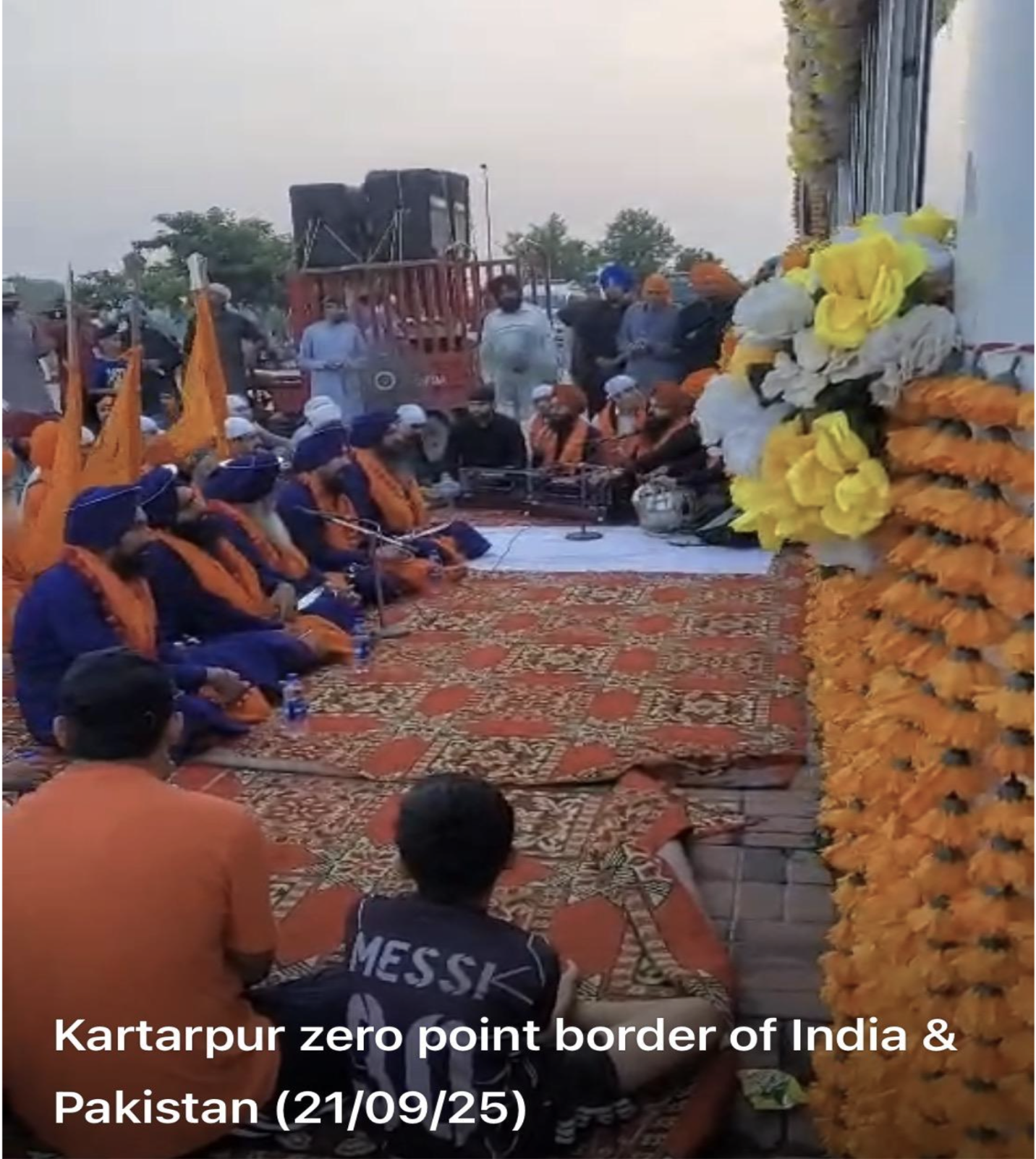
Rehras Sahib ceremony at the Kartarpur–Dera Nanak Zero Point Border, held on September 21, 2025 (Pakistani side).
Hindu Religious Spaces in Sindh
In Sindh, the rupture of Partition was far less pronounced than in Punjab. Hindu communities who remained on their ancestral lands continued to maintain most of their religious spaces, albeit within a newly minoritized context. In contrast to Sikh sacred sites in Punjab, which are largely administered by the state through ETPB, many functioning Hindu temples in Sindh continue to operate through localized forms of community management and gatekeeping. This divergence has produced a distinct configuration of religious space: while Sikh gurdwaras in Punjab are incorporated into formal regimes of state administration of evacuee property management, many Hindu religious sites in Sindh remain embedded within community networks. As a result, access to these spaces works through insider knowledge and community-enforced boundaries.
At Shree Ratneswar Mahadev (cave) Mandir in Karachi, my first solo attempt to enter was unsuccessful. “You need to know the codeword,” my Hindu friends later advised. They told me to say “Jay Shankar” at the entry. The next day, I accompanied my host but was still stopped; the guard asked him to present his national identity card to verify religious affiliation. On my third attempt, accompanying the women of the family, entry was smooth. As the congregation bowed at the conclusion of the puja, I remained seated, surveying the space, until the head pujari—who had denied me entry on my solo visit—spotted me from across the hall. We made eye contact, but under the weight of the pujari’s strong stare, I looked away. In that moment, I was an outsider, visible and spotted.
Udero Lal is a saint venerated by both Hindus and Muslims. Hindus regard Udero Lal as an avatar of Jhulelal, the river saint, while many Muslims identify him with Khwaja Khizr. At the dargah of Uderolal, the sanctum itself is physically divided, with one side managed by a Muslim gaddi nashin and the other, which houses the mandir, overseen by Hindu gaddi nashins. This dual arrangement functions with notable efficiency. The current Hindu custodians, who are Indian nationals, visit annually for Udero Lal’s festival.
In Raharki Sahib, the Sant Satram Dham (SSD) is said, by the local Hindu community, to have purchased the entire town. Over the decades, the Dham has expanded into a large complex offering accommodation for visitors, maintained entirely by the community. Entry and exit are fully controlled by the Dham administration.
ConclusioN
The mass exodus of Sikhs from Punjab during Partition created an institutional vacuum that led many historic gurdwaras to fall directly under state custody. This situation differed in Sindh, where Hindu communities largely remained and were able to maintain the management and control of their religious spaces. What emerges here is a paradox of postcolonial belonging: minorities are granted visibility in national life through their religious sites, yet this visibility remains fragile and conditional. Sacred spaces thus become contested arenas where majoritarian nationalism is simultaneously reinforced and challenged, and where minority presence persists not through full inclusion but through a sustained condition of liminality: access is never unconditional—it hinges on trust, reputation, and compliance with spoken and unspoken rules.
Notes
[1] I approach the concept of “minority” as a contested construct rather than a fixed category. The designation “religious minority” is not a self-chosen identity, but a category imposed by the nation-state, one that reduces the complex social lives of individuals and communities to a singular status.
[2] The Board’s mandate extends beyond religious sites to include residential properties and agricultural land left behind by the evacuees. Requisition and management of these properties continue till date. In recent years, the ETPB has also handed over the management of some historic gurdwaras and mandirs to communities who claimed them. One such example is Gurdwara Shiri Guru Singh Sabha, built around 1900. Following the absence of a resident Sikh population, it ceased to function as a religious site and remained closed until 1976. Thereafter, the building was repurposed by various government departments, including the police, before being converted into a public library in 2000 under the possession of Mansehra’s Town Municipal Administration since 1999. In 2021, the ETPB demanded that the gurdwara be returned to its custody. Sadaf Butt, and Muhammad Rizwan. 2022. “Gurdwara Shiri Guru Singh Sabha: An Ancient Historical and Religious Cultural Heritage of Hazara”. International Journal of Social Science Research and Review5 (5), 251-58. https://doi.org/10.47814/ijssrr.v5i5.248. Also: The Indian Express. “In Pakistan’s Mansehra, a resplendent gurdwara to open for prayers again soon.”
https://indianexpress.com/article/india/in-pakistans-mansehra-a-resplendent-gurdwara-to-open-for-prayers-again-soon-7395953/. Accessed 8.15.25.
[3] The Ghadari Babas were members of the Ghadar Party which was founded in 1913 by expatriate Punjabis in the United States. The movement sought to overthrow British colonial rule in India. See: “The Ghadar Party: Freedom for India,” The Pluralism Project, Harvard University, https://pluralism.org/the-ghadar-party-freedom-for-india (accessed March 7, 2026).
Sadia Mahmood is Assistant Professor at Quaid-i-Azam University, Pakistan, and Visiting Scholar in the South Asia Program at Cornell University. Her research explores the making of postcolonial religious minorities in South Asia. She is grateful to Cornell University and IIE for making this contribution possible.
Prepared with the editorial assistance of Mishaal Mahmood.