Indigenous Resurgence Against the Hindu Caste Nationalism in Dolpo, Nepal
Tashi Tewa
“Majority/Minority Politics in South Asia” is an essay collection, co-edited by Mohsin Bhat and Natasha Raheja, that moves beyond nation-specific frameworks to foster comparative, cross-disciplinary, and cross-border inquiry into how majoritarianism takes shape across South Asia. The collection illuminates shared mechanisms of majoritarian rule and the varied forms of opposition they provoke, thus advancing critical scholarship on democratic erosion while contributing to public debates on resisting authoritarianism and rebuilding democratic futures.
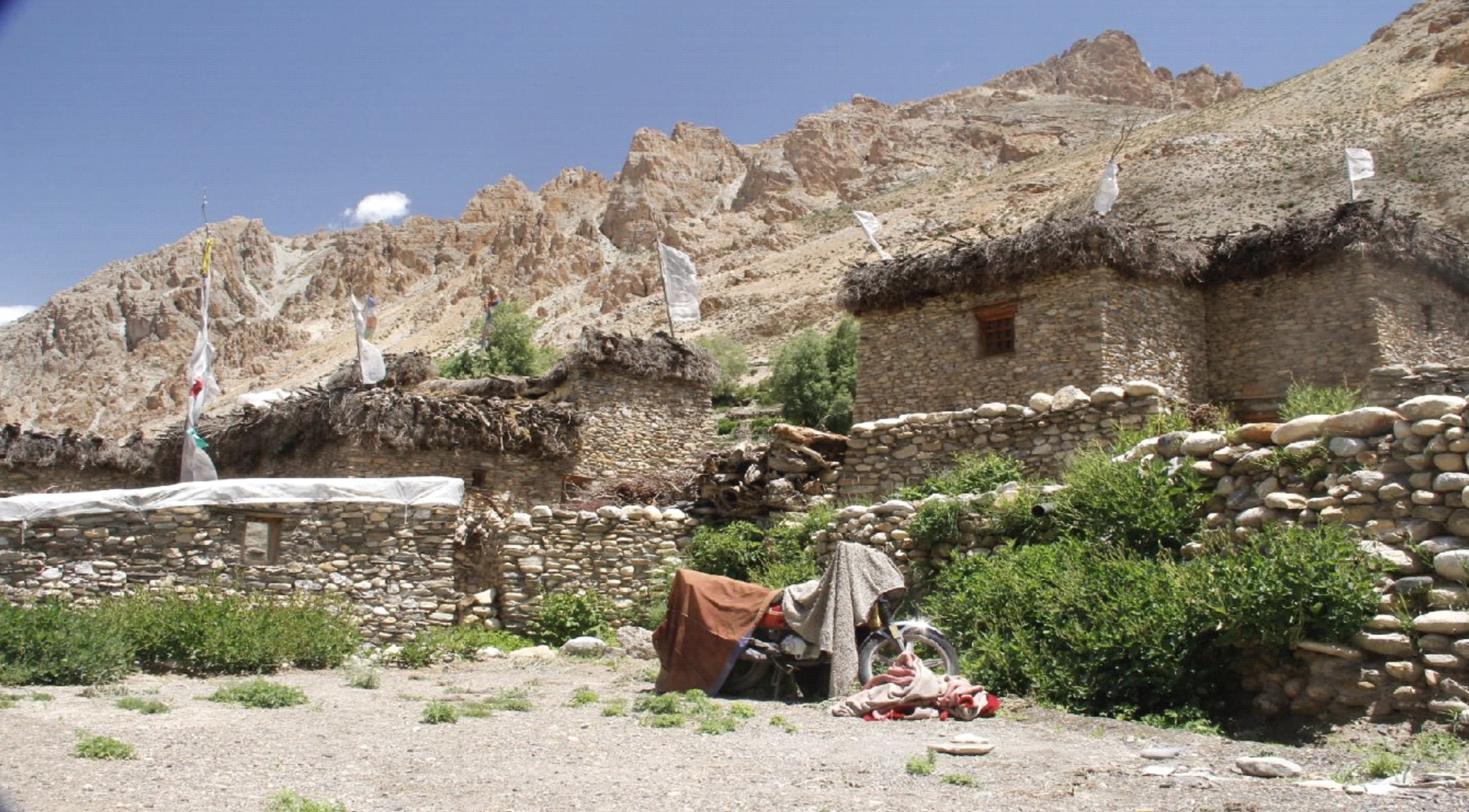
A motorbike covered with some clothes. (Photo by author)
Motorbikes in Dolpo, Nepal, exemplify a distinct non-Western mode of capitalism; these bikes are imported from Tibet, China, and currently operate with little regulatory oversight from the nation-state. In addition, these Chinese motorbike owners, who are mostly male youths, identify themselves as Dolpo, one of the Indigenous nations from Nepal. This assertion contrasts the Hindu legal classification of Dolpo as a “backward” caste group, with Brahmins at the top as keepers of knowledge, and as an alpasankhyak (minority) group). On the ground, it also entails regulating Indigenous mobility, attempting to levy a tax on motorbikes, and the planned imposition of a border checkpoint. Such forms of caste nationalism require the expropriation of a community-land managed by the Dolpo people. On the contrary, Dolpo youths frame and use motorbikes for agricultural work and collective initiatives that are fundamentally tied to their land-based foundations. Such initiatives accentuate the relevance of social relations, resources, and Indigenous sovereignty, which are often tied to the political imagination of the modern Nepalese nation-state. [1] While motorbikes may signify individual status and upward mobility, they are equally important for facilitating connections with family and the wider community, connections that have frequently been attenuated by the processes of Hindu nation-building. These patterns of social mobility emerge from existing socio-economic dynamics, frequently challenging Nepal's Hindu caste nationalist political structure.
Other than the study of vehicles, such as a taxi (India) and a matatu (Kenya), the implications of motorbikes for rural Indigenous minority youths are yet to be studied. A Kenyan scholar and a Professor of History at MIT, Kenda Mutongi (2017) claims that the existence of matatus—the mass public transportation system for Nairobi’s commuters not only reveals a “simple frustration” but also “a sense of thwarted prospects, even a sense of national failure, at-least to the extent to which the whole of the city and its economy have come to depend on these vehicles” (p. 3-4). Tarini Bedi's (2022) analysis of Indian automobiles, with respect to Mumbai cab drivers who frequently rely on networks of wives, kin, and community, altered the meaning of work, often contesting corporate capitalism. However, these ethnographic studies lack consideration of communities where vehicles are subject to minimal government regulation. Complimenting the bulk of research conducted on the social importance of vehicles, my attention to the usage of motorbikes by Dolpo youths adds the relevance of collective values that are fundamentally rooted in their place-based knowledge and practices.
Inspired by these works, I argue that motorbikes are not just a commodity to be taxed but are part of local imaginations and struggles for a more just post-caste future, where motorbikes are vital elements of a vibrant community that sustains both human and nonhuman life. Motorbikes are not solely individual markers of status and class mobility, but also tools to connect with relatives and broader community members, connections often disrupted by the Hindu nation-building processes. These modes of social mobility build on traditional socio-economic relations, often contesting the political framework of Hindu caste nationalism in Nepal. The paper asks: how are individuals using motorbikes to resist the Caste Nationalism? Focusing on community-level practices encouraged by Dolpo youths using motorbikes, this essay will analyze the nexus of socio-political and infrastructural paradoxes unfolding in Dolpo.
Indigenous populations utilize their territories to challenge governmental authority. Gergan and McCreary’s (2022) conceptualization of Indigenous struggles against temporal and territorial displacement implies that the Indigenous resurgence is useful only when the state is actively violent and displacing Indigenous lifeways, such as those of Lepcha’s and Dekelh’s. Acknowledging the violence inherent in the Indian and North American contexts they discuss, I will elucidate how the Nepalese state and its development initiatives, though not overtly threatening, can nonetheless indirectly encourage citizens to cultivate knowledge, practices, and relations, divergent from those of the state. The state functions as an extension of the caste system, frequently replicating Hindu caste authority in its control over non-Hindu Indigenous populations, their resources and movement, and their organizations. To specify such a formation, I use the term Hindu caste nationalism. As I show below, Hindu caste nationalism, therefore, manifests in the restructuring of Indigenous territories and the restriction of movement of Indigenous Peoples, thereby undermining Indigenous self-determination derived from these dynamics.
Unlike the liberal framing, Indigenous resurgence in this paper is manifested and generated vis-à-vis the knowledge and practices of Indigenous communities that enhance collective land-based ways of life, often contesting hegemonic caste nationalism and broadening the position of Indigenous movements in Nepal. Notwithstanding the historical dominance and resultant advantages accrued to elite members of Brahmin communities within the Hindu nation-building processes, Indigenous or Adivasi communities, together with their ancestral knowledge and lands, have undergone profound and considerable transformations. The treatment of Dalits as “unequal citizens” still shows the relevance of social categories, such as caste. Yet, categories, such as indigeneity and caste, are less operationalized to widen the debate of social and political-economic relations. My analysis, therefore, follows Gergan’s (2025) assertion that reducing categories, such as indigeneity, race, and decolonization, “as merely Western theories” does a disservice to critical thought and practice (p. 2).
Shingley
Shingley (ཞིང་ལས།) refers to agricultural work for the Dolpo people, land-based activities like weeding, irrigation, plowing, and seeding, that are synonymous with Dolpopa lifeways. Mainly after the ongoing road construction in Dolpo, another important element that supports these agricultural works is the motorbike. Construction of the road between Tibet (China) and Kathmandu (Nepal), initiated in the late 2000s, saw an accelerated pace after the 2015 earthquake's aftermath and the subsequent Indian blockade, which prompted then-Prime Minister KP Sharma Oli's visit to Nepal's northern frontiers. Notwithstanding initial endorsement from select rural Dolpo community members, the construction, undertaken as a component of a top-down nation-building endeavor, ultimately caused irreparable harm to farmlands and walls. The realities inherent in Hindu caste nationalism obscured the land values pertinent to the Dolpo people.
The use of motorbikes facilitates a dual reconnection for Dolpo youths, fostering ties with their families and their undervalued lands. Agrarian principles, reproduced by farmworks, now constitute an inseparable aspect of these complexities. Locals use motorbikes for transporting manure and to access irrigation routes, facilitating water flow to the farmlands. Motorbike mobility also gives people more time to help other community members who need support in their farmwork. As reported by a majority of the Dolpo youth I engaged with, effective time and work management enables their involvement in communal projects, including the establishment of a novel protected irrigation route or wooden bridges that link community members and their livestock to pasturelands and other villages. A significant portion of the Dolpo youths I engaged with indicated that their proficient time and work management enables them to contribute to community projects. These projects often involve the creation of new protected irrigation routes or wooden bridges, which are vital for the access of residents and livestock to pasturelands and neighboring settlements. Consequently, motorcycles play a vital role in promoting the principles and practices of community development, which may be considered objectionable if interpreted outside the legal framework of the Hindu nation-building initiatives.
Traditional transhumant trade—a form of seasonal pastoralist movement—has played a vital role in encouraging Dolpo to acquire motorbikes. The Hindu caste nationalist government officials on the ground plan to control such historical forms of relation-building. In contrast, some people, like Nyima Gyaltsen, who lived in the community of Shingmen, bought a motorbike from the annual Tsongra (Tibet, China) market to work as a teacher in Tingyu (another community in Dolpo), a two-hour ride away. According to Gyaltsen, this is the same market where his ancestors traded and exchanged different goods and built relations. Largely because of the transportation cost of NRs. 10,000 (US$ 95) to bring a motorbike from Tibet to Dolpo, Nyima learnt to ride a motorbike from his friend networks, which also helped repair his motorbike whenever needed. The aforementioned social relations, which frequently challenge nationalistic regulatory policies, contributed to cost savings in transportation, training, and maintenance.
Riding a motorbike for Nyima also meant allowing his horse to rest in pasturelands. Excessive use of horses often results in owners neglecting their health and essential care needs. Neglecting the proper care of horses results in nyodpa (demerits) for the caretaker. As a result, when residents transition to motorcycles and allow their horses to rest, it signifies an accumulation of merit. Besides being used for carrying loads, horses have been increasingly subject to fatal attacks by wolves. Those local residents who consider wolves to be Satag (protectors of the land) consider the attacks as retribution against ecocide stemming from road construction. Nonetheless, many of these drawbacks originate from informal social outcomes and are commonly linked to daily occurrences, often in conjunction with road construction. Therefore, the procurement of motorbikes partly revives ancestral patterns of life—healthy horses and merit accumulation, and modifies adverse local situations and interspecies dynamics.
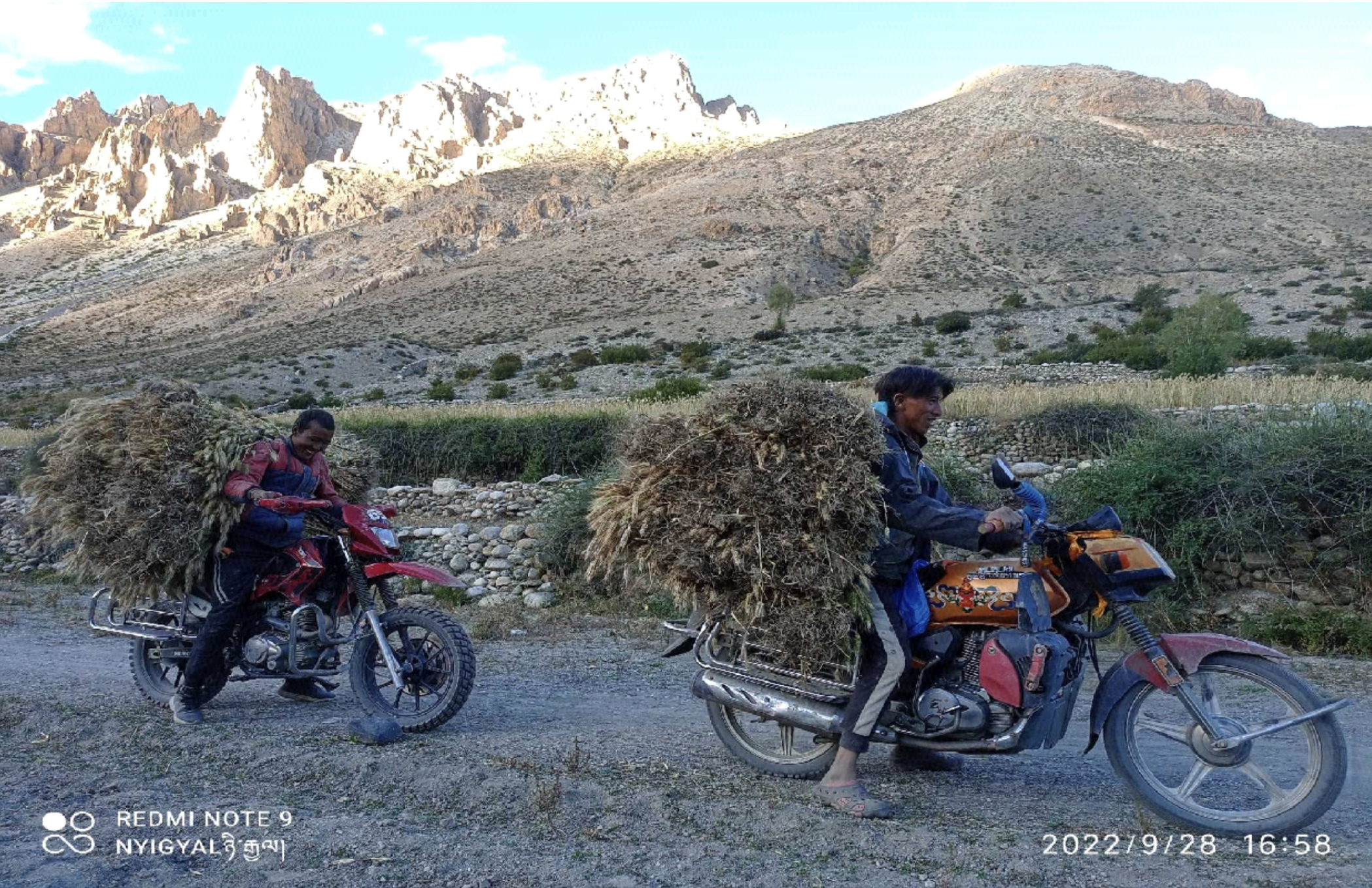
A glimpse of Dolpo youths using their motorbikes to transport the harvest. (Photo by: Nyima Gyaltsen)
In light of how most inhabitants realize the value of motorbikes in their agricultural livelihood, reactions opposing the Nepalese government's initiative to levy a motorcycle tax are fraught with uncertainty. Largely because of the 2020 COVID pandemic and the pro-US approach of the Nepal government towards the Millennium Challenge Corporation (MCC), the Chinese government, led by Xi Jinping, has possibly refrained from the dialogue of resuming the trans-Himalayan trade with Nepal. The government’s intention to extract a motorbike tax and regulate revenue collection, as stated in the opening of this essay reflect the consistent need of the government to curtail the movement of Indigenous people at margins. This also implies that the administration in Nepal has difficulty accepting the Dolpo community's self-led initiatives to change their living conditions. Dhondup (name changed), a resident of Bentsang, stressed that the government cannot just plan to collect the motorbike tax if they cannot build a proper road. [2] The new road is still incomplete, and people continuously face challenges, such as regular bike maintenance, uneven road surfaces, and leg pain even when walking on it. Several of the seniors I engaged with indicated that the incomplete road was a contributing factor to certain walking difficulties. He maintained that the government should not confiscate a Chinese motorbike acquired through diligent effort. Consequently, obtaining motorbikes reanimates age-old modes of existence and reshapes arduous local environments and connections with other species. The experiences of other young people mirrored Dhondup's discontent, thereby revealing the mechanisms of spatial marginalization and how motorbike taxes can disadvantage the economically vulnerable.
These critiques lead to one of the crucial demands of Dolpo: Indigenous sovereignty and self-determination. Their demand is for a separate district and a territorial consolidation of the presently divided three rural municipalities: Chharka Tangshyong, Dolpo-Buddha, and Shey-Phoksundo. This will also allow them to regulate motorbikes on their own terms if needed, without undermining their values to farmwork that directly contribute to reviving the broader relation between people and land. In contrast, the Federal ruling government and even the government in opposition, led by the Marxist (Center), who previously championed the idea of ethnic federalism, have restricted the power of province and local level. Communities like Dolpo require the power distribution at a local level to implement the idea of Indigenous sovereignty. Some of these moves at a federal level have further emboldened the pro-Hindu monarchy supporters. [3] Apart from the revival of the Hindu monarchy, the Nepalese government has historically undervalued agricultural products, such as barley from Dolpo. These political formations fundamentally rooted in the idea of Hindu caste supremacy often ignore the idea of Indigenous sovereignty perpetuating the historical oppression of Indigenous communities, including our land relations. However, local communities have consistently reconvened to reaffirm their shared land rights, with current assistance provided by young individuals on motorcycles.
Tsogpa
Literally, Tsogpa (ཚོགས་པ།) denotes a gathering of people for a collective good. Tsering (name changed) is a respected teacher from Dolpo. Although his daily schedules are packed with teaching duties, Tsering is also a responsible community defender. This idea of defense is translated into his awareness of lands and commitment towards bringing youths together with football. As I will show below, the emerging local unity renewed by motorbikes is crucial to reclaim the land, planned for the building of the check-post.
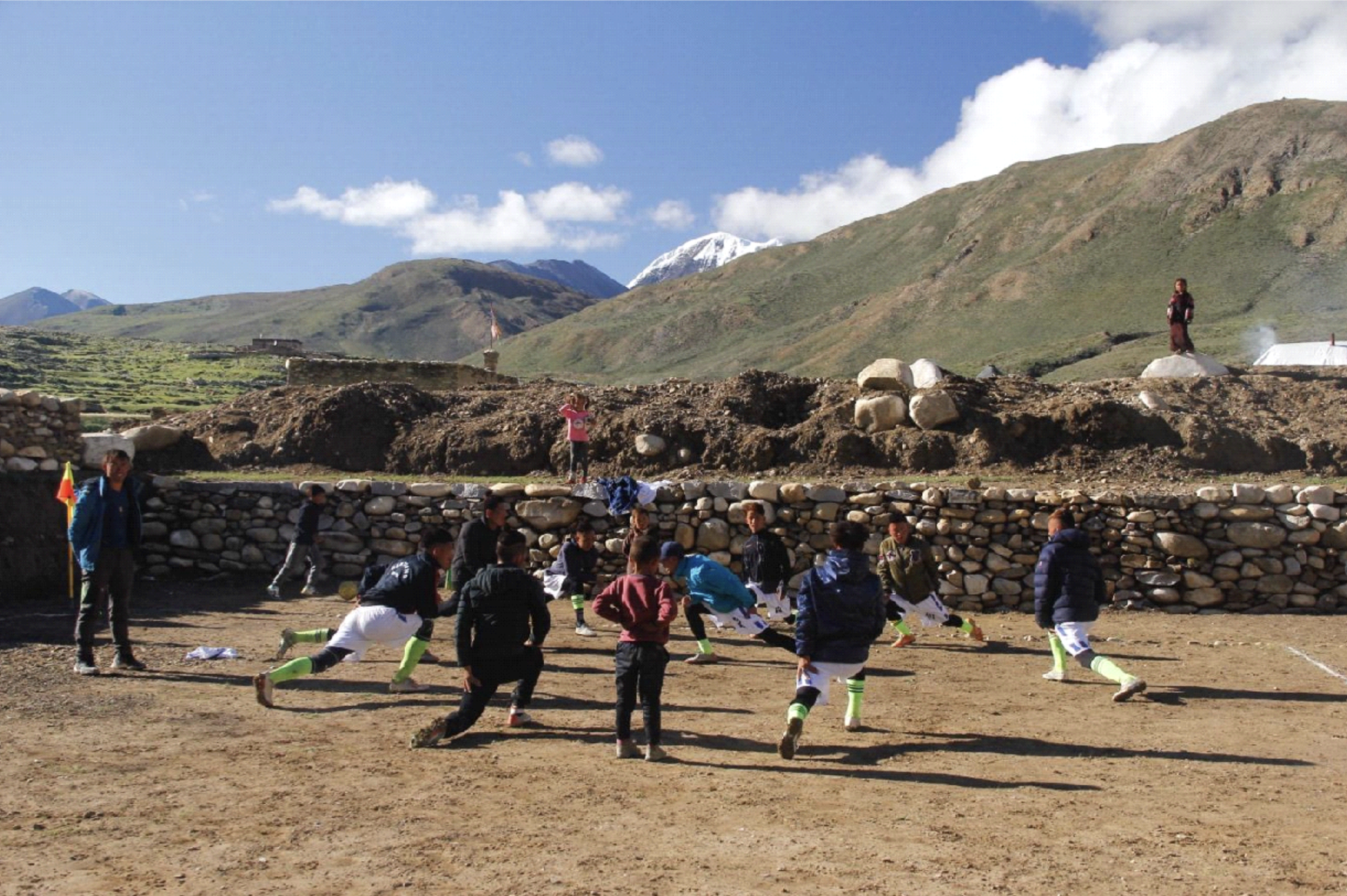
Dolpo youths preparing for the 2021 football tournament. (Photo by author)
Tsering overheard government officials discussing their efforts to locate land for ›a proposed border checkpoint. This conversation included the area where the border check-post will be built. Recently, officials from Kathmandu, Dolpa, and Surkhet, including military personnel, had visited the rural community. A non-Dolpo district administration officer I interviewed asserted that the government intends to enhance border security by establishing the border check-post. The planned check-post is also later supposed to support tax collection and other forms of border control, often reducing locals and their movements to the purview of crime. Certain inhabitants expressed concern that a greater government presence locally would impose additional restrictions on the Dolpo people's rights. Consequently, several military officials were expected to charter a helicopter to conduct an inspection of the border. Upon my arrival at the borderland in Tingyu, I encountered a police check-post staffed by four or five non-Dolpo officers, who expressed a need for a dedicated police station and a proper building in addition to the existing border security measures. The location, which local youths later occupied for the 2021 football tournament, is the only site under consideration for the proposed border check-post.
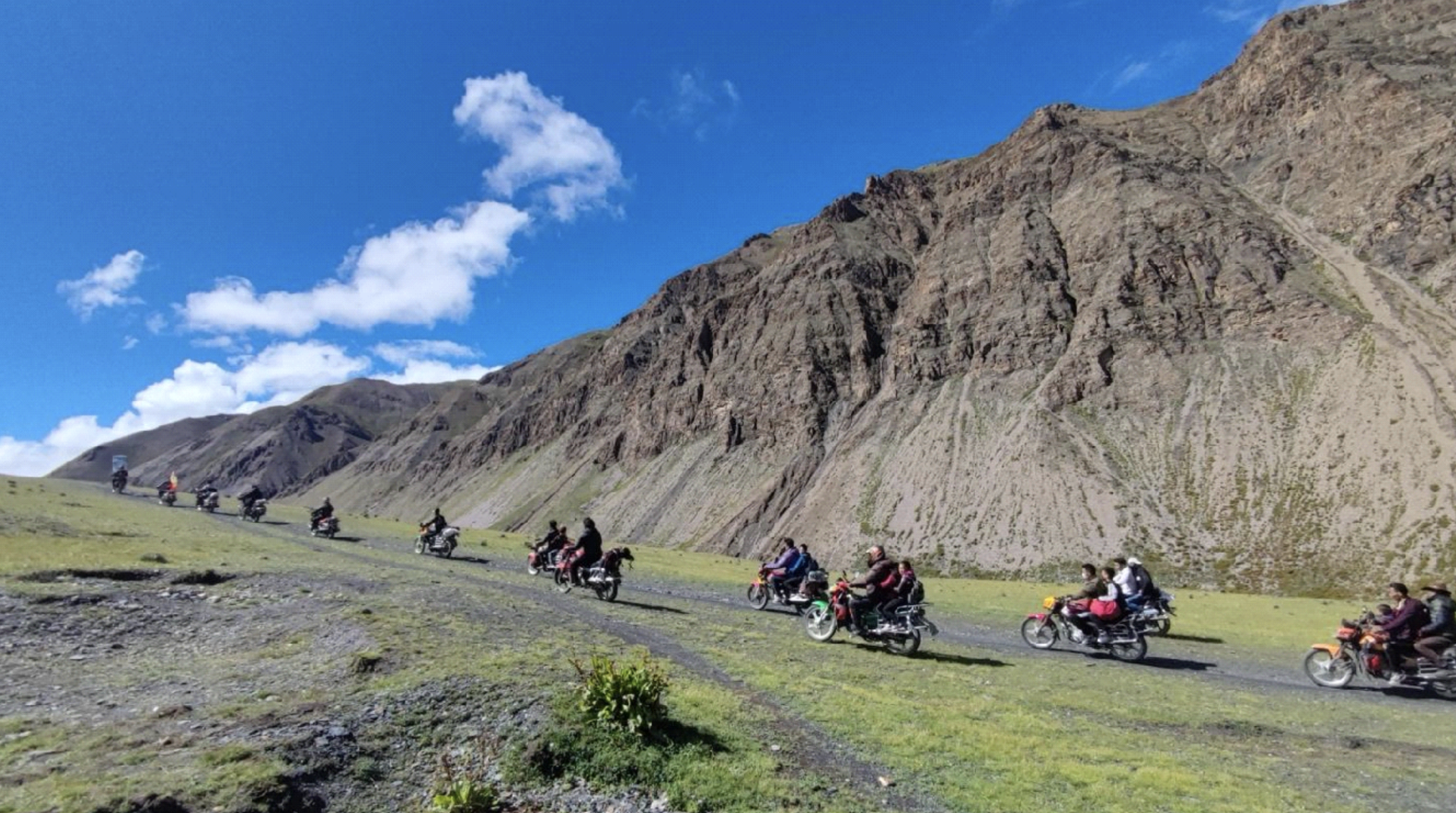
Shingmen youths creating a motorbike rally to attend the 2021 Bentsang Football Tournament. (Photo by author)
During my attendance at the football tournament event, Tsering and several other youths recommended that I participate in its preparations, which were set to take place at a different venue. By evening, a group of us erected and slept inside a tent that we had borrowed (using a motorbike) from another member of the community. Presently, members of the Dolpo community view the youth of Shingmen as a humble group, comprising individuals who exhibit considerable football talent. A disciplined motorbike rally conducted by the players and the supporters to reach the tournament ground further consolidated the new perception of youths and the relevance of motorbikes for youths and other community members.
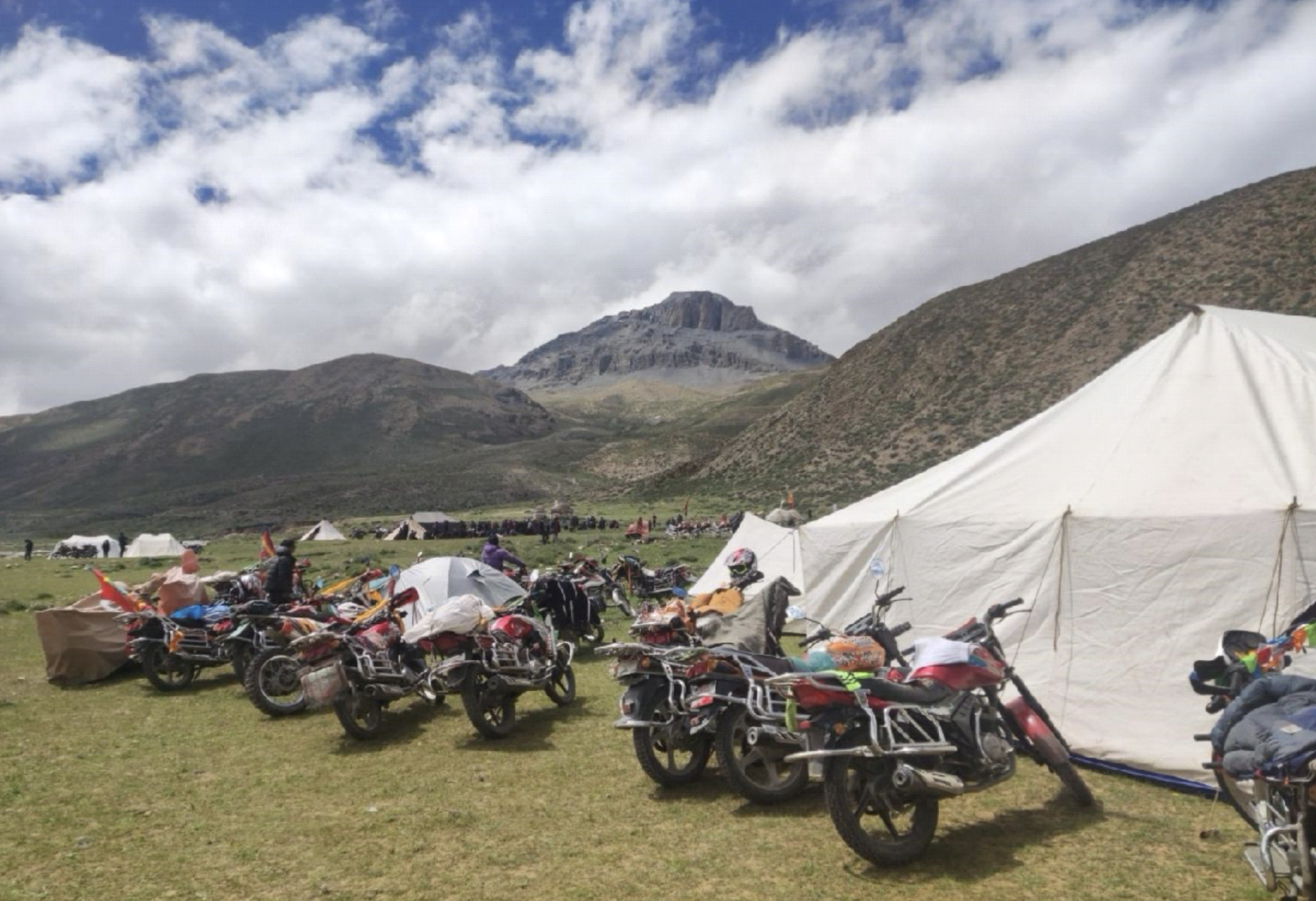
Motorbikes placed close to a tent during the 2021 football tournament. (Photo by author)
Similarly, Ngawang, a chairperson of a Ku Lha (a mountain god) youth club and the organizer of the 2021 annual Bentsang football tournament, agreed that motorbikes—which helped move required tournament materials, including equipment and tents where guests were welcomed—massively helped in running the tournament and following the tight schedule. The proceedings regarding these collective works in action illustrate that certain youths involved were primarily acting in opposition to the governing body's occupational land policies. This stance, which motorbikes helped to establish, was then supported by community members, including elders and women, who insisted that the land was primarily a communal asset, not the government's. In reality, Dolpo people riding motorbikes promoted individual self-determination, self-actualization, and nurtured intimate relationships among individuals, linking with the larger collective objective. This challenges the changing national rationalization of Dolpo, often diminished to an alpasankhyak (minority) from a "backward" caste group, contrasted to Brahmins as keepers of knowledge. Even with the new 2015 constitution providing delimited rights, the constitution-making process was largely dominated by elite Hindu Brahmin men politicians. It represents a further entrenchment of the sovereignty of the settler state, normalizing the assimilation, co-option, and (dis)placement of Indigenous peoples. Yet, the paper has shown the ways in which Dolpo youths riding motorbikes came together to work against such nationalist threats.
To conclude, the youth of Dolpo perceive motorcycles as having significance beyond mere transportation. In response to the Nepalese government's stated intentions, often influenced by privileged high-caste Hindu male figures, to regulate motorcycle access and collect taxation following the opening of a Dolpo border checkpoint, the youth mobilized their motorcycles to reclaim and redefine their mobility and territories for communal purposes. Motorbikes utilized in farmwork have been repurposed to transport materials and individuals essential for organizing a football tournament, thereby fostering stronger community relationships and economic development. These relationships, grounded in agrarian principles, are integral to Dolpo's conceptions of political autonomy, frequently challenging the pervasive influence of Hindu caste nationalism. In this way, Chinese motorbikes running in Dolpo have become more than a means of transportation. In Dolpo, their distinctiveness from Indian motorbikes in other parts of Nepal stems from their capability to interact with both human and non-human lives. Consequently, these activities warrant a reevaluation of the casteist perceptions of Indigenous peoples dehumanized as alcohol drinkers, and highlight their proactive efforts to modify their motorbikes to enhance shared practices embedded in Indigenous resurgence.
Notes
[1] Currently situated within the northern political boundary of Nepal, connecting Tibet, China, Dolpo presently consists of three rural municipalities (the largest district of Nepal): Shey-Phoksundo, Dolpo-Buddha, and Tsarka Tangshyong. Most of the community members from these three RMs, although scattered due to rugged landscape, closely align themselves with the social category, Dolpo and are mostly farmers and pastoralists engaging in subsistence farming and barter exchanges. The Nepal government, mainly due to the larger Indigenous Peoples movements since 1990s has officially considered Dolpo as one of its many Indigenous communities. Yet, different social collectives in Dolpo predate such legal consideration (Dolpo, 2016; Choekhortshang, 2017).
[2] Names are changed to ensure their safety.
[3] In this interview of Durga Prasain (one of the pro-monarch leaders) conducted by Jagdish (a well-known journalist), Prasain for the first time publicly acknowledged the role of the former King Gyanendra in the organization of recent pro-monarchy protests. In one such protest, some supporters even used a poster with a photo of both Yogi Adityanath and the former King Gyanendra. To date, Gyanendra’s supporters (mostly elite upper-caste/class men) have not publicly declared the King’s role in the pro-monarchy protests. On the other hand, Yogi’s role in exacerbating the Hindutva agenda in Nepal is well known. https://www.youtube.com/watch?v=93Z_rRF060g
Tashi Tewa is a first-generation Ph.D. scholar in Anthropology at Washington University in St. Louis, United States. His scholarly research advances critical Indigenous methodologies and thoroughly examines the complex relationships among infrastructures, caste, and indigeneity, shaped by imperial, colonial, and neoliberal realities within the global South, particularly in Dolpo, recognized as one of Nepal's Indigenous Nations. As a scholar, his research works are published in both mainstream media and journals. In practice, Tashi is also a co-founder of the Haatemalo Collective, an anti-caste organization in Nepal dedicated to creating alternative pathways toward liberation. This practice builds on his years of active engagement in various community-based political organizations and participation in Indigenous movements across Nepal.
Prepared with the editorial assistance of Mishaal Mahmood.