Towards a Technopolitics of the Global South: Political Publics in the Global Present
arvind rajagopal
“Technopolitics of the Global South" is a modest proposal for naming an aggregator site of new and relevant research that can easily be lost in one disciplinary silo or other. This occasional series on Borderlines inaugurates an effort to connect questions regarding contemporary political forms and practice with numerous other intellectual vectors, of data and digital colonialism, computing from the South, platform imperialism, and mass mediation.
This inaugural dossier begins with introductory framings by Arvind Rajagopal and Francis Cody. This is followed by a set of reflections from Shahrukh Alam, Kajri Jain, Shubhangi Heda and Ishita Tiwary, Anustup Basu, Joyojeet Pal, and Mehak Sawhney.
Introduction
If the event, as Gilles Deleuze remarked, signals a rupture between different ways of knowing, the making of a news event signals its iterability, and thereby its value in the fast-growing and politically influential attention economy. Political sovereignty and assertions of right, in the age of intensified media spread, become increasingly grammatized, and turned into malleable sequences of signal and noise, whose uptake in the attention economy can be manipulated and fought over by different political factions.
Francis Cody’s The News Event [1] demonstrates how the manufacture of consent to an increasingly centralized world is constantly threatened, since the grounds of consent can be undermined by the news itself. He offers a close-grained view from field sites that western or northern media theorists seldom write about. Liberal pieties about the public sphere as a virtuous circle of reason and rationality, already upended thanks to the technological affordances enabling the rise of Hindu nationalism, are further exploded in the events Cody examines in southern India. Print and digitized forms of visibility crisscross and interact across elite, mass and party faction, to enable a distinct currency for popular political engagement.
With The News Event being read across the disciplines, a symposium seemed an appropriate forum to discuss broader issues of technopolitics and its relationship to politics as such.[2] Taken together, the reflections assembled here each propose conceptual approaches to media based on studies in India that reach toward broader horizons of application.[3] Eschewing both (1) narratives of the unilinear unfolding of universal processes emanating from the North Atlantic to the rest of the world, as well as (2) converse teleological arguments that what happens in the Global South should be of interest because the so-called “west” is beginning to look more and more like its underdeveloped Other, our interlocutors can be linked through a different set of questions: What political energies are being shaped in technology’s wake, and what ground of criticism can be drawn to respond to these challenges? Hence the title of this piece.
Post Cold War Publics
A casual glance at the front pages of newspapers before and after independence in India, hints at a steep drop in foreign news not long after independence. National development entailed a period of relative self-absorption compared to the internationalist sensibility of anticolonial nationalism. With the formation of a nationalist government, internationalism became a province of experts, and domestic matters dominated attention at “home” – which was of course, no longer London.
Even if national events were rehearsed elsewhere, and appeared like local symptoms of something more far-flung and global, just as for example, India’s national campaigns against corruption and rape modeled themselves on the Arab Spring, national events could still appear magically alone, since the meta-level awareness that technological developments have highlighted, like Minerva’s owl, takes its time to emerge.
Globalization, far from creating a flat world, produces something closer to a Riemannian geometry, that can shrink or stretch Euclidean space, making the nearby distant, and vice versa. Riemannian space can render the originator of an action or event absent, and nurture a favored fiction of the sponsor, namely that publicity spontaneously reflects the world without any intervention. In mediatized environments capable of splicing factuality away from actuality , where almost anything can be declared as the truth, recessed layers of sovereignty can come to the fore and render any public claims nugatory, and do so without account.
We have witnessed this process in India as well as elsewhere, and the reflections assembled here approach it variously. Each of the pieces deserves to be read for itself; I will try to introduce them with some historical and theoretical framing.
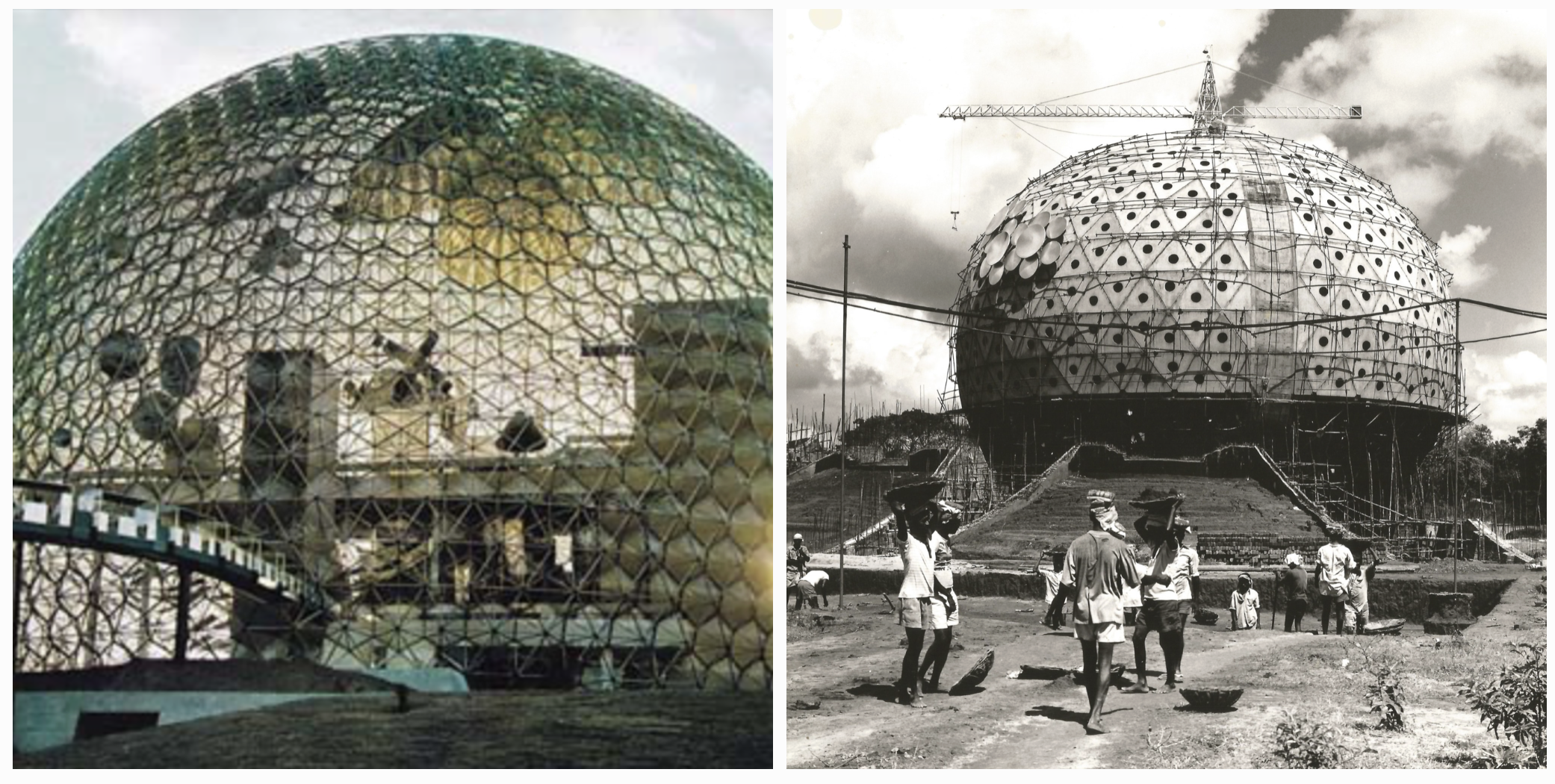
Both are images of a geodesic dome, which is modeled on Riemannnian geometry. The left-hand image represents the theme for the US Pavilion in the 1967 Montreal Expo, "Creative America." The other is from Auroville, India, begun in 1971 and completed in 2008.
Image credits: Image 1: Expo-67 (Domerama.com, licensed under CC BY-SA 3.0); Image 2: Matrimandir Construction Photos 1971-2008 (Auroville Archives, licensed under CC BY-NC-SA 4.0)
The Indian public began as a ventriloquism of the state, and a proxy of state reason, to be held against the crowd, the folk or the mob as political order demanded. A break point was arguably the 1992 demolition by Hindu militants of the Babri Masjid in Ayodhya, culminating a years-long, television-fueled campaign. Such militancy was indirectly affirmed in a 2019 Supreme Court decision that ruled the destruction to be illegal, while respecting the Hindu claim that the land represented Ram Janmabhumi, Lord Ram’s birthplace. The judges’ decision to acknowledge Hindu violence only to then reward it, rendered de jure what was until then merely de facto, and posed the question whether coercion was sanctified if it somehow yielded Hindu gain, now defined as national.
From the viewpoint of the Nehruvian era, such an outcome would have been hard to visualize. But with the end of the Cold War, and of the deep freeze on geopolitics, long-standing state protocols of neutrality towards religion became inconvenient even as a façade. Although India had benefited from the Cold War, its end was greeted as if it brought a new dawn of freedom – no thanks to the corrupt and misguided socialists who had until then crushed the Indian spirit, at least in the new elite view.[4] It is not sufficiently noted that some of India’s leading capitalists greeted the fall of the Berlin Wall writing op eds hoping that the Babri Masjid too would soon fall, and take Nehruvian socialism with it. Globalization (often synonymous with liberalization in India) was in fact viewed by big business as a chance to define the future. Hindutva was, in the words of the late BJP finance minister Arun Jaitley, merely an opportunistic “talking point.”
Whether a talking point or a fascist program, it is ironic that as multiculturalism was embraced in many parts of the west, identitarian movements fed into the political mainstream and challenged universalist Eurocentrism, often from the right. The affective charge of belonging, of opposition to a corrupt old order, of finding new connections between earth and sky, so to speak, fueled some of these movements to power. In India, to some extent the Congress Party’s liberalism allowed it to be the butt of ridicule, whereas the more authoritarian BJP denounced its critics with a ferocity that drew supporters even closer to it.
The ideological shifts away from secularism and towards the market indicated a “change of mindset,” discarding old ideas and long-standing principles e.g., of social welfare as no longer practicable. [5] If some ideas arrived as abrupt turns of opinion, it reflected a more generally thing-like character ideas seemed to acquire, circulated and exhibited rather than criticized, appearing or disappearing like images circulated and withdrawn by mass media. The idea of the communication revolution itself, although launched with such fanfare in the 1960s, has itself fallen into disuse. We would do well to recall that its aim when launched was to save capitalism and destroy communism, with communication as its instrument rather than its end goal.
In a quite literal sense then, the communication revolution was aimed at the Third World, because the Third World represented the stakes of the superpowers’ rivalry; it was their nonalignment that John Foster Dulles denounced as immoral and shortsighted. The American aim was to make communism unacceptable, and render capitalism as the only meaningful choice. The vision was of capitalism arriving much like a conquering force, inoculating the world’s societies against communism, and conscripting the world into a modernization that avoided the pitfalls of socialism and communism.
National communication systems began to be touted as precisely the means for former colonies to enhance state capacity, regulate their social temperature and build national culture. Fears of western imperialism, however resonant they were, could be countered by sovereign national states. Or so national governments, certainly India’s, invariably reassured their citizens. The foreign hand had to be kept in check – perhaps using the media itself. Thus India’s Publication Division released a report presenting television as the means for constructing an Indian personality for the country.
That television has been instrumental in constructing an Indian personality for the country is a fact as widely known as it is little discussed. Politics thereafter was conducted on television, to a greater extent than before, and not merely known through television. And television’s growth ensured that cognitive and semiotic labor would be increasingly central to the production of value.
Technopolitics and/in the Global South
A technopolitics of the Global South acknowledges the colonial element in the entanglement of technological and political practice, and challenges the reproduction of such dependencies, and aims at a world where the political minority status of the world’s majority is sought to be reversed.
By way of resonance with the moment of writing, we can recall the age of high imperialism, when colonial genocides did not make the news, or if they did, it made no difference. Although we have been told that imperialism is “history” in Henry Ford’s sense, we can see that it has in fact, not disappeared, but needs to be understood in today’s terms.
What the publishing tycoon Henry Luce influentially declared as the American Century was supposed to be different: it offered a new deal for the former colonial world, and a fair deal at that. Writing in the 1980s, William S. Burroughs saw power and control at work instead:
There can be no doubt that a cultural revolution of unprecedented dimensions has taken place in America during the last thirty years, and since America is now the model for the rest of the Western world, this revolution is worldwide. Another factor is the mass media, which spreads all cultural movements in all directions. The fact that this worldwide revolution has taken place indicates that the controllers have been forced to make concessions. Of course, a concession is still the retention of control.[6]
The cultural revolution that Burroughs refers to followed the end of WWII. Developments such as the Universal Declaration of Human Rights, adopted by the UN in 1948, and U.S. aid, designed to deter communism, inaugurated the American Century.
“Culture” was suddenly everywhere after the war, Raymond Williams noted, an old word generating new meanings for new times. This was true not only in the industrialized west, but also in the former colonies engaged in nation-building through economic development. Americans launched a “communication revolution” whereby media technologies would accelerate returns on investment and quicken development. Culture would hereafter serve to bring the world’s nations on the path of modernization, while neutralizing any alternatives presented by “tradition” – alternatives that, in this understanding, could only be disruptive.
The American Century thus aimed not only to counter the appeal of Soviet Communism. It also launched a phase of technopolitical expansion, in which the sphere of communication, i.e., of circulation and exchange, became crucial to the realization of economy. Communication was thus no longer merely ancillary to economic production, but a system stabilizer and hence potentially a source of instability. Therefore, to manage participation in the U.S.’s “empire of freedom” involved continuous adjustment and modulation of unforeseeable behaviors.[8] In Burroughs’ words, “The mass media has proven a very unreliable and even treacherous instrument of control. It is uncontrollable owing to its need for NEWS.…”[9] (emph. orig.)
The Birth of Technopolitics?
Now, the contest between superpowers to influence decolonization yielded a measure of technological sovereignty to developing countries. But the existing terms of trade ensured dependent development, compounding colonial-era disadvantages of the Third World, as Latin American economists argued.[10] Such criticisms led to demands in the United Nations for a New International Economic Order (NIEO), and it provoked counter-organizations like the G-7 and the Trilateral Commission, to ensure that rich countries maintained their advantages.
When similar arguments about dependent development were made in the realm of culture, revealing the largely one-way flow of communication from the west to the rest, the backlash was overwhelming. A fog of counterpropaganda generated by western governments and their advocates helped to trivialize the demand for a New World Information and Communication Order (NWICO) made by representatives of the Non-Aligned Movement in the United Nations in 1974, some weeks after the NIEO was proposed. The pushback was so successful that the debates over “one-way flow,” so prominent at the time, have virtually disappeared from scholarship on the period.
The west’s response to arguments of dependent economic development contrasted sharply with its dismissive and obfuscatory response to similar arguments with respect to media. Since post WWII international institutions were premised on an economic model of the world, these institutions could more easily accommodate Third World arguments on that terrain even if they challenged the status quo. The category of communication signaled new territory, that the United States aimed to dominate. Complaints about the west’s near monopoly over the world’s airwaves, coming from the Third World, could only be a Soviet-led conspiracy. That charge was applied to the organized opposition emerging via Unesco, which the U.S. quit in protest.[11]
If the Third World protested that western dominance was reflected and reinforced through media, the West’s counter-assertion essentially maintained that media technology required Western-style, i.e., market-friendly oversight. Any attempt at interfering with communication flows risked making things worse. The self-evident proof against political remediation, in this argument, was the Soviet Union, whose state socialism was regarded as a failed project.[12] Behind the anti-communism was the question of representation, raised as a test of political adequacy. “America” was a real democracy, or so its media appeared to confirm day after day, while authoritarianism, where not already overt, seemed to lurk behind almost every non-western government.[13] The debate arguably marked the birth of a technopolitics of the Global South, expressed in the idiom of its time.
It was not until the end of the Cold War that the term technopolitics appeared in scholarship in the work, e.g., of Gabrielle Hecht and Timothy Mitchell. Entangled geographies of technological production and practice initially appeared to render technopolitics inherently global and trans-regional, according to some scholars. However, with the widespread fever against immigration, “entanglement” appears delimiting, and as requiring to be reduced. If modernization was first theorized as a convergent process, and liberal scholars in the post-Cold War period hypothesized divergence instead, today divergence has become a war cry on the right (against DEI at home, and against immigration and globalization).[14]
It should not be forgotten that the market success of digital and cellular technologies was prepared by popular political mobilization in the Global South. Newer media from cable tv onwards, represented themselves as effective means of popular representation, bypassing legacy institutions and the geopolitical inertia that supported them. The Zapatistas, the Green Wave of Iran, the Arab Spring and the anti-corruption and anti-rape campaigns in India, in different ways appeared like advertisements for the power of social media. The idea that popular mobilization could be swift, smooth and successful overlooked the possibility that such success could reverse as swiftly. The generally euphoric reception of western media and their proxies elsewhere provided a therapeutic rehearsal of Cold War triumphalism, following the humiliating market crash of 2008. Capitalism might be crisis-ridden, but technology understood as the agent of capital, could still come to the aid of democracy. More media meant better communication among people. That could clarify class struggle and resolve political contradiction. And that meant the communication revolution was still a living thing, albeit as the digital revolution.
Those moments of policy remediations for media imperialism, or of new technologies helping to curtail despotic power, appear distant now. The solutions proposed by the new world information order are hardly adequate to a world now governed through metadata, or information about information. What is the ground view like in emergent societies of metadata? The papers in this collection seek to address this question from the Indian context.[15]
Now, anthropologists have traditionally been concerned with expanding our understanding of the human, through engaging with its presumed others. But a technologized landscape has absorbed and turned markers of what was earlier understood as irreducible cultural difference into shifting sets of cultural techniques whose widespread accessibility signals democratization. If communicability appears as a transcultural idea or value of sorts, then perhaps we can follow this idea and the traces of its material realizations where they take us. Cody bypasses the scholarly convention of framing the “area” to escort readers directly to the media-political event, whose participants recognize it as both real and virtual, of the moment and yet evolving. He observes the collapse due to media saturation, of “the distinction between a storyline and that which it is reporting on.”[16] Occurring amidst familiar tropes of media virality reflexively deployed in an unfamiliar setting, this allows a flipping of the figure-ground relationship that typically spotlights nonwestern cultural difference while ignoring shared (cross-regional) tendencies. Cody’s method leads us to contemplate the flawed and inchoate universality of media practices, that were envisioned to modernize the world and meld together its constituent regions. Instead, we witness diverse populations being drawn into extractive attention economies, and making the Global North and South converge in some respects, but around the pole of competitive authoritarian populism rather than of functional parliamentary democracy.[17] As Cody writes in his essay for this forum:
What could be framed as a planetary “undercommons,” remains heterogeneous in its ethic of address, without feeling the corresponding weight of the other’s gaze falling upon it. The claim to factual truth remains steadfast when articulated from this “view from somewhere.”
Shahrukh Alam, a civil rights lawyer in India’s supreme court, confirms Cody’s argument about communicability, but locates it in the historical context of a given media form, when obeisance to the rule of law had to be performed and reiterated even if it was also being flouted. Contrast those contexts where even a nominal salute to the law can be dispensed with. The normless is also formless, capable of being defined only in the negative, as not this and not that. That the truth is beyond words, and can be captured only partially is of course an old idea, and compatible with Hindutva, as Alam’s essay leads one to observe.
Ishita Tiwary and Shubhangi Heda’s paper can be read in similar terms, although their aim is to compare state speech to state action, contrasting policy claims to actual politics. Now, India’s communication policy for decades was summarized in an unvarying trinitarian formula: information, education and development. As long as the government retained its monopoly over the airwaves, this formula was the equivalent of a Chinese wall capable of deflecting all questions of interpretation. After the state lost its monopoly of the airwaves in 1995, however, communication policy attenuated and fragmented, and all references to the long history of state developmentalist policy vis-à-vis media abruptly disappeared. In fact, the era of market liberalization came to be seen as one of freedom from policy. In other words, ad hocism prevailed, amid celebration of the demise of the old order, which was declared to be corrupt and elitist. The erasure of the past helped to frame what came afterwards as positive and visionary, but without a referential ground for measuring the new claims. The authors offer a coinage from their analysis of state action in the realm of digital media: strategic duality, or, saying one thing and doing another.
Joyojeet Pal elaborates on contemporary modes of deep mediatization, that depend on charismatic nodes of circulation, through paid and unpaid “influencers” on social media, that have become indispensable to the digital equivalent of the “last mile” in communication infrastructures. “Highly relatable” figures groom audience tastes, and align themselves on one or other end of an increasingly polarized society, with the majority defining itself not as hegemonic so much as the negation of its minority. This underlines the fact that control over communication technology far from serving the public interest, is being weaponized for sectional purposes. Essentially, when a state-sponsored neutral public domain is overturned, the market becomes vulnerable to the agenda of powerful players. A neutral and rule-based order is reformulated as a personalized system, a nested series of charmed circles, veritably a new “chain of being” that users are invited to join.
Kajri Jain argues in a survey of battles over spatial occupation in the Indian context of caste apartheid, for “a dialectic at the heart of publicness that will keep space in the picture so long as it is a ground of exclusionary organization and a source of value that is subject to occupation and capture.” She traces some of the intricate ways in which increasingly virtualized circuits of communication have still to negotiate the stubborn materialities of bodies and spaces in Global South contexts, rendering extant forms of order unavoidably contingent.
Anustup Basu shows how Hindutva has transformed mainstream nationalism by integrating a range of disparate forms, and anticipates modes of control witnessed in the west. Violence instead of withdrawing from visibility, as assumed in the civilizing process (Norbert Elias), “suspends the language games, and constitutional and juridical pieties of liberal democratic politics and communicative action,” in Basu’s words, and renders ideologies of communication and transparency nugatory. Basu dubs the result as “the politics of the advertised,” where factuality and actuality part company, and communication, instead of harmonizing diverse minds with each other, becomes a subset of metadata computational logics.
Mehak Sawhney reads the contemporary moment as one where the companion terms of incommunicability and communicability are both salient. She writes of the auto-immune disorders of authoritarianism, and the need to recognize what she calls shadow knowledges, that rephrase, resist or subvert authority, and generate archives that sustain oppositional potential. She understands politics as a field of forces with a horizon of expectation, and a set of practices sustaining the sense of a horizon. Although Sawhney’s essay is written in the vein of political philosophy, her essay, together with those of the others, remind us that theory does not always have to flow from the metropolitan core to the world’s periphery.
Endnotes
[1] My thanks to Francis Cody for his deep and generous engagement at every stage of this project.
[2] Shahrukh Alam, Francis Cody, Tejaswini Ganti, Joyojeet Pal, Ishita Tiwari and I spoke at the Nov 7, 2024 event. NYU’s Department of Media, Culture and Communication provided financial support for the event. My thanks to Dove Pedlosky and her team for their invaluable help.
[3] Three papers were solicited following the event, from Anustup Basu, Kajri Jain and Mehak Sawhney, and these are included here as well. Titled “Publicity and the Politics of the Global Present,” the call for papers stated: “Erstwhile arguments about the anodyne character of publicity seem naïve today. Dispelling secrets, ensuring transparency and even honesty, bypassing the power of princes and empowering ordinary people to ensure perpetual peace: incremental acts that telescoped into an idea of enlightenment made manifest. Today, who is and who ought to be the subject of publicity is itself anything but uncontested. We witness the widespread fragmentation of shared understandings, the expansion of surveillance and the weaponization of publicity for private ends. In social formations that are being reconstituted as emergent societies of metadata (Pasquinelli), what theoretical and political pathways can we craft for attempts at popular sovereignty? What strategies of mediation and dismediation predominate, and how are these being countered?”
[4] ‘Spirit’ in this account harmonized religious and economic motives, apparently disproving Max Weber’s contention that the Hindu caste order discouraged capitalist rationality.
[5] Kapil Sibal, then Union HRD Minister. Personal conversation, c. 2010, Indian Consulate-General’s Office, New York City.
[6] William S. Burroughs, “The Limits of Control,” in The Adding Machine: Selected Essays. New York: Seaver Press, 1986, p. 198.
[7] Raymond Williams, Keywords. 1975.
[8] Odd Arne Westad has suggested that the Global Cold War can be characterized as a competition between the U.S.’s “empire of freedom” and the Soviet Union’s “empire of justice.” See Westad, 2005.
[9] Burroughs, ibid., p. 198.
[10] Raul Prébisch and thereafter Celso Furtado and others, theorized a core/periphery model for the world economy, in which the terms of trade declined over time for primary commodity exports.
[11] The U.S. quit Unesco thrice, in 1984, 2003 and 2017, alleging leftist, anti-Israel, inefficient and corrupt management. US funding amounted to between a fourth and a fifth of Unesco’s budget, when it was contributing to Unesco, between the 1980s and 2025, the latter being the third occasion of its departure.
[12] In the U.S., NWICO was a rallying-point of internationalism in the academy through the 1980s, especially in media studies, where it became a means to confront American exceptionalism.
[13] See e.g., Anthony Smith in The Geopolitics of Information: How Western Culture Dominates the World (Faber & Faber, 1980).
[14] See e.g., S.N. Eisenstadt, “Multiple Modernities,” in Daedalus Winter 2000, “Multiple Modernities.,” vol. 129, no. 1, of the Proceedings of the American Academy of Arts and Sciences.
[15] Space constraints forbid an extensive bibliography but see Sareeta Amrute and Lis Felipe R. Murillo, “Introduction: Computing in/from the South.” Catalyst: Feminism, Theory, Technoscience, 6(1), pp 1–23, 2020
[16] Francis Cody interviewed by Shikhar Goel, Sept 21, 2023, https://campanthropology.org/2023/09/21/frank-cody-on-his-book-the-news-event/
[17] A coinage of Stuart Hall, see e.g., The Hard Road to Renewal: Thatcherism and the Crisis on the Left (Verso, 1988)
Arvind Rajagopal is Professor of Media Studies at NYU and is an affiliated faculty in the Departments of Sociology and Social and Cultural Analysis. His interests are in comparative media, global genealogies of media theory, and the relationship between mediatic form and geopolitical order. His work includes Media and the Global Cold War (with Rossen Djagalov, under review), Media and Utopia (Routledge, 2015), The Indian Public Sphere (Oxford, 2009), and Politics After Television (Cambridge, 2001). The latter volume, which won the Ananda Kentish Coomaraswamy Prize from the Association of Asian Studies and the Daniel Griffiths Prize at NYU, was part of a new wave of literature on Hindu nationalism. His work is influential for its analysis of post-secular politics across real and virtual spaces in the South Asian context, for historicizing Hindutva, previously marginalized in nationalist scholarship, and for demonstrating the relevance of the Cold War for moving beyond erstwhile area studies approaches, e.g., on Cold War humanism, on media theory from the Global South, on the rise and fall of secular realism, and on historicizing the commodity image (here and here, eg.).