Flow, Corporeality, and the Inebriating Alterity of a Kinesthetic Arabness: A Conversation on Dabke, Baathism, and Gender with Shayna Silverstein
Shayna Silverstein’s book, Fraught Balance: The Embodied Politics of Dabke Dance Music in Syria interweaves performance studies, history, and anthropology (among other disciplinary currents) delivering a brilliant study of embodied politics and Levantine gender dynamics in which mazaj (atmosphere or mood) sheds light on Baathism’s less evident tempo.
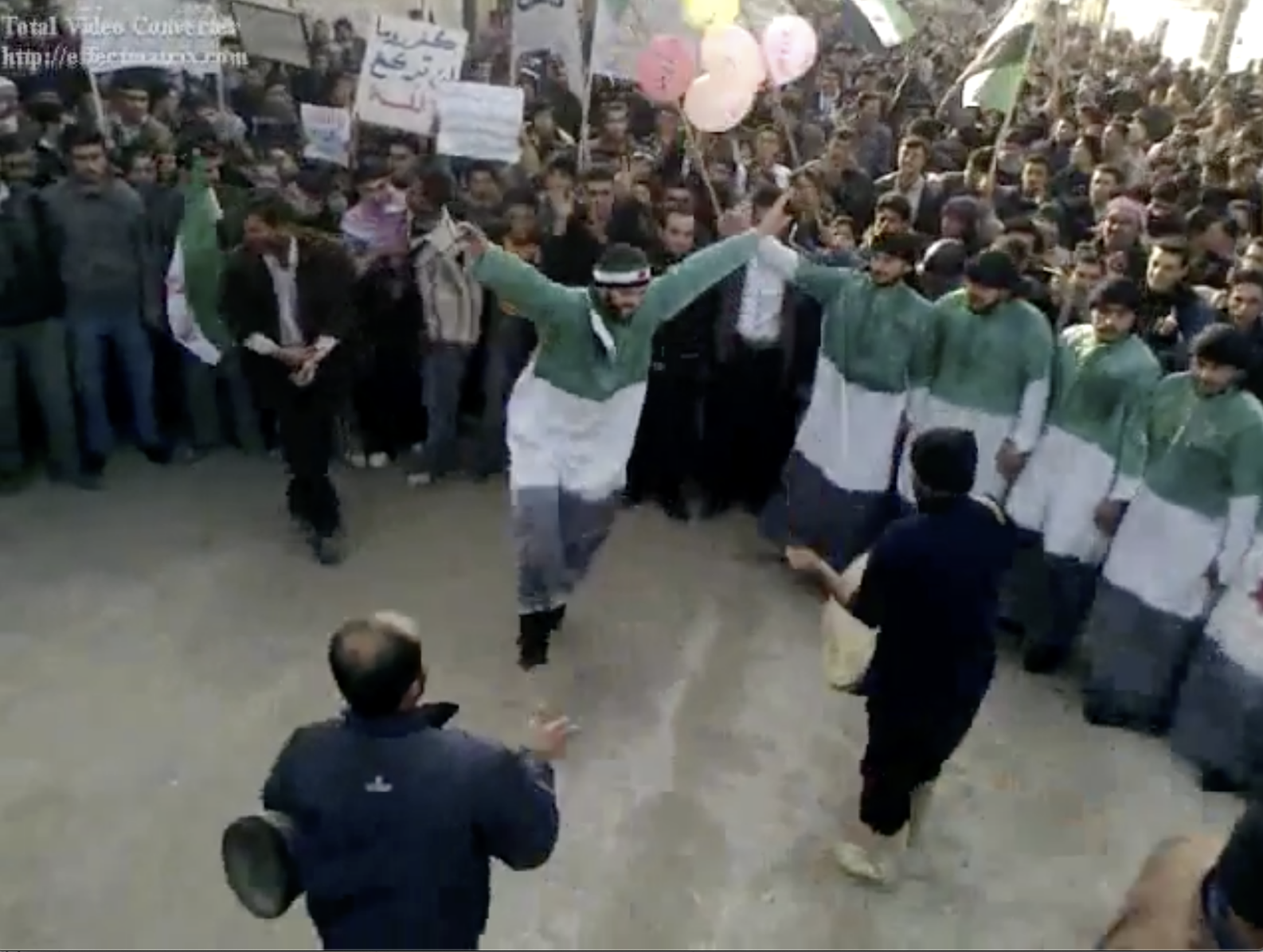
The Holiday of Cursing Hafiz’s Soul,” Kafr Rouma. November 2011. Youtube video.
Part I - Configuring the Syrian sha‘b, a question of wataniya and Arabiya
Lidia Helou (LH): Your book offers a depiction of the Middle East as a geography in movement, a heterogeneous map of dabke (the traditional Levantine folk dance recognizable by its rhythmic stomping performed in a line). How does the rather unfixed notion of “Bilad el sham” —which can be translated as Levant and which conventionally corresponds to present-day Syria, Lebanon, Palestine, Jordan—come into play in this coordination between fixity and flow? How do you balance these notions together?
Shayna M. Silverstein (SMS): A key way to think about Bilad al-Sham is through the concept of Arabness, although this remains contested and up for debate. Bilad al-Sham is an incredibly heterogeneous region in terms of race, ethnicity and religion. Yet amidst these different categories, Arabness has become a particularly dominant force for over a century.
Arabness—specifically as an ethnic construct of Arab nationalism—had particular resonance for the Syrian nationalists who established a modern Syrian nation-state in the late 1940s, and continued to build on that work in the 1950s and the 1960s.
The 1916 Sykes-Picot Agreement carved up Bilad al-Sham, which was then part of the Ottoman Empire, into separate colonial mandate territories under British and French rule. Then, ethno-nationalist and religious nationalist movements mapped cultural modernity* as into the modern nation-states of Syria, Jordan, Lebanon, and Palestine—historically, Bilad al-Sham.
Thus Syrian national identity, for example, became distinct from a Lebanese, Jordanian, or Palestinian one. Palestinian national identity, of course, has been rather exceptional since the Nakba and amidst the ongoing statelessness of Palestinian political organizing. In addition to the formation of the various nation-states that organized along the notion of a Bilad al-Sham, there comes this vector of Arabness as something which connects cultural modernity to the nation-state and turns Bilad al-Sham into something associated with the past and a time before the formation of the modern nation-state. From this perspective, the struggle for independence from the Ottomans and the mandate powers, France in the case of Syria, and the fight to create one’s own national identity became associated more with Arab identity—in contrast to a Bilad al-Sham “Syrianness”—particularly in Syria, the context on which I focus.
Bilad al-Sham is an extremely resonant category, but only as a form of nostalgia, or as a tool to elicit a political sentiment from this historical and affective attachment. Arabness, on the other hand, becomes the modern political vector that indicates where the nation-state is heading towards, the concrete future of the nation-state and state building.
Dabke became part of the modern nation-state because it helped establish a fixed relationship between place, culture, and identity. You asked, what is the fixity, and what is the flow?
The concept of flow, developed by Mihaly Csikszentmihalyi in 1990, is very efficacious and helpful for everyone, for all of us who are managing time and being creative. I turned to it as a way to capture the fluidity and suspension of dabke itself. Csikszentmihalyi thinks about flow in terms of when we get lost in reading, in painting, or in making music, which is very much a single person doing their craft. But as we have been talking about, dabke is relational and social. It makes no sense to hold on to the idea of one person lost in solitude and moment.
Part one of my book is invested in identifying how dabke became a fixed marker of Syrian national and sub-national identity, dabke can be read as a factor of fixity within the SWANA region.
Dabke is caught up in projects that are shaped by all of these political and social dynamics as a cultural tradition considered to be pre-modern and which functions as a means to suffuse the modern nation-state with a sense of homeland.
LH: In a sense, dabke fixed the mythology of Bilad al-Sham into a choreography.
SMS: As if the stage’s floor were Syria’s map. People not only dance on the map, they are supposed to dance according to that map. I remember a conversation with someone who lived in Damascus and had a second home right outside of the city. He would say, “Oh, this is my village. This is where I really have my hearth and my home, where my people come from.” I was later kindly invited to attend a wedding in his village where I heard him utter, potentially contradicting his previous statement, “Oh, my family came from Beirut two generations ago.”†
LH: The sense of history is so flexible and modulable. To this regard, you touched upon the idea of space and the mise-en-scène of dabke within Bilad al-Sham which might allude to the opus’ inner mise-en-scène. Your book is divided into three main sections, each preceded by a “historical interlude:” the first part tackles the emergence of Syria as an independent state in the mid-twentieth century, the second part focuses on the era of postsocialist neoliberalism in the 2000s, and the book ends with armed conflict and forced migration in the 2010s. Throughout your exploration of the Syrian performance arts, questions of authority and authenticity structure your lens, is the tripartite division of the book a way of anchoring your study in a diachronic “irrefutability”/authority? I am particularly interested in your use of “Historical interludes” preceding each section. What does history do to performance?
SMS: What history offers to performance is that it affixes it, it allows to anchor the impermanence of performance in a specific time and place. Scholars of performance theory are always reflecting on the ephemerality of performance. If performance is considered something that is live, embodied, and happening in the moment, then when that moment has closed and the action has ceased, what is left, what remains?
What remains is the memory, the history, as well as the forgetting and the rewriting of history. And then, what kind of historical authority gets imposed? In the book, I offer the historical interludes to think about how societies change over time. The concept of Syria is not something that is fixed, but rather has shifted through the three historical periods by which I structure part one, part two, and part three.
History is an anchoring device to frame a certain set of social and political processes that are bound up with economics and politics throughout specific decades of the 20th and 21st centuries. Meanwhile, dabke remains a lens to thoroughly understand these changes.
Offering historical interludes also helps to offer background information. Many readers need some orientation, especially those in cultural studies, dance studies, music studies, and performance studies, who are not really familiar with Syria or with the SWANA region. By separating out the parts, I could establish a balance, if you will, between history and ethnography, which are the methods lying at the heart of this book.
LH: It can sometimes be tricky to delimit the borders between disciplines. How did you operate the balance and division between historical and ethnographic material? How did you distill it?
SMS: This is a great question, or rather questions: how does one distill disciplinary balance when doing research, and then when writing it up as a book? Many different methods came together in my research. When I was in Syria as well as Lebanon, conducting ethnography in its most immersive dimension, I depended on shadow archives—to use Andrew Simon's excellent construction of archive materials: bookstores, street vendors, outside markets, personal libraries, all these types of informal, non-institutionalized spaces. I also visited institutional spaces, but I was not able to find any written material, even a single page on the phenomenon I was studying, and obviously there is a lot to be said about how authoritarian regimes control information and knowledge production. However, the question of access might require a whole other set of interrogations. So maybe that is for a later conversation.
In order to discover what we might call shadow archives, ethnographic fieldwork entails coming upon and encountering materials through social networking and the enmeshed social dynamics that make up those networks. Meanwhile, to write the historical interludes, I offered a summative reading of each historic period based on understandings of modern Syrian history and politics that are shared and generally agreed upon by scholars in Syrian studies, such as Benjamin White and Elizabeth Thompson, Lisa Wedeen, and Christa Salamandra. Of course, there is always some room for debate, but the ethnography that follows each historical interlude tries to deepen the understanding of the history behind these periods while also privileging the role of popular culture and embodied phenomena in making history as we understand it.
LH: The question of periodization remains challenging. Even more so when trying to find the “start and end” date of a phenomenon such as dabke which is characterized by this quasi atmospheric sense of self and flow. In this vein, the idea of the companion website really helps readers immerse themselves into the object of study and dabke’s play of gazes. It also allows you to go beyond a sort of ekphrastic writing. How did you come up with this idea of a multi-sensorial, scholarship hybrid?
SMS: The recourse to digital platforms has existed in my field since I began training as a graduate student. The use of media, and companion media in particular, has for a long time been an essential feature in scholarship tackling the subject of recorded arts. The wonderful thing about being able to access a digital network site is that it is accessible anywhere, from any part of the world, and you are not bound to a physical object that has to travel, like with the physical object of the book.
This also means leaving the academic bubble. I was debating whether and how to make a companion website, what it would look like, and all the mechanics I knew nothing about, like coding and website building. I talked to a friend far outside of the academic bubble, and he just laughed. He said that a thing cannot exist in the world without a website that declares and affirms it in the world. This also allows us to think beyond the written word and offer media for everybody who is engaging with the project.
At the same time, we have to be critical about how we create this genre of encounter, and what is at stake when viewers start to engage with subjects –meaning with the people who are presented in the video as recorded and documented subjects—through a particular kind of framing.
LH: There is a work of curation and care tied to recording and you touch upon the idea of framing. In your analysis of dabke and its emergence as a national folk dance, or raqs sha‘biyya in Arabic, you point to the construction of an idyllic character: the fallaha, the peasant woman, and its projection of authentic Syrian citizenship in a timeless nature. How does the timeless fallaha in a timeless nature tie with the Baathist definition of Arabness and Syrianness? Who is left out of this idyllic tableau?
SMS: Really a complicated question in all the good ways. I want to start by stepping back and asking, what is Baathism? What are the principal ideologies of this political party and what does it enable in its organization as a political party?
The Baath was a political party founded in 1943. At that time, it took as its central tenets anti-imperialism, anti-colonialism, socialism, and pan-Arabism. It became the dominant party in Syria as of 1963, and later became the engine for citizenship and compliance with the authoritarian Assadist regime that took power in 1970. The Assadist regime took these tenets of anti-imperialism and socialism as rhetorical anchors for which to ask its citizen-subjects to comply with authoritarianism.
Many scholars have found that there is a gap between the Baathist political rhetoric and how the Syrian state was actually governed and administered by the Assadist regime. So how does Baathism relate to Arabness and Syrianness ? Within Baathism in Syria, Arabism, including pan-Arabism, was a key part of the Baathist project, as was in Iraq, Egypt, or elsewhere.
Arabism played a crucial role in shaping national identity. Not only was Arabness upheld as a unifying force that took expression through language, culture, and history, but non-Arab social groups, especially Kurdish communities, were dispossessed of land, banned from celebrating major holidays, erased from national histories and school curricula. Therefore, elevating dabke as a specifically-Arab folk dance that gestures to a Bedouin past (in concomitance with Bedouin tribes’ negotiations with Baathist authorities) served to erase non-Arab performance practices from the national stage. There was no Kurdish folk dance.
Although this changed around 2018 and 2019, it also flattened Bedouin expression as historical or pre-modern, rather than as a constituent part of contemporary society, which Bedouin life very much is. Not only did dabke as a form of cultural Baathism promote Arabism at the expense of Bedouins and Kurds, among other groups, it also enabled certain configurations of representational power.
The Syrian state is composed of 14 provinces, or governorates, the organization of which stems from Ottoman and French colonial mandate borders. Each province has developed a distinctive regional identity over time based on local traditions, identities, and histories. What is crucial to note about these distinctive regional identities is that they are celebrated in official state cultures, such as raqs sha‘biyya. But this celebration is geographical, strictly local, emphasizing the role of place in forming identity, memory, and history.
In doing so, official state culture promotes an ethno-national logic of culture at the local and regional level. Very often we think about ethnocentrism and ethno-nationalism as being about a national identity. However, what the Assadist statecraft did was project these logics down to the local and regional level in ways that aligned with the administration of the state through the provinces. By constraining memory and history to geographic and place-based forms of identity, official state culture avoided articulating other forms of difference, for instance religious difference, as part of the cultural diversity within Syria's national polity.
Of course, religious difference was not entirely unrecognized. The Assadist regime rested its purported political legitimacy on the claim that it supported religious minorities and advocated for minoritarianism, or the rule of minorities in political life. Still, by promoting place-based cultural heritage—the rural peasant female figure, the fallahin, the fallaha—as a dominant vector for how Syrians could express cultural difference in public, the Assadist regime used the ethno-nationalist logic as a cover for what was in actuality a highly sectarianized regime.
LH: In this uniformization of raqs sha‘biyya along ethno-sectarian lines, is there a new configuration of sha‘b (people) itself as a social category?
SMS: Absolutely. The categorization of the sha‘b really emerged as part of Arab nationalism. It surfaced over the first three decades of the twentieth century even before there was a Baathist state. It rested on the idea that the peasant, the land-working class, the proletariat, had political rights. With all the changes occurring in the late Ottoman Empire, where land-owning elites were gaining more political authority even as the empire was collapsing, the role of the rural peasant figure became a galvanizing force for nationalist movements.
This was happening all over; in Egypt and in Iraq, as well as in Syria and Lebanon. Sha‘b emerged as a category in concert with the rise of early nationalism and later carried forward once the modern nation-states were established across the region as specifically political categories.
The way in which the notion of sha‘b was used in the political rhetoric shifted depending on the intentions of the state or the political leader, in the case of ground movements and civil society.
Sha‘b became part of raqs sha‘biyya because of its role in celebrating a sense of homeland that orients and territorializes the nation-state. Sha‘b helps attach these political sentiments to a sense of belonging and tradition.
LH: Absolutely. We are here alluding to the idea of raqs sha‘biyya and dabke as epistemological objects. You beautifully introduced your readers to Butrus al-Bustani (1819–1883)’s encyclopedia Muhit al-Muhit (Ocean of Oceans, 1869), in which dabke carries a particular identitarian charge. By entering into the scholarly canon, dabke leaves its state of suspension to settle on the page. Could you give us a few words on this historicization of dabke? How does Al-Bustani’s historicization of dabke change the object itself? Who does it impact?
SMS: I love this question, because it is at the heart of trying to do any sort of scholarship. Academics ask all the time: does studying and engaging with the object of study change the object of study itself? Depending on your field, your object is constructed differently, but especially for people who are working in embodied forms, whether it is music or dance or theater or everyday embodied actions, there is an ephemerality of embodied actions that challenges the kind of work that writing about that ephemerality does.
Butrus al-Bustani is considered by many a forefather of Arab nationalism. While he himself was not actively working in Arab nationalist movements of the late 19th and early 20th century, as he was active a generation earlier, his works indelibly shaped and influenced those who mobilized the notion of Arab nationalism. Technically speaking, a citation of dabke in his encyclopedia Muhit al-Muhit establishes it as a social fact. It is worth noting that he created this encyclopedia to document all the facets and features of what constitutes society as Arab, and in doing so was literally constructing Arabness as something that could be verbalized and made part of discourse, as opposed to something that could only be felt or understood through nonverbal ways of communication. By doing this, he also created a historical record that was written.
The fact that al-Bustani included dabke is not surprising at all—it was such an important part of life that not including it would have been bizarre. But for scholars like us, al-Bustani’s inclusion of dabke is one of those absolutely exciting and gleeful moments of discovery in the course of research. For me, it establishes an imaginary kinship with al-Bustani, because it creates a sort of epistemological value to dabke, which is also what my book project is trying to do.
Al-Bustani’s Muhit al-Muhit teaches Arabness, distinguishing it from Ottomanness. It is not necessarily part of something that is nationalized, but rather more about a model of Arabness that is ethnic and social.
LH: You also wrote about the idea of thaqafa wataniya (national culture) and thaqafa arabiyya (Arab culture). Could we consider al-Bustani’s introduction of dabke as one of the first iterations of this thaqafa wataniya or arabiyya? How would you label it?
SMS: I do not think I am able to speak to the entire scope and impact of al-Bustani’s many works. There are wonderful scholars, such as Stephen Sheehi, who have examined al-Bustani’s oeuvre closely and deeply. My understanding of how Arab culture shows up in al-Bustani’s Muhit al-Muhit is that it tends more towards thaqafa arabiyya since thaqafa wataniyya is formulated several decades later through readers and interpreters of al-Bustani who applied his teachings to later notions of the state and nationalism
In chapter one, I trace how this interpretative work happened from generation to generation. There were intellectuals and journalists working in Damascus in the 1910s who were reading al-Bustani and then documenting the very cultural and social phenomena that al-Bustani had documented, while also seeing how they had changed. They then wove their observations and understandings into their own projects, which were tied to thaqafa wataniya. These social and cultural phenomena’s framing depended on the historical period and specific political movements in which they were generated.
LH: Fascinating. Then, what did prevail, thaqafa wataniya or thaqafa arabiyya? Which one is the umbrella term, the nation or Arabness?
SMS: Well, to ask that question today, [this interview happened right after the suicide-attack carried against the Greek Orthodox Church of Mar Elias in Damascus] is extremely difficult. It might today be the nation, because now there are Circassian folk dances, there are Kurdish folk dances… Even though stage culture requires a certain kind of framing, there is always a gap between what happens in real life and what happens on the stage. The inclusion of non-Arab cultural expression on the national stage means that we have moved away from the thaqafa arabiyya, which was part of the Assadist modern nation-state of Syria, into a more encompassing and inclusive kind of wataniya.
LH: A return to localities.
SMS: But like all forms of multiculturalism, the question remains: is this actually supported by political equity and economic equity, or is it only happening on stage?
LH: And if we go beyond this idea of the village, or the nation, or the Arab world, we return to other binaries too, such as the masculine and feminine, that also structure dabke’s politics and choreographies. Evoking a feminized nostalgia in contrast to a masculine ambitious future, as you mentioned in the first chapter, even tempo seems stuck in gendered binaries. How did you analyze this rapport to temporality as a gendered entity?
SMS: I like how you are phrasing the temporality of gender. It is wonderful to hear how people are reading the work and giving more oxygen to it. I think the gendered temporality, as you noted, of this feminized past, appears in quite a number of post-colonial nation-states; it is hardly isolated to Syria or the SWANA region. It is part of the process of cultural production and national identity. People are grounding the making of the nation in an anachronistic pastness that then becomes gendered as feminine. The contemporary state is attached to this notion of nationhood as territorial and ethnic, which helps to promote the state as eternal, which is what helps to ensure the power of those who are engaging in statecraft. Meanwhile, the apparatus of the state itself tends to be masculinized.
In Syrian studies, the scholar Rahaf al-Doughli offers incisive analyses of the militarized masculinity of the Assadist regime. In terms of gendered temporality, any state must be future-gazing in order to project and perform its power as a stabilizing political force. If the apparatus of the state itself is masculinized, then there is also, as you say, a masculinized future. Meanwhile, Dabke complicates any neat division between a feminized past and a masculinized future or present, this gendered temporality as you put it. Dabke as a folk dance is certainly gendered toward a feminized past, but dabke as an everyday practice in social life during the conflict that started in 2011 was gendered masculine in an immediate and urgent way as a kind of heroics of battle for home communities. At times it was linked to the state, and at many times it was about contesting what the state even stood for. In this way, it can be masculinized in a present tense as well as feminized in the past.
Stay tuned for PART II!
____________________
* Cultural modernity is here mainly intended as the formation of a public sphere in the Arab world starting in the late 18th century with the popularization of the printing press.
† This anecdote illustrates migration’s role in shaping Bilad al-Sham as an unfixed notion across generations.
Shayna Silverstein is an Associate Professor of Performance Studies at Northwestern University. She is a multidisciplinary scholar working on music, dance, and sonic praxis in both global and SWANA contexts of embodied socialities.
Lidia Helou is a Lebanese-Italian doctoral student in Middle Eastern and Islamic Studies - Culture and Representation at New York University. Her current work focuses on the mechanics of sensorial memory in relation to conceptions of space, time, and agency in the Levant.
Prepared with the editorial assistance of Akshara Santoshkumar.