Publicity and Territoriality in Social Media's Mise-en-Scène
Kajri Jain
“Technopolitics of the Global South" is a modest proposal for naming an aggregator site of new and relevant research that can easily be lost in one disciplinary silo or other. This occasional series on Borderlines inaugurates an effort to connect questions regarding contemporary political forms and practice with numerous other intellectual vectors, of data and digital colonialism, computing from the South, platform imperialism, and mass mediation.
This inaugural dossier begins with introductory framings by Arvind Rajagopal and Francis Cody. This is followed by a set of reflections from Shahrukh Alam, Kajri Jain, Shubhangi Heda and Ishita Tiwary, Anustup Basu, Joyojeet Pal, and Mehak Sawhney.
Spaces of appearance
As William Mazzarella says of anthropologists, “we are no longer able to sustain the fiction of an actually existing normative liberalism against which the difference of our informants’ life-worlds can be measured.” It is now a commonplace that framing publics and publicity solely in relation to reasoned discourse, and liberalism more generally, does not help us understand the populist politics whose putative flaws and exceptions are not just engulfing liberal norms but revealing themselves as the norm. Indeed, it is becoming increasingly apparent that populism was always a constitutive outside of liberalism, such that “the political” becomes a dialectic between a phantasmatic normative liberalism and its populist doppelganger. Here democracy is the necessarily ongoing, paradoxically auto-deconstructive project of constituting a people as a public through their re-presentation to each other and themselves. In this always-emergent self-representation the affective force of ideas and arguments is caught up with that of embodied sensations and experiences. This is clear in the spectacular orchestrations of bodies by or around populist leaders, from the collective mobilization of “mass ornaments” to the individual immobilization of self-immolation, and in popular movements that have deployed assemblies of bodies on the ground as their basic formal elements, from anti-enclosure peasant actions to the Paris Commune and Haitian Revolution through myriad later revolts, revolutions, and movements, to occupations of public squares like Tiananmen, Tahrir, and others. More recent instances (2020-24) include the storming of the US Capitol; the 16-month farmer’s protests on the outskirts of Delhi; and the university encampments protesting the unconscionable genocide in Gaza. These mobilizations of bodies through public streets and their occupation of public spaces immobilize business as usual. South Asia has an extensive and specific vocabulary for such spatial dissensus: bandh, dharna, rasta/rail roko, chakka jam, gherao, etc. (I will return to this). Lisa Mitchell draws on these forms to argue that using bodies in space to make affective political demands constitutes an alternative genealogy of the forms of democracy.
As Mitchell describes, these spatial forms have a long history as idioms of popular democratic participation, aimed at getting authorities to act as behooves their authority in practices of what she calls “state-hailing.” Against the unidirectional, state-down accounts of Althusser and Foucault, she foregrounds the “multidirectionality of practices of hailing,” remarking that Althusser’s scene of interpellation by the police is also set in the public arena of the street. We might then see the street as a mimetic theatre of hailing and counter-hailing in the practice of democracy. Judith Butler draws our attention to the way spaces like streets and squares, as well as bodies, function as material supports for what Hannah Arendt, describing the Greek polis, called a “space of appearance” – the space where publics are potentially constituted through their self-representation. Like the people, this space of appearance is itself not pre-constituted in a given location but emerges in the process of “acting and speaking together” in plurality and difference: it is a space of encounter and emergence. Challenging the public-private distinction underpinning Arendt’s notion of action that creates this location, Butler argues that the material supports for the space of appearance—we might call them infrastructures—are not merely given but also participate in processes that enable or impede, legitimize or delegitimize, certain forms of speech and action as well as certain forms of bodies and comportments. Writing in the wake of Tahrir Square in particular, she points out that these infrastructural participants include “the”—curiously singular—media, whether mainstream or rogue: “the media extends the scene visually and audibly and participates in the delimitation and transposability of the scene… the media constitutes the scene in a time and place that includes and exceeds its local instantiation.”
If we are thinking of publicity as a matter of affective embodiment, and if we understand the affects not just as emotions but also as states of bodies—both organic and inorganic—as their power of acting is increased or diminished through their encounters with each other, we might want to tarry a while among these material supports or infrastructures of the space of appearance. More specifically, I’d like to dwell on the circuits among bodies, spaces or locations, and social media images as a means not only of the virtual extension/delimitation, amplification, and transposition of spaces and bodies, but also of their material and sensible constitution in assemblage with other forces. If these material supports are sites of mimetic exchange between the hailing state and a people constituted in the process of holding the state to account, does it not serve populist leaders and publics alike to try and capture or supplement potential spaces of appearance and modulate people’s self-representation by creating new forms of public location and choreographing the movement through them?
This, I propose, is what we are witnessing in post-liberalization India at the nexus of social media’s proliferation of images and orchestration of events/spaces, Hindu nationalist populism, Dalit-Bahujan and other political assertion, and the intensification of development, particularly infrastructure development. Here social media temporality extends beyond that of the event as crisis, emergency, or exception to that of more everyday cyclical events of leisure, ritual, and festival. If crisis is the (putative) other of the everyday, leisure, ritual, and festival are more regular and predictable breaks that are not emergencies but built into the rhythm of business as usual. This becomes particularly evident in the religiously legitimated spatial regime of apartheid known as caste, which might provide an entry point into apprehending existing and incipient apartheid in other regimes. With varying force and speed, all these modalities of the event play into the “circulation engine” of social media that produces events as well as spaces. They are therefore fair game for attempts at spatiotemporal engineering as much as they are for dissensus.
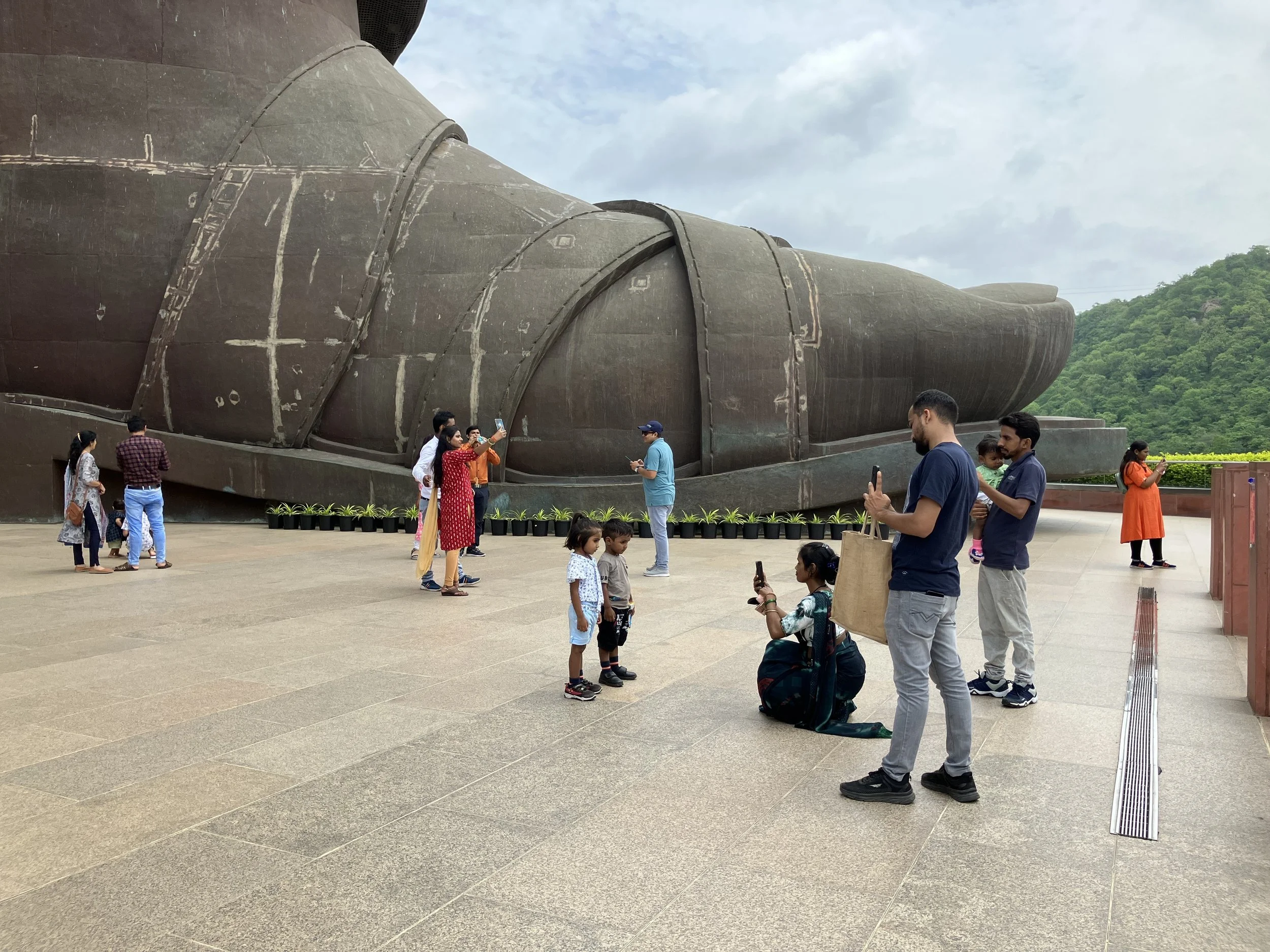
Image by the author (at the Statue of Unity, Gujarat, India)
Mise-en-scène
I explore these propositions with some recent instances of what we might think of as political mise-en-scène, borrowing from cinema studies this term for what Adrian Martin calls “the art of arranging, choreographing and displaying,” of which “an essential part … happens in what is staged (predominantly, actors in an environment) for a camera.” While notoriously ambiguous in its limits and definition—whether it extends beyond just the profilmic event to camera movement, editing, special effects, and everything the director does—mise-en-scène speaks to the production of environments for the camera. (I prefer the term mise-en-scène to scenography, because of this association with the camera as well as live performance.) This is the condition of many physical spaces in the age of digital photography and social media, and to a lesser extent since the early days of photography (as described by Elsaesser, Nastasi and Ponzini, and Wagiri et al). Further, mise-en-scène attends to control over the movement of bodies through space in the service of a narrative but also, crucially, in the service of conjuring style and atmosphere.
If Butler’s “the” media in the space of appearance feels like a throwback to “the” public, “the” camera of mise-en-scène is treated as singular by political scenographers even as it is dispersed across multiple loci and agents of image production. This duality—what Michael Sorkin, in the context of the globalized, electronic city as theme park, called “a universal particular”—speaks to the homogenization of image genres through mass circulation and the determining affordances of media technologies and distribution platforms. Sorkin, writing in and of the early 1990s USA, suggests that “Cyburbia,” like the sanitized theme park, is a “substitute for the democratic public realm”. As he famously wrote, “…there are no demonstrations in Disneyland.” The political mise-en-scène I describe here shares many features with analyses of Cyburbia/Disneyland, but three decades later, from a location in the global South, and in light of the alternative genealogy of democracy outlined above, there are significant differences. First, political mise-en-scène is explicitly a modality of the state in the service of capital, consistent with the deepening and normalization of populism in neoliberal regimes. Second, virtual sociality as well as control and surveillance by the state and corporations have intensified well beyond anything anticipated at that time; in that sense every location is a potential mise-en-scène. Third, perspectives from Black, Indigenous, and postcolonial scholars have shown how approaches to the value and affordances of land must treat capitalism’s economic operation as one of social as well as economic discrimination and exploitation, as with racial capitalism. In that light, as Rebecca Struch points out, Sorkin’s nostalgia for a lost public realm is misguided, for that realm was itself founded on theft and structural oppression. Fourth, uneven development’s clearer visibility in the global South helps attune us to non-linear temporalities of technologies, media, and social forces – including the ongoing force of “religion” – where new forms, including social hierarchies and forms of exploitation, are layered onto and interact with existing ones. And fifth, related to the trajectory of development in the global South, the scale of this mise-en-scène extends well beyond the city, as transport infrastructure—particularly highways in nations like India with burgeoning auto industries, airlines, and ports—ramps up alongside urban penetration at a regional and national scale. The polis is not just the city.
Mise-en-scène joins surveillance and spectacle as an analytic of the state’s image-power – which is also to say, in neoliberal dispensations, that of the corporations that back the state and vice-versa. Or rather, it combines these analytics, for here the spectacle of power accompanies the disciplining of bodies. But in attending to the “backdrop” of the photographed or filmed image as one of its platforms, supports, or conditions of possibility, mise-en-scène goes beyond operations on human subjects to the radical reshaping of land at scale, or terraforming, which affects humans in other ways. So the stakes of identifying these virtual-actual circuits include the extractive reshaping of lifeworlds and cosmologies that continues even as political projects, cynical and sincere alike, explicitly bring ecology into their mediated ambits. We know that the Cloud where our selfies go to die has consequences for the clouds, just as we know the corporations force-feeding us AI are adding petrol to the pyre of our burning planet; we can add terraforming to the list.
The Case of Ekta Nagar
An instance of political mise-en-scène that speaks directly to these concerns is the tourist corridor around Ekta Nagar (literally Unity Town, formerly Kevadia) in the Indian state of Gujarat, the heartland of Prime Minister Modi and the Hindu nationalist Bharatiya Janata Party (BJP). This corridor is being developed around the Sardar Sarovar mega-dam on the Narmada River that Modi inaugurated in 2017. The highly controversial dam displaced at least 32,684 families, most from Adivasi (Indigenous) communities inhabiting the densely forested area. Looking out over the dam is the world’s tallest statue, a 597 ft. figure of nationalist leader Sardar Patel titled the Statue of Unity, a pet project of Modi that he inaugurated in 2018. This features a wildly popular 3D projection mapping show on its surface that requires visitors to stay in the area overnight: an event situated in the space-time of leisure that maps onto the space-time of the nation. Many relay the show to relatives and friends via social media (mostly WhatsApp), as well as images of themselves in the multiple “eco” themed attractions that stretch around the dam and statue into the Narmada valley. These include close to a dozen themed gardens, from the Arogya Van that showcases Indic (read exclusively “Hindu”) wellness systems to an inorganic Disneyesque Glow Garden; the “Jungle Safari” zoo; outdoor “eco” adventures; and a spectacular evening prayer to the river. Here “nature” is reconfigured with a spiritual, ethical, and nativist charge consistent with the biopolitical makeover of Hinduism that grounds Modi’s techno-sacred authority. The area is still developing; currently in the pipeline (in 2025) is a 135 km. “eco-corridor” along the riverbank. This is not a wildlife corridor but an “ultramarathon trail” for humans.
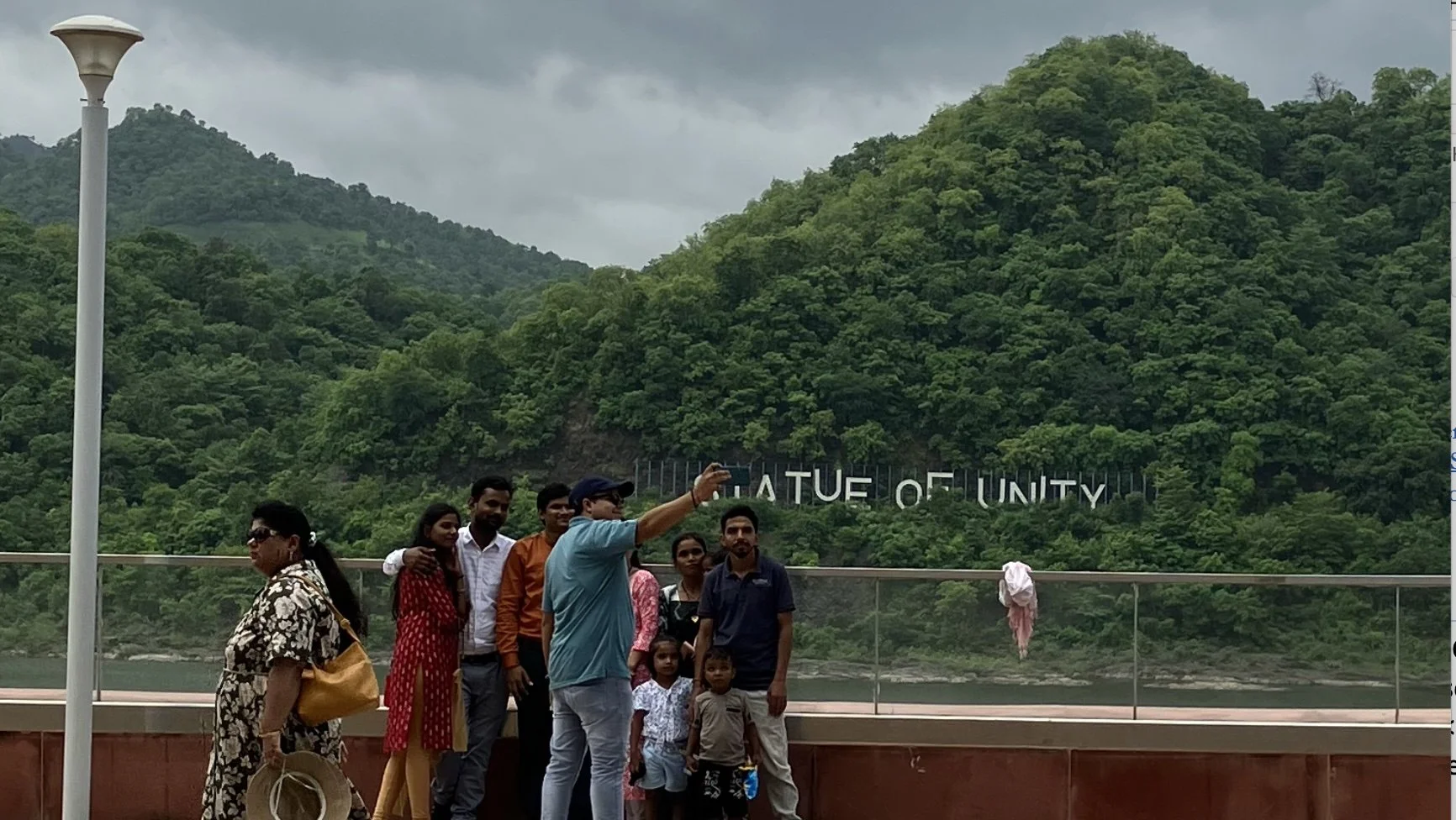
Image by the author (at the Statue of Unity, Gujarat, India)
These attractions, along with the statue, the upscale museum at its base, and the tourist infrastructure of hotels, restaurants, and other services, retool both colonial technics and precolonial cosmologies in ongoing territorial penetration and dispossession of the six remaining Adivasi villages and their forest environs. The villagers, deprived of the gardens and river that were their livelihood, are contracted to the tourist industry as guides, drivers, cooks, mechanics, plumbers, masons, and – yes, gardeners. The terraforming here extends beyond the dam and the attractions to transport infrastructure for accessing them, including connecting the island on which the statue stands to the road along the riverbank. Locals say the statue is built on top of an Adivasi devasthan or shrine; this is a spatial expression of the site’s racial capitalist project, aimed at “civilizational” as well as technological development. Only state and VIP cars are allowed in the area, enabling tight control over visitors’ movements via designated buses, “e-rickshaws,” elevators, escalators, and moving walkways. These last shore up an embodied experience of globality, which for some requires instruction from the (mostly Adivasi) visitor experience personnel. These restrictions also make visitors a captive audience for the ubiquitous road signage that presents Modi as the host of their experience. This choreography is frequently punctuated by much-used designated “selfie points” – in India “selfie” has become synonymous with photography, given the near-concurrent introduction of cellphones, digital cameras, and social media. Other features are also clearly intended as photographic backdrops, like the letters on the hillside opposite the statue that spell out “Statue of Unity” in the manner of the iconic Hollywood sign (used as an establishing shot in many LA films). This, then, is explicitly a photographic/cinematic mise-en-scène for producing global-yet-local selves on social media.
This space is one of a certain kind of appearance, not primarily that of plural others encountering one another within it but of those already networked beyond it. Despite the keen agglomeration of footfall at this physical site, it departs significantly from the features of Arendt’s idea of public space as Hans Teerds glosses them: “freedom, motion, relationships, plurality, and unpredictability, which are all included in the possibility of appearance to one another.” Visitors are unified in nationalist capture while watching the 3D projection mapping show on the statue, echoing each other’s cries of “Bharat Mata ki jai” (hail mother goddess India) as their phones transmit both spectacle and response to distant others. That other, virtual space—the space of WhatsApp groups, Instagram reels (after TikTok was banned), YouTube videos, and X or Facebook posts—becomes a key mediator of how political potentials develop and retranslate into embodied action. This is not merely a matter of the transposition and extension of physical presence, for as we know virtual spaces are modulated by code with its illusory sense of agency, and by hashtags, likes, and algorithms that reinforce existing inclinations and networks. Platforms and bots participate in virtual publics, as do armies of embodied trolls employed by the BJP and others. In this social media ecology, embodied experience is highly scripted, both by the site’s choreography and by the conventions of social media imagery. This is not unlike the earlier (and still extant, though rare) photo studios as theatres of dreams described by Chris Pinney and others, where photographs are vehicles of social aspiration. As in the photo studio, visitors draw on a mostly given vocabulary of poses and gestures to take turns being photographed in the same designated spots, staging themselves for this space and occasion in singular-yet-generic styles – with cool sunglasses, trendy hairstyles, hats, boots, flowing dresses, careful makeup, matching saris, bridal jewellery. Just as the land is terraformed for the camera, people produce their appearance for this mise-en-scène. Even in this scenography of (physical) atomization and attempted capture, as expressions of aspiration, self-respect, and presence these acts of photography are moving to witness, for they stage a claim to futurity, a call to recognition, and the verification of equality at the heart of democracy. But is this equality if it does not extend to those whose lands provide the backdrop for these acts, and whose bodies serve as their infrastructure?
The Corridor
Unlike in the photo studio, the backdrops around Ekta Nagar are not obviously crafted, modest, and temporary, but naturalized, literally writ large on the landscape. Also, more akin to cinema, there is movement involved, both at each attraction and along the river valley “corridor”: by road, rail, boat, a now-defunct seaplane. The roads, the river, and the paths through the attractions function like camera tracks, as bodies behind, before, and beyond the camera move through this ribbon of scenography that is at once backdrop and spectacle.
The corridor form as a developmental unit is as ambiguous in its character and scope as mise-en-scène. The term implies a space of connection whose raison d’être is getting things or people from one place to another, and in this sense it is a key element in urban and—particularly since the 1990s—regional planning. Its large-scale, top-down restructuring of spaces and populations to facilitate growth is often associated with imperialism and extractive geographies. But while the Narmada valley “tourism corridor” is an instance of the latter, it is not so much about speedy transfers between points as it is about engaging with, and moving within, the corridor space. Or rather the speedy transfer is a communicative one, echoing the origins of “corridor” in the 14th century Italian corridiore, an “unobstructed path built immediately behind defensive fortifications to ensure that messages could be conveyed quickly” (emphasis added). The corridor as mise-en-scène is at once a means of primitive accumulation and an efficient media platform for the interpellation or hailing of bodies by the state and its corporate partners: a thin strip of space optimally engineered to serve as backdrop, spectacle, and real estate for tourist and other infrastructure, along an avenue of mobility and development that doubles as a camera track.
The corridor is a key element in Modi’s formal vocabulary as a canny aesthetico-political actor (an actor best understood as an assemblage functioning in his name), and features at several other sites in India. The much-hyped 2021 Kashi Vishwanath Corridor in his constituency of Varanasi has further catalyzed plans for a spate of Hindu “pilgrimage corridors,” many along sacred rivers, that will combine religion, cultural heritage, and recreation. Its Gujarati architect, Bimal Patel, also designed the controversial Central Vista Redevelopment in New Delhi that is putting Modi’s stamp on a key scene of politics: India’s Parliament building and state administrative offices. Another Bimal Patel corridor, started in 2005, is the Sabarmati Riverfront redevelopment in Gujarat’s largest city, Ahmedabad. Its stated aim is “to provide Ahmedabad with a meaningful waterfront environment along the Sabarmati River and to redefine an identity of Ahmedabad around the river” by removing putatively polluting “informal squatter settlements.” Critics construe this as displacing vulnerable populations for gentrification and real estate development. Here again communicative aspects—meaning and identity—are foregrounded, as the caste-inflected religious and moral values of purity and pollution are made over in the biopolitical language of health and hygiene.
The Sabarmati Riverfront project was enabled by the Narmada Canal, fed by the Sardar Sarovar Dam (described above), which has converted the Sabarmati from a fluctuating, monsoonal river that dried up in the summer to a bounded, perennially flowing one. If Ekta Nagar’s “eco”-themed attractions are directed at the health, recreation, and interpellation of tourists at the expense of other lifeworlds in the Narmada valley, the Sabarmati Riverfront is implicated not only in that process but also in the displacement of at least 14,000 households (the official figure) and the destruction of other lifeworlds and ecologies: textile dyeing and block printing; farming and markets in the dry riverbed. Displaced dyers must work downstream where untreated sewage is released into the water, while other residents of Ahmedabad now jog, walk, bike, boat, and take photographs along the river. Citing its many environmental and social critiques, a 2018 report sounding the alarm at plans to introduce a similar project for Lucknow’s Gomti River called this a ““Selfie” model of development” that was thought to win elections due to its role in Modi’s success in 2014.
Bearing out this moniker, the Sabarmati Riverfront Flower Park, inaugurated in 2016, features backdrops for photography where a cycle of coloured lights projects onto just over human-size walls. The entire area feels like a cool but disturbing contemporary art installation (of course, art installations are also prime subjects for social media photography, as are the museums that house them). At one end is “the Iconic [sic] Atal Bridge” (again, the official website highlights its function as an icon), a futuristic pedestrian bridge inaugurated in 2022 whose colourful illuminated geometrical members are visible for kilometres up and down the river. The name invokes former BJP prime minister Atal Behari Vajpeyi, but atal also means unmoving, permanent – a pointedly territorializing term. Again, this bridge does not meaningfully connect spaces as it is not really used to go anywhere; its primary function is as mise-en-scène. Not only is it the perfect photo backdrop, but it also provides its visitors with a gentle soundtrack of nationalist theme tunes. The space sutures together a range of scales of experience for subjects’ performances of style and presence, to be amplified and virtualized via social media: individual, familial, urban, regional, national, and – in the technological illumination and insistent cleanliness of the space – global. Here lighting is both a key component of cinematic mise-en-scène and itself a peculiarly efficacious index of technology and hence globality, becoming a pervasive decorative feature of Indian cities in the early 21st century. This aesthetic enthusiasm anachronistically echoes the introduction of public electric lighting in the early 20th century, much like the excitement at India’s moon landing in 2023. Such signifiers of modernity establish belonging to a global order, even as they reinscribe developmental belatedness. Spun in social media’s echo chambers they exert an uncanny imaginative force, as do terraforming projects in the Modi oeuvre like bullet trains, mega-dams, stadiums, and statues, all aimed at world-record-breaking scale.
Apartheid
This, then, is how mediated circuits of actual and virtual bodies literally “hit the ground” in one kind of choreographic oeuvre, one genre of political mise-en-scène that modulates and supplements spaces of appearance via invitations to embodied style and presence within theme-park-like, propaganda-heavy communicative environments. But clearly there are also other types of spaces and choreographies that have raisons d’être other than racial capitalist primitive accumulation and interpellation into an exclusionary-yet-global nationalism. These are also struggles over space in which mediated and embodied publics play a part, and which come into mimetic relays with dominant forms, but they are of a different order. For in situations of social apartheid where spatiality is itself the ground of oppression, the sheer occupation of a space by historically excluded bodies—the assertion of the right to be there, to be citizens and constitute a public—is a performative act beyond any specific claim or demand being made in that space. The right to be present, to be seen and heard, touched and smelled, is the demand, or rather that right is verified in the act of taking up space and time. The very habitation of a space-time in common, and the unmasking of injustice via others’ resistance to that habitation—which is to say an engagement with others, albeit conflictual and often violent—makes it a space of appearance, of dissensus, of politics, of emergence.
This can be said of the 1927 Mahad and 1930-35 Kalaram satyagrahas led by BR Ambedkar where “Untouchables,” as colonial law called Dalits, respectively sought to draw water from a public tank and enter a temple, both with violent savarna reprisals. The same goes for the controversial monuments built by Dalit-Bahujan leader Kumari Mayawati in her tenure as Chief Minister of Uttar Pradesh off and on between 1995 and 2012, for which she was reviled by right and left alike across media platforms. As I have argued elsewhere, these state-sponsored monuments might resemble imperial or fascist complexes, and do in fact draw on the architectural idioms of earlier—pointedly non-“Hindu”—empires, but their will to occupy space is different: they are spectacular enactments of a thus far structurally occluded presence. In contrast to the verdant, nature-themed, virtue-signalling yet extractive attractions around Ekta Nagar, their extensive use of stone anticipates neglect by later regimes, the horizontal territorial excess of their relentless “hardscape” spreading over the ground in a poignantly impossible bid to compensate for all the spaces and times of Dalit-Bahujan exclusion. Mayawati took what she knew could well be a fleeting opportunity to create spaces for and of the bahujan (the numerical majority) that presume them to be the sarvajan (everyone, the all, the people or public).
This massive bid for permanence inevitably had a terraforming aspect: Mayawati’s Ambedkar memorial in Lucknow started as a 30-acre project in the Gomti river’s flood plain before expanding to its current 150 acres and adding to the considerable existing stresses on the river. But its health-giving aspects for human life also extend beyond individual bodies to the social body as a whole. If it has become a Dalit-Bahujan pilgrimage site on annual occasions like Ambedkar’s birth and death anniversaries, it is also a major tourist attraction and a space for locals across castes, classes, and creeds to cohabit, thronging on summer evenings to take the air and make photographs in its splendid, dramatically lit, inspirational mise-en-scène. Multiple event rhythms run through this site and, accordingly, on social and other media. If savarna disquiet at this claim to space fed a crisis machine on mainstream and social media during and after the building process, Mayawati was the one stoking this display of antagonism by apparently wilfully chopping and changing the site’s design. This is a different approach to media than designating selfie points: a dissensual “labour of the negative” rather than interpellation into embodied consensus. Meanwhile, the annual Ambedkar pilgrimage cycle mimics the time and form of religious festivals, particularly public procession, maintaining the Dalit-Bahujan claim on this public space. And in the space-time of leisure, the site’s embodied enactment of co-presence in a space marked as Dalit-Bahujan (rather than overarchingly national) breaks through the caste regime’s sensory status quo to make its way into a gradual transformation of what Gopal Guru and Sundar Sarukkai call the “everyday social.”
I would speculate that it is the centrality of space and touch to the caste sensorium that has given spatial dissensus such force and such an extensive vocabulary in South Asia, even as spatial apartheid is hardly unique to that context. In the sensible regime of caste, spatial inclusion and exclusion are an extension of the moral schema of purity and pollution undergirding untouchability, where arguably all the senses have operated as forms of touch. But spatiality has been key to democratic participation everywhere, following various organizing logics of staging that either reinforce or respond to specific modes of exclusion, as with the polis. Even within South Asia, these logics are not reducible to caste. The 2019-20 protests against the threats to citizenship status posed by the Citizenship Amendment Act (CAA) and National Register of Citizens (NRC) at Shaheen Bagh took the form of a sit-in led by women, many of whom invoked their role as mothers and grandmothers in a claim to generational belonging in the nation-space; the presence of children was notable here. In another choreographic logic, the farmers’ movement rematerialized the dependence of the city on the countryside by setting up habitation on the outskirts of Delhi and staging a tractor parade, bringing villages to the city. But this was not the logic of the trucks in Canada’s 2022 “Freedom Convoy,” whose roadblocks protested the public health driven interruption of cross-border supply chains during the COVID pandemic (in the name of a “free trade” whose semblance has since imploded). Similarly, the developer-led public art projects proliferating in North America in the name of creating “community” but ultimately serving exclusionary gentrification and consciously targeting social media are quite different from the art at Shaheen Bagh.
In all these instances, it is not so much the forms occupying the spaces that have valence in and of themselves—green spaces, sacred rivers, corridors, stone monuments, trucks, art—but their expression of the forces embodied in that occupation. As our interface with the world is increasingly virtualized and apartheid becomes everywhere more naked, we cannot forget that in democratic struggles actual spaces and bodies have always been in efficacious circuitry with virtual or imagined ones at various scales: nations, regions, cities and countrysides, global alliances. This is a dialectic at the heart of publicness that will keep space in the picture so long as it is a ground of exclusionary organization and a source of value that is subject to occupation and capture. We would do well to attend carefully to operations of everyday capture and dissensus—mises-en-scène—in choosing how, and whether, we participate in them, and in making other spaces that nurture life rather than extinguish it. In doing so, we cannot advocate a return to an idealized but in fact exclusionary prior state of nature or community, seeking out instead the conditions for emergence, preparing for the violence attendant on dissensus, and retooling our senses of space and performance as we have our sense of sight.
Kajri Jain is Professor in Art History and Visual Culture at the University of Toronto, interested in how the efficacies, affects, and values associated with images arise not only from what goes on within the picture-frame but also from the production, circulation, and deployments of images as material objects. She is the author of Gods in the Bazaar (Duke 2007) and Gods in the Time of Democracy (Duke 2021).