Influencers and the Changing Political Landscape of India
Joyojeet Pal
“Technopolitics of the Global South" is a modest proposal for naming an aggregator site of new and relevant research that can easily be lost in one disciplinary silo or other. This occasional series on Borderlines inaugurates an effort to connect questions regarding contemporary political forms and practice with numerous other intellectual vectors, of data and digital colonialism, computing from the South, platform imperialism, and mass mediation.
This inaugural dossier begins with introductory framings by Arvind Rajagopal and Francis Cody. This is followed by a set of reflections from Shahrukh Alam, Kajri Jain, Shubhangi Heda and Ishita Tiwary, Anustup Basu, Joyojeet Pal, and Mehak Sawhney.
Introduction
What does a prime minister do on LinkedIn, other than protect their username from doppelgangers? Why would it be worthwhile listing one’s achievements at the various political and administrative offices one has held if the overwhelming number of your voters have not heard of a social media platform? Clearly, the hope to get the eyes of the next employer is not in the offing, even if Bangladesh has a potential vacancy.
The reason is closer to what Modi has turned into a personal brand in the last decade—to be an influencer in whatever space allows that. Aspirational young urban Indians use LinkedIn to signal their openness to being hired, to painstakingly generate the right text to describe every worthwhile detail from every job or educational experience. With professionally written, clear descriptions of the work done in every political and administrative position, Modi emphasizes to his viewers that just like his young voters, he stands on his achievements. Social media helps articulate the narrative of professionalism; his summaries present as evidence of why he deserves the job that his main rival scores through his lineage. Most important, his being on LinkedIn confirms what every other platform already knows—from the moment Modi graces you with his presence, he is an influencer for your users.
Modi has roughly 100 million followers on each of Instagram and X, another 50 million on Facebook. His YouTube channel has over 30,000 videos and hundreds of playlists, carefully curated and updated, making him one of the most important social media influencers in India. Modi is on Pinterest and has a WhatsApp channel, a well-curated and regularly updated website, and a Spotify channel, and he is even one of the few global leaders who have an account on Donald Trump’s platform Truth Social.
While much has been written about Modi’s own branding and his own use of social media, less work has engaged how his ecosystem and his leadership of online social media have provided a configuration for influencer culture more broadly in India. In turning social media influencer, Modi led the path for rethinking what it means to be a politician who just happens to be a man for all seasons. When the one packaged to lead by example is the influencer-in-chief, the currency for public engagement is measured and articulated by new rules. What one did through mainstream media interlocutors, one can and should just do themselves. What one did in building alliances, dependencies, and contingencies in mainstream media is now irrelevant because a much more pliable alternative to the Fourth Estate is possible.
Modi’s switch to online alternatives and away from direct engagement with journalists to avoid public confrontations and better manage his brand and narrative online would end up being the standard for Indian politicians across the board. When Modi started swapping interviews with journalists for those with influencers—first celebrities, then social media influencers, he showed other politicians not only that this did nothing to dent his credibility, but, more important, it expanded his reach to new populations. Within one general election, pretty much every major politician in India started following his lead—and every serious political campaign manager started offering up influencers as part of their outreach services for politicians. And soon enough, the West learned too. By the run up to the 2024 US general election, pretty much every Republican primary contender did their outreach through podcasters and YouTubers, some even launching their campaigns on social media.
Influencer as Interlocutor
In 2012, Narendra Modi hosted his first public interaction with citizens moderated by Hindi movie action film actor Ajay Devgun in what would come to be associated with his style of communication for years to come. The interaction was touted as a massive success, where citizens were able to directly ask the leader questions, and Devgun played the role of a gentle supporter rather than the aggressive interrogator that a political journalist may have been. For much of his first term in government, Modi had little if any engagement with mainstream journalists, and his first major televised interview prior to 2019 was with another film star, Akshay Kumar. Like Devgun, Kumar was an easy interviewer—he asked questions that helped humanize the leader, was careful not to let his stardom overpower the engagement, and, most important, allowed Modi to seize the moment. But while sharing screen with a major film star may have been valuable in getting an interview out, Modi didn’t need a movie star to bring him front and center. He was without question a bigger crowd puller than just about any movie star in India, especially online.
The presence of social media influencer interviews was ubiquitous in several of the elections that took place in 2024. In the US, both the Democrats and Republicans had separate setups for social media influencers in their pre-election conventions, and the takeover of Twitter by Elon Musk completely changed the influencer balance in favor of Trump. In the German 2024 elections, both far right and far left candidates were for all practical purposes influencers themselves, and indeed Musk himself did an interview with the far-right candidate Alice Weidel. In Indonesia, old political hand Prabowo Subianto, otherwise thought of as a stern politician, redid his image on Tiktok as a friendly grandfatherly politician along with his running mate Gibran Rakabuming Raka, while in Ghana, John Mahama changed the flavor of election outreach by starting "Mahama Conversations’ on Facebook live to reach his constituents directly,
Unlike traditional celebrities like film stars or sportspersons, social media influencers have no legitimacy outside their online persona. While film stars have to balance the tension of losing fans who may take umbrage to their actors’ political choices, influencers already understand their audience well and know whether a political endorsement is valuable. The pure influencer is unlike the film star, whose decisions could cause heartache or financial pain for a producer with millions at stake for past, present, or future productions if they get cancelled, or worse, a sporting superstar, who could quite simply find themselves eased off a national team by a government authority. The influencer produces their own content and does so fast—they can be nimble with their audiences, and indeed change who their audiences are in a way that a mainstream film or sports star simply cannot.
By the 2020s, India had the highest number of major influencers, measured across multiple platforms and above all on YouTube. Having cut its cord with the West, the phenomenon had moved toward India, where it was already clear that YouTube and other streaming platforms were posing a major challenge to mainstream television and radio news. Television anchors who were either marginalized on networks or sought their own voice were starting their own YouTube channels; at the same time, mainstream television increasingly looked at what worked online to decide what to show on networks. The Indian influencer space included not only content creators who serviced the media needs of what advertisers typically care for the most—young urban upper classes—in fashion, technology, and lifestyle, but also included creators from across India’s class spectrum as mobile phones got cheaper and audiences expanded. Creators made niches in agriculture content and a massive variety of food and travel content; older adults were doing arts or commentary, and domestic workers were giving viewers daily insight into their work. This new spread of social media influencers also included people from across the political spectrum—unlike a television anchor or a doctrinaire commentator whose audience’s political leaning was already known, influencers with niche followers offered entirely new possibilities of reaching out to political fence-sitters. They also offered two other advantages: first, influencers were rarely trained in policy or able to push politicians on their claims; and second, in the casual settings that influencers set up, a politician could appear a lot more relatable than they did as talking heads on television.
Influencers and Polarization
Data on influential Indian accounts on social media have shown a few interesting trends that help understand the relationship of a certain kind of media production with polarization. Using data from four sets of social media accounts on Twitter (prior to it becoming X), my research team examined the extent to which various groups were polarized as measured by politicians or handles from which political parties retweeted their content [Divided we Rule and Political Interviewing on YouTube] (see Figure 1). Essentially, this measure of polarization asked, if an account is engaged by politicians, how partisan is that engagement?
First, there is a clear movement of Indian media houses toward one or another extreme in terms of who engages their content. Media sources are as polarized in their appeal on Twitter as they are on mainstream television—thus ANI, Republic, and OpIndia, among others, find themselves highly polarized on the Bharatiya Janata Party (BJP) side of the spectrum, while sources like NDTV, Newslaundry, and BBC are on the exactly opposite end of the spectrum.
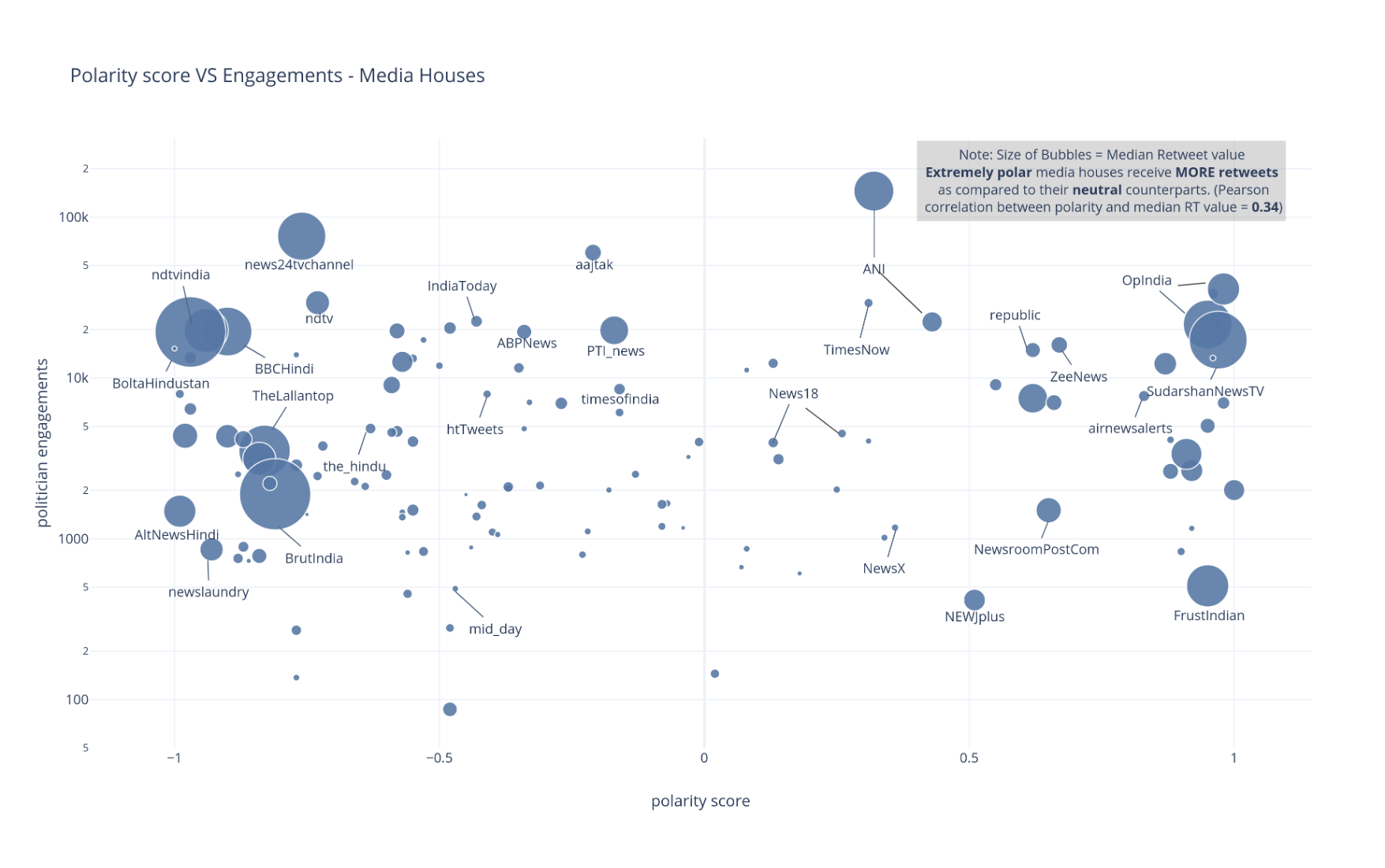
Figure 1: Polarization of Indian media houses [from Political Interviewing on YouTube]. Each account was assigned a binary polarity score based on the number of retweets by the Twitter accounts belonging to party members or official accounts belonging to the ruling party coalition (+1) or all other parties (-1)
More important, the most polarized news sources also get more political engagement. Interestingly, individual journalists’ accounts are more polarized in terms of who consumes their content than the accounts of media houses themselves. Thus, we see in Figure 2 that journalists from the same media house—Rajdeep Sardesai, Rahul Kanwal, and Gaurav Sawant—place very differently, from left to right on the spectrum, suggesting that Sardesai overwhelmingly gets his political endorsements (retweets) by opposition politicians, Sawant gets his endorsements from the ruling party, and Rahul Kanwal gets engaged from both sides.
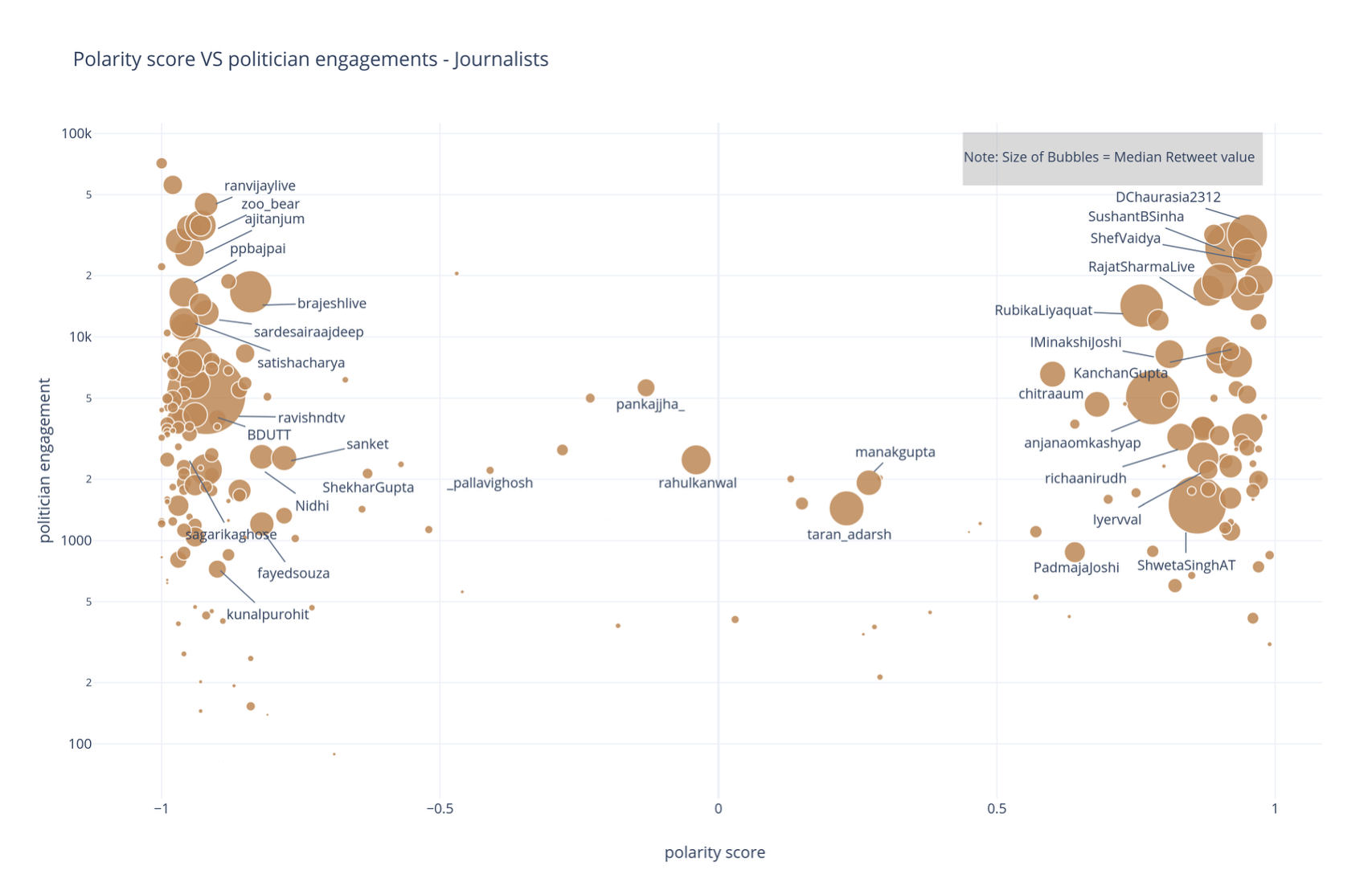
Figure 2: Polarization of Indian journalists and commentators (-1 = engaged solely by opposition) [from Political Interviewing on YouTube]
Outside of news organizations, we found that mainstream celebrities on Twitter were also polarized, but slightly less than journalists. The single category that saw the highest level of polarization was digital influencers. This does not mean that influencers are in and of themselves polarized a priori, but rather that when an influencer gets political engagement, it is likely that most such engagement will come from a single party or ideological bracket (Figure 3).
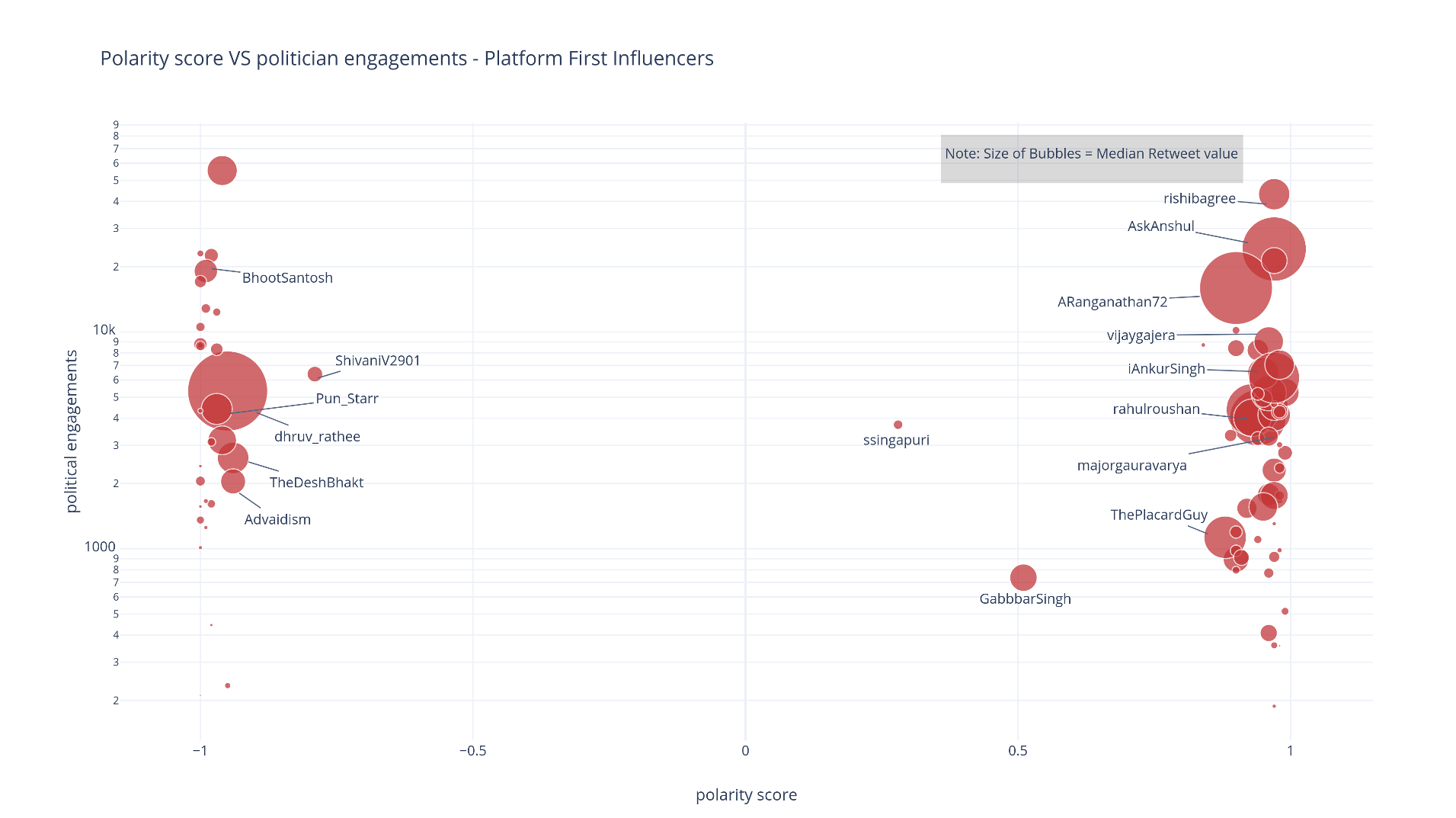
Figure 3: Polarization of Indian digital influencers on Twitter (-1 = engaged solely by opposition) [from Political Interviewing on YouTube]
In a nutshell, we found that influencers who are categorized as “online first” were much more likely than mainstream celebrities, television news, or journalists to put out more polarizing content. Now, it is important that the data do not show that influencers are polarized in general, but rather that those influencers who get aligned with a political side tend to then be almost exclusively on one side of the spectrum. While we cannot speak to the direction of causality, what we can say is that those influencers who go down the path of political engagement often turn into spokespersons for one or another side.
Mechanics of Influencer Engagement
The expansion of the social media industry in India has been one of the main reasons for the increase in politicians’ engagement with influencers. Alongside the increase in influencer management companies, there has been a corresponding increase in the number of organizations that help manage politicians’ social media and campaign strategies. From politicians standing for small municipal elections all the way up to those in the national cabinet, the typical social media team ranges from a single person to a diversified team with a few dedicated members for each channel a politician is on.
Social media campaign agencies typically keep track of the various influencers on the ground for three key factors—what they cost, what segment of audience they reach, and what the ideal format is for optimal engagement. Smaller influencers typically take a flat fee, similar to what they may charge with a commercial product, whereas the highest-level influencers often do this for no monetary remuneration. This may seem counterintuitive, but the influencers who have millions of followers need to be cautious about where they engage in paid partnerships, and they may also recognize that other benefits of aligning with a politician sometimes matter more than the cash amount of a single engagement.
The data from Twitter also show that there is a measurable uptick in engagement when an influencer gets engaged by a politician, for both parties. Small influencers, typically in the range of fewer than 100,000 followers on platforms like YouTube and Instagram, may do a political engagement for as little as the equivalent of US$100 for a short media item, while a major influencer may demand as much as US$20,000 for a one-on-one interview. More often, though, such engagements end up having no cash exchanged because the influencer is happy to do this for the exposure.
Second, in terms of the segment of audience, a politician’s social media consultants do not pick influencers purely based on the existence of potential voters in their following. The more important element with an influencer is the fact that they have media reach and that the engagement itself may lead to second-order effects. Thus, an influencer whose content gets circulated through local WhatsApp groups or someone who typically makes the mainstream media news may be more valuable than an influencer who directly aims to reach a politician’s base but does not get circulation in the mainstream media. Essentially, the influencer then opens up new voter markets for the politician.
Third, in terms of the format, there is a fairly wide range. An influencer with moderate following or brand attention may simply agree to run a politician’s content as provided by the politician’s social media team, whereas an influencer who is more careful about their brand and the tone of their content output will put conditions on how a politician’s engagement would play out on their channel. Some influencers with a very specific content format and branding may insist that the engagement happen on their terms—such as in their studio or with particular kinds of questions they ask, so that it does not feel at odds with their typical output. For instance, when travel and lifestyle influencer Kamiya Jani, who runs a channel called “Curly Tales,” does interviews with politicians, they are typically asked to do outdoor shots, eat on camera, and talk about their travel and food preferences, whereas some influencers may be asked to conduct the engagement at premises preferred by the politician.
On the influencer’s end, there is a fair amount of agency in choosing whether to get involved in the enterprise. Outside of the pure financial considerations, certain influencers’ format allows for easier segue into political interviews, especially if they do studio interviews as part of their regular output. Other factors an influencer’s team needs to consider are whether the length of an interview or engagement is aligned with what they typically produce; the influencer has a trademark style—casual, combative, funny; and most important, whether the audience of the influencer is pre-disposed to engaging the political content.
Influencers’ Political Engagement in the 2024 Campaign
The 2024 General Elections in India saw a massive involvement of influencers on YouTube. Research on the spread and content of influencers’ involvement in political interviews showed that while the YouTube handles of mainstream media channels featured interviews of politicians toward the end of the campaign cycle, influencers interviewed politicians more evenly throughout the year. One interpretation of this is that mainstream news is more likely to be interested in politician interviews closer to the end of the campaign, when they are more newsworthy, whereas influencers may choose to integrate politicians into their content as appropriate at any point. Another interpretation could be that the work of party propaganda is a slower process that must happen more consistently through the year and can be done independently of the voting cycle, whereas election-specific campaigning makes the most sense when parties declare their candidates, which happens only within a few weeks of polling dates.
Of significance for campaign offices is the finding that influencers are far more successful at getting eyeballs than mainstream or digital news. Influencers also understand the medium—the long form interview that a politician does may have several shorter clips spun off into viral videos that can move from YouTube to other platforms. When a politician engages with an influencer, their party’s social media ecosystem will also enter the fray, helping boost the messages to their networks, and by extension, bringing new viewers to the influencer. Figure 4 shows the range of views that political interviews got from a selection of influencers and mainstream media channels and we see that influencers massively outperform mainstream media channels.
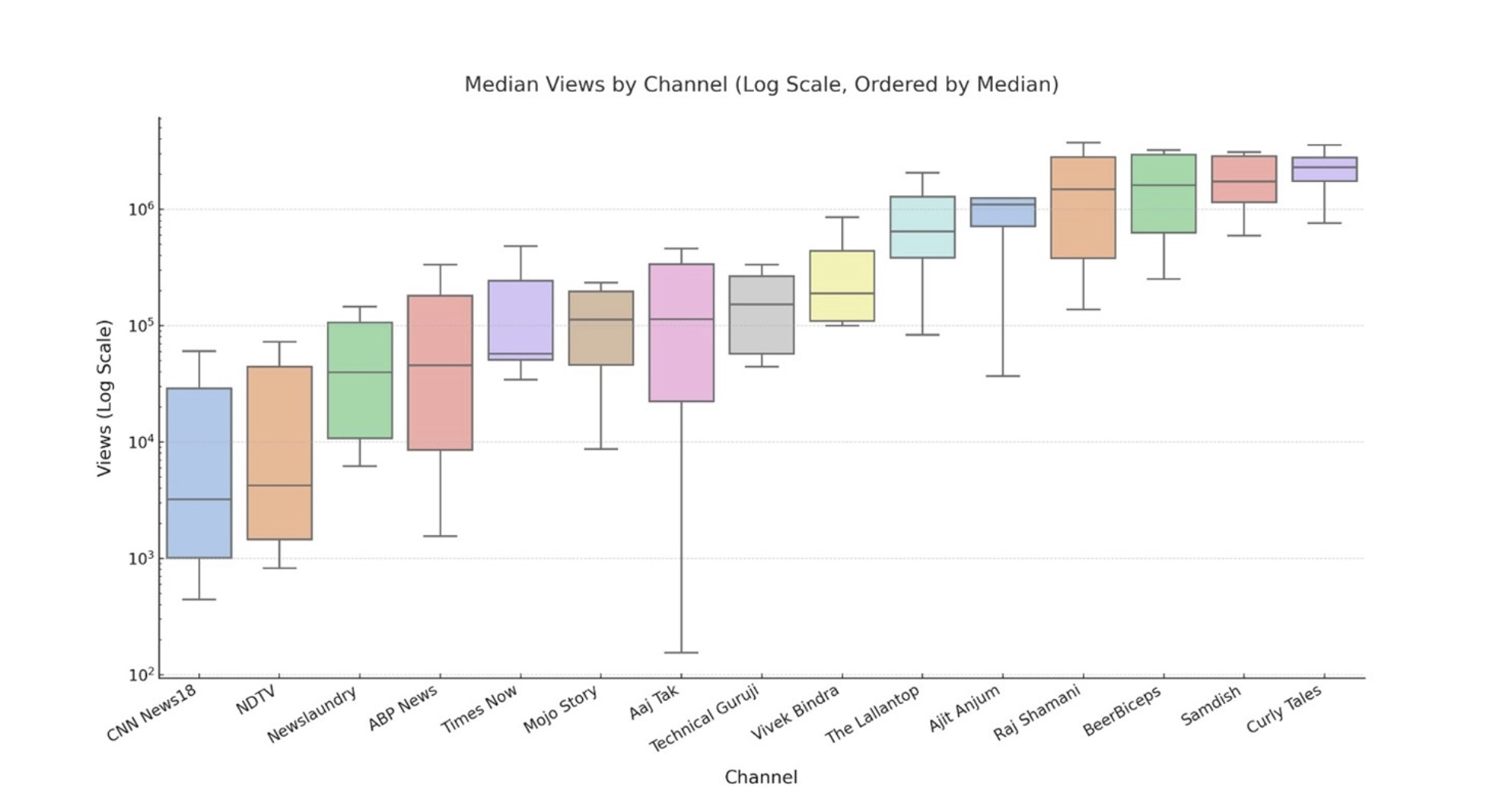
Figure 4: Boxplot shows views of political interviews on YouTube by various channels that interviewed Indian politicians in the 2024 election cycle
Figure 4 is log scaled; in essence the YouTube channel of influencer Curly Tales averages over 500 times the views that an average politician’s interview does on CNN-News18. A range of factors impact this, most important being the choice of politician and the effort of outreach by the influencer. The influencers listed here are all high-level influencers with millions of followers, thus they have the ability to choose to engage only with those politicians who they feel will be valuable to their bottom line. However, the data show that when the same politician did interviews in multiple channels—news and influencer channels—they got massively more eyeballs when the interview was with an influencer. In a nutshell, the YouTube channels of influencers who were unknown a few years ago are consistently more valuable than those of global brands in political news.
In 2013, Modi was the only prominent politician eschewing the mainstream media. When he switched off from doing interviews with political journalists, it was still a point when the decision was not without detractors within his own party. Modi also never held a press conference, which is a first for an Indian prime minister.
By 2024, hundreds of politicians invested in influencer interviews; many had stopped talking to the press altogether. What we are seeing is not a trend, but the shape of things to come. But another thing had changed since 2013. While the pre-Modi era featured a range of celebrities and influencers on all sides of the spectrum willing to engage on political issues, the space for dissent had grown increasingly thin. In 2024 only one major influencer was consistently engaging politicians from opposition parties, while the overwhelming majority of big-ticket influencers were better off playing it safe and solely talking to members of the ruling party.
Conclusion
In October 2022, YouTube rewarded an Indian social media influencer, Monu Manesar, with the YouTube Silver Creator award for reaching 100,000 subscribers. In the coming months, there would be a series of complaints against Manesar for doing what made him famous—livestreaming attacks on Muslims on his social media channels. Nonetheless, Instagram gave him a blue tick, reserved on the platform for celebrities and known public figures [He Livestreams His Attacks]. Not only was Manesar being rewarded for his acts by viewers online, social media companies likewise saw the value he brought to their platforms through his sensationalist and polarizing content.
The social media influencer ecosystem has given politicians a new means to appear responsive and communicative by continuing to put forth their positions, without the mediation of a journalist posing difficult questions. The datafication of social media content has meant that politicians can gauge what value an influencer brings and which viewers they will increase access to, and in turn increase a politician or party’s ability to analyze what content does well to a very granular level and surveil who does and does not do the bidding of their political positions either as content producers or as consumers.
An influencer interview is soft and generally devoid of policy pushback, but it also offers a form of performative authenticity for the politician allowed to be in a relaxed, relatable setting, serving to obscure accountability with likeability. The ethos of journalism as being in the public service also means that a known journalist allowing a politician to run circles around them may be embarrassing at best, and potentially damaging to their credibility. An influencer, on the other hand, has much more leeway for falling short on political acumen or scrutiny.
The emergence of the influencer as an arbiter of visibility should not be seen as a moment that will pass. What we have in India is a new architecture of public accountability that allows parties and their leaders like to invest in charismatic politics over substance. While the ruling party in India may have a significant advantage in getting influencers to do their bidding, what should concern all citizens is that opposition politicians have likewise given in to this as a functional reality of elections to come. The one thing that Narendra Modi and his ubiquity on social media have taught Indian politicians is that the game of communicating to the hearts and minds of the voter will necessarily be mediated through the algorithm.
Joyojeet Pal is a Professor in the School of Information at the University of Michigan in Ann Arbor. His recent work has been on the use of social media in mainstream politics, on the flow and networks of misinformation online. He started the Social Media and Society group at Microsoft Research, and founded the Social Media and Society in India symposium at Michigan.
Thumbnail Image: via NDTV