(Continued) Flow, Corporeality, and the Inebriating Alterity of a Kinesthetic Arabness: A Conversation on Dabke, Baathism, and Gender with Shayna Silverstein
In PART I of the interview, Shayna Silverstein, author of Fraught Balance: The Embodied Politics of Dabke Dance Music in Syria, spoke with Borderlines Contributing Editor for the Middle East Lidia Helou about her research on the traditional Levantine folk dance dabke. Their conversation opened with a reflection on dabke’s relationship to the contested notion of Arabness. They retraced dabke’s construction as a national folk dance (raqs sha‘biyya) that celebrated “a sense of homeland that orients and territorializes the nation-state” within the Baathist political rhetoric and under the Assad regime, and reflected on the use of ethnography and shadow archives when conducting research in non-institutional spaces. Lidia and Dr. Silverstein now turn to a discussion of the gendered dimension of dabke.
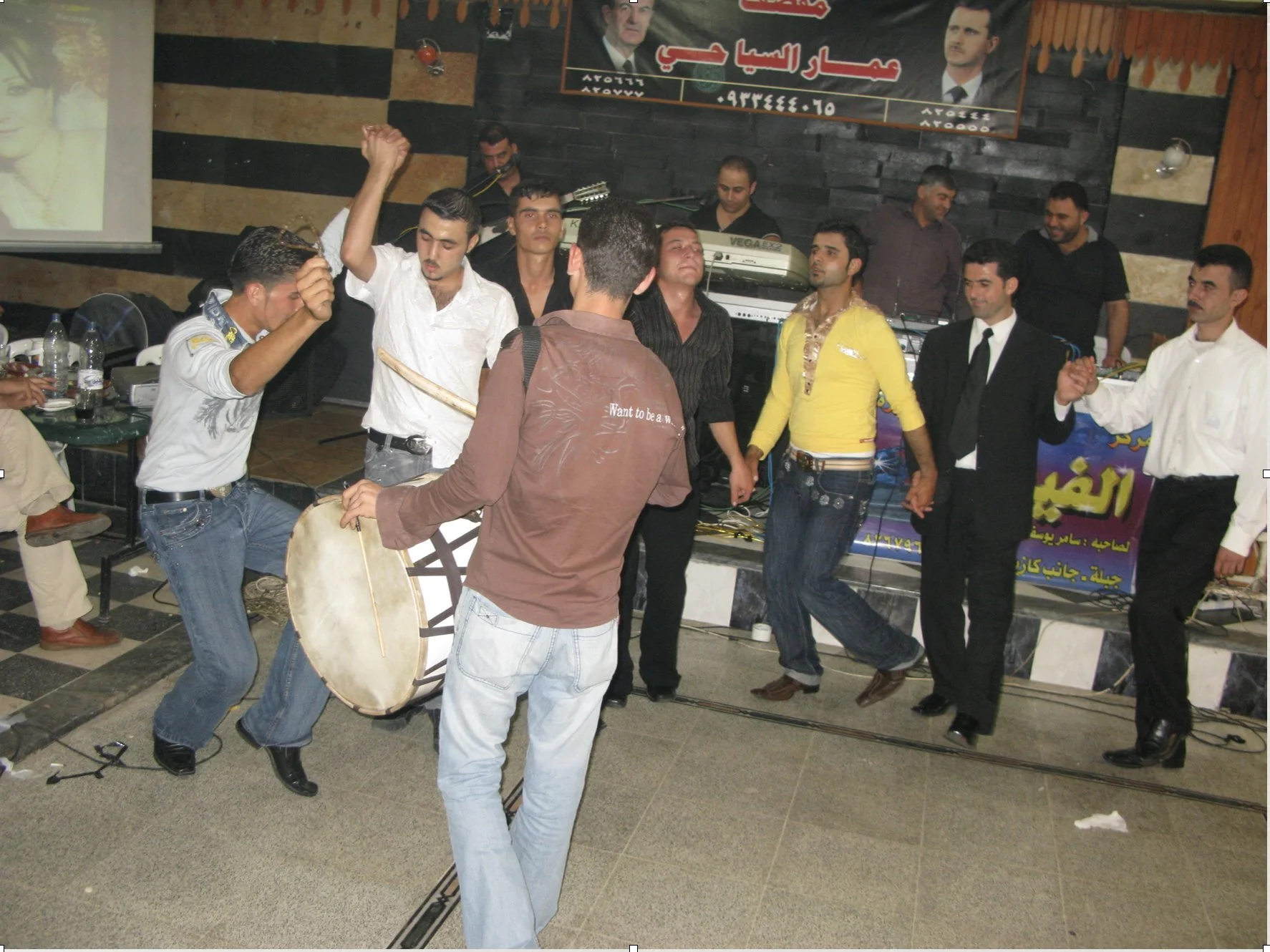
Lead dancer and dance circle at a wedding in Jable, Syria. 8 October 2008. Photo by author.
PART II - DABKE OR PAS DE DEUX? THE PATRIARCHAL SOCIAL CONTRACT AND OTHER BINARIES
LH: How was gender configured within Syria’s patriarchal social contract in dabke and raqs sha‘biyya (national folk dance)? Since Baathist Syria was not alone in this period in rebranding folk dance as a tool of citizenship, could we link the patriarchal structures of the Soviet and Baathist states by examining how they configured gender in dance and beyond?
SMS: Absolutely. In Chapter Three, I focus on how everyday masculinities are embodied, performed, and privileged in the course of dabke practice. To be clear, women more often than not participate in the dabke circle, but there are different and greater expectations for men to enact an embodied mode of play and skillfulness that is masculinized through dabke practice and distinct from the expectations for women in dabke circles. Chapter Three examines how everyday masculinities are part of a patriarchal social contract, specifically within families, and how dabke is practiced in kinship spaces.
Let me turn to your really good question about Soviet influence, part of the background of Syrian history. There was a close alliance between Syria and the Soviet Union in the mid-1970s. People went to study in Moscow, whether in mathematics, engineering, dance, or music. Many Soviet instructors came to teach in Damascus. The ballet school followed a Soviet model of dance, and the music conservatory had many Soviet and Russian instructors. There were quite a few pathways established for education and culture as part of the political and economic forms of Soviet influence. This shaped the historical development of raqs sha‘biyya in Syria.
In Chapter One, I go into detail on who played what role, what kinds of meetings and tutorials took place, and what kinds of training occurred. I would emphasize that the Soviet dance instructors received a mixed reception. They were not always elevated on a pedestal. Syrians maintained autonomy in how they wanted to create their own folk dance. But they were fundamentally interested in continuing and becoming involved in this very Soviet folk dance project. The main figurehead of Soviet folk dance, Igor Moiseyev, influenced state-sponsored folk dance troupes across the entire world. Syria was part of this worldwide pattern of building national identity through the cultural heritage of dance, turning to the Soviet model of folk dance to develop a repertoire and visions for that identity. How this relates to the patriarchal social contract is really fascinating. Even before the mid-1950s, when many of these dance groups began to emerge, local scholars in Syria were already gendering dabke.
In terms of normative binaries, for instance, men’s dabke was generally considered faster and more agile, while women’s dabke was considered more gentle and virtuous. You referred to this in an earlier question about the temporalities [see PART I], even within the different dances. These framings were emerging at a time when, across the world, people were beginning to see athletic or physical culture as a space for youth development, a means to advance modernist visions of progress.
There was, I would say, a bit of absorption of Western gender binaries that occurred alongside the modernization of athletics and other forms of physical culture, all of which were considered sites for inculcating cultural citizenship as nationalist movements were growing around the world. So when cultural leaders in Syria began forming the first folk dance groups in the 1950s, the naturalization of heteronormative gender binaries and the mapping of cultural expression onto those binaries had already been in circulation for about twenty years.
At the same time—and this connects to the patriarchal social contract we discussed earlier—cultural expression was viewed as an engine for social progress, specifically as a vector for egalitarianism between men and women. This was very much part of socialist philosophy and how social movements built themselves.
Folk dance was considered a morally appropriate way of conducting one’s body in public, whereas other public forms of dance were deemed inappropriate, especially for women, and could lead to social stigmatization for the individual female dancer and for her family.
In Syria, the social contract encouraged Syrian women to pursue education, earn college degrees, and secure employment commensurate with their high levels of education, as part of a citizenly duty to the new, independent Syria, while continuing to perform traditional patriarchal roles at home as mothers, wives, sisters, and so on.
Additionally, folk dance itself was viewed as a service to one’s nation and ascribed with a certain kind of virtue, both as national service and cultural citizenship, as well as a virtue related to how the body communicates in public. In other words, folk dance was considered a morally appropriate way of conducting one’s body in public, whereas other public forms of dance were deemed inappropriate, especially for women, and could lead to social stigmatization for the individual female dancer and for her family.
LH: Is this where Suad Joseph’s theories come into play? It is interesting how dialects of folk dance emerge from this, you could say, tournée of Soviet choreographers. And could this parallel Suad Joseph's “kinship idioms” that you often refer to in relation to the construction of “virtuous” women and “proper” masculinity? How do kinship idioms complicate the construction of ethno-nationalistic and socialist gender roles in 1950s-1960s Syria?
SMS: Suad Joseph’s concept of kinship idioms complicates the way raqs sha‘biyya—the folkloric folk dance performed on the national stage—functions as a site for constructing ethnonational gender roles. As I said, women perform folk dance on stage as an act of cultural citizenship, but they are only allowed to perform folk dances, not other forms of dance, in respectable public spaces.
What I did not have a chance to mention is that there is a kind of paternalism often on display in stage choreographies of dabke as a folk dance. This is especially true in the first generation of dance productions, based on archival images I was able to view. Paternalism shows up in the way that young men are placed behind young female dancers in a sort of guardianship or companionship choreographic gesture. The fallaha on stage is not unaccompanied; there are performers placed behind her. It also appears in the body language that dancers were trained to present, where you see a paternalistic carriage of the body or the use of hand gestures. As we know, paternalism is alive and well today in many social settings, not just on the stage. Folk dance personas are indicators of how ethnonationalism itself is gendered. When ethnonationalism is realized through cultural expression, it reinforces and rearticulates dominant social norms in ways that reveal those norms.
To get to your question, what are kinship idioms? This is Suad Joseph’s term for verbal and nonverbal gestures or idioms that forge familial relations in patriarchal Arab societies. Joseph examines how patriarchy operates within the family and how families communicate among themselves, and elaborates on how different relationships appear.
I extend this concept of kinship idioms to dabke, treating it as an idiom to underscore its role in family spaces. Specifically, dabke activates familial relationships in ways that privilege patriarchal hierarchies of gender and age. In other words, the dabke circle at a wedding is not a space of exception but part of the work of the wedding itself, which is to reproduce the family unit within a system of patriarchy. It is part of generating the ritual affirmation of community.
LH: You explore two linguistic dimensions of masculinity: rujula and marjala. Could you guide us through this differentiation? How did “relational masculinity” come to be associated with one or the other?
SMS: These distinctions are attributable to Ebtihal Mahadeen, who wrote a fantastic essay unpacking not only rujula, which literally translates as masculinity, but also differentiated between rujula and marjala. According to Mahadeen, rujula perpetuates patriarchal forms of gender domination, that specific code of masculinity. Mahadeen asks whether we can possibly frame masculinity as doing something other than being harmful.
Marjala, according to Mahadeen, is situated, relational, embodied, and sometimes contradictory. It is a gendered construction that shapes both hegemonic and non-hegemonic social relations in public as well as private domains. It opens up a vast way of approaching masculinity as opposed to its assumed toxicity. I take this as a point of departure for thinking through the kinds of masculinities that are embodied and instructed through dabke practice, and how they invite much more complexity.
Also, at a linguistic level, in English, unlike Arabic, we talk about masculinities as something that can be qualified. If we want to invite a range of masculinities, we qualify masculinity: toxic masculinity, healthy masculinity, metro masculinity. But what Mahadeen is saying is that we can actually conjugate masculinity itself. We are not just qualifying masculinity, but rather conjugating the way that it presents itself in the world. I am quite a fan of the work underway in that particular area of scholarship. In Fraught Balance, I play with it and take up marjala as situational, relational, and embodied because doing so offers many more ways to think about how families and communities build themselves, and how larger social groups are formed.
LH: We are almost queering masculinity, in a grammatical sense. What happens to this masculinity when it travels abroad in the diasporic context? What happens to the masculine Dabbikkun (dabke dancers)? We have seen that dabke seems to choreograph a sense of place within both family and nation, simultaneously in accordance with, and subversion of Baathist injunctions. In the diaspora, the dramatized sense of place enacted through dancing is concomitant to the deconstruction of the Syrian refugee as “emasculated and racialized.” How does the shakl da’ira (dabke circle) perform a reorientation of Syrianness in a diasporic context? And in a revolutionary one? What type of Syrian gets to be represented in the shakil da’ira in, say, Berlin? Could diasporic dabke be a form of revolutionary export?
SMS: One framing of masculinity in dabke practice that I set up in Chapter Three, riffing on the concept of marjala and the relational aspect that Mahadeen proposes, is the notion of what I call relational masculinity. I am interested in exploring masculinity as something that emerges between men and between men and women. It is not about an individual; it is not about an autonomous self, as masculinity is so often constructed in discourses on modernity in North America and Europe. Relational masculinity emerges when the dabke line really gets going, and practicing and feeling the flow requires an interdependent relationship with the people you are dancing with. If masculinity is privileged, then it is also very much constructed among all others in the space, in differentiated and hierarchical ways.
In Part Three of the book, I examine conflict, displacement, and revolution as both shaping and being shaped by masculinity. Relational masculinity, as a framing, helps us see how society is ruptured. We can see how masculinity shows up in the dabke circle, as well as in the shakl da’ira.
For those who are not familiar with the term, the shakl da’ira is an open-ended circle created by the chain and line of dancers. It is a social choreography that naturally emerges as people practice dabke. Participants place themselves in the moment, moving together, generally dancing the same steps at the same time to the same rhythms, while being very close to one another. People interlace fingers, clasp hands, sometimes interlace elbows, or place arms around shoulders. Shakl da’iras are very close-knit.
This synchronous motion and proximity lend themselves to political and creative imaginings of what the shakl da’ira does as a cultural imaginary. The shakl da’ira is also a space for relational masculinity because masculinity is privileged in the moment of dabke practice. So what does this mean for, as you mentioned, historic moments of diaspora or revolutionary sites? I suggest that what we see is a denationalized iteration of Syrianness.
LH: Thaqafa Wataniya evaporates!
SMS: Yes! What I mean by denationalized is best described by the two projects that are most engaged with in Chapter Six, which is about displacement and diaspora. These two projects, entirely developed by Syrian artists, are deeply invested in resisting ethno-national forms of culture, even while there is tremendous European pressure from funders and audiences to perform Syrianness as something that is inherently ethno-national. For instance, Mithkal Alzghair just developed a choreography titled Displacement, in which he presents the shakl da’ira as the core formation of the choreography’s second act. Act one features a single dancer, while act two involves three different performers. These three different performers compose the shakl da’ira, and they all happen to be of different nationalities. They are all male dancers. When performing together on stage in displacement, they embody group resilience in response to the experience of social isolation and racial stereotyping that has shaped Syrian displacement to Europe in the 2010s.
In act one, we see the difficult and disturbing performance of a singular male dancer isolated on stage, separated from community life in Syria, trying to figure things out on the ground, often being racialized into binaries of good Muslim/bad Muslim, good Arab/bad Arab that circulate in Europe. In contrast, act two, with its shakl da’ira of three male performers, shows that coming together can once again bolster these conditions of marginalization. This is the way we see masculinity shifting. Masculinity becomes a more isolated experience because of diaspora and displacement, but at the same time, when men are able to work together and provide social support for one another, masculinity can be a source of resilience and social resources. This connects back to the marjala framing.
The second project is by Medhat Aldaabal and Ali Hasan, two dance artists and a percussionist based in Berlin. They have been hosting a dabke community workshop for years, since about 2017, continuing it throughout the pandemic and still running it today. In their dabke community workshop, they bring together people of all backgrounds into a large dabke circle that foregrounds collective bodywork and self-care. It is not so much about learning Syrian dabke. They want to have a shared experience that fosters group bonding through the dabke circle, the shakl da’ira.
In doing so, they break down the shakl da’ira, moving it away from a family-based kinship space where patriarchal forms of masculinity are foregrounded. Instead, they decenter it and make it accessible to anyone, from any background, encouraging people to feel they can move their bodies and explore new ways of embodied knowledge together in a learning space. Ali Hasan shared with me that one Syrian woman who participated in the dabke community workshop said she felt more comfortable in that dabke circle than in any others she had previously performed in. This is also a way diasporic contexts allow many new perspectives to enter, how masculinity is formed and shaped to decenter it and expand it.
LH: It is almost a counter-Baathist sha‘biyya enacted in the diasporic and revolutionary context.
SMS: It is absolutely beautiful. And that is the work of revolution. The work of the revolution is to allow all sorts of new modes of being to come into play, rather than constantly complying with one ideology.
LH: Dabke truly encapsulates all sorts of dynamics and dialectics—gendered, colonial, economic, class-based—all gravitating around this polysemy of sha‘biyya that you have been exploring throughout the book. How did you detect the classism of dabke, and how has the hierarchy of class and taste espoused the sonic spectacularity of the performance ? Especially since the Revolution.
SMS: The class politics of dabke were really obvious from day one. Some contemporary artists might shun dabke and its melodies readily available as MP3s at bus stations and other public transportation sites, preferring a more conceptual approach to music. I think anyone who spends more than a day in the region understands that dabke is lower class, working class, popular, sha‘bi. It is a sound that can be celebrated and also stigmatized, depending on one’s class politics.
Of course, this class position is not exclusive to dabke at all, but visible and audible in popular culture worldwide. I would say, though, that a lot of the class and taste politics that had ensconced dabke changed with the Syrian revolution. Dabke became politicized by both anti-regime and pro-regime actors in ways that cut across established class and taste markers.
The revolution recharged dabke. It became a vector for political mobilization. There is no clear political category for dabke. Many well-known dabke singers championed the regime, while many others challenged it. Similar to how the revolution as a movement cut across class boundaries, dabke’s popularity muddled any clear demarcations of class and taste that existed before the war.
Before the war, dabke music was often excluded from the ritzy and bougie cafés in downtown Damascus. It was not played on satellite music channels that made revenue for major media companies by broadcasting light Arab pop music, which avoided the so-called sha’bi dabke. The revolution recharged dabke. It became a vector for political mobilization. There is no clear political category for dabke. Many well-known dabke singers championed the regime, while many others challenged it. Similar to how the revolution as a movement cut across class boundaries, dabke’s popularity muddled any clear demarcations of class and taste that existed before the war.
LH: On a more technical level, how did you capture the sense of suspension [from time and space] associated with dabke? How do you contrast the state of suspension in which dancers and audiences are trapped with the struggles that might arise from the practice or that might nourish it?
SMS: I found the concept of flow to be really helpful for capturing suspension. Performance studies, as a field, is also interested in those moments of suspension from daily life, especially when they arise through cultural expression. Whether you are at the theater experiencing high art and high culture, or so involved in making something that you lose yourself in the everyday rigmarole of time, the concept of flow is useful.
I turned to the concept of flow to capture the fluidity and suspension of dabke. The concept of flow, developed by Mihaly Csikszentmihalyi in 1990, is very helpful to describe the feeling of time while being creative. Csikszentmihalyi thinks about flow in terms of getting lost in reading, painting, or making music, which is very much a single person doing their craft. But as we have been discussing, dabke is relational and social. It makes no sense to hold on to the idea of one person lost in solitude and a moment.
Let's expand the idea of flow and talk about it as something that is social. Flow helps people bond. You only find flow by interacting with others. I project this concept throughout the project to discuss how dabke builds families, other social institutions, and collective identity as fundamentally intersubjective and interdependent on one another.
Flow is intercorporeal. It is situational. It reorients dance and music beyond the individuality of performers. We are not talking about an individual social actor, even if they are incredibly talented and virtuosic. Dabke is not that kind of practice; it really is about the sociality of a flow.
LH: It is almost a by-product of Arabness itself. Arabness becomes an intercommunal and relational experience. I wonder if we could index Arabness on flow.
SMS: It would be incredible if somebody were to do a research project on how Arabness is embodied and played with on, for instance, college campuses. There are so many different student associations that are building social clubs and identitarian groups, and dabke is incredibly popular as part of the programming for these gatherings. It has been this way for decades; it is not new. It would be an incredible research project to examine how dabke is doing that kind of work.
LH: In the last chapters of your book, you also touched on the stark contrast between the ephemerality of the dance and the spectrality of the state that always lingers in the background. Could you tell us a few words about this contrast? How did it hit you?
SMS: There is abundant literature on how spectacles of power shape perceptions of the state as eternal, legitimate, and sovereign, even today. Lisa Wedeen analyzes this in Syria, especially under Hafez al-Assad. Alexei Yurchak examines this in the late Soviet Union. His work is a deep dive into state spectacle and its mythological and narrativizing power. While Wedeen, Yurchak, and many others focus on large-scale political rituals, I try to look beyond the grandiose political stage and into the texture of local life.
I find that there is a consistency to the role of dabke in everyday life and in forging community and family institutions that defy the attempts by statecraft and by the big political rituals of the Assad regime to divide and isolate social groups from one another. In fact, the ephemerality of dabke performance has a lasting impact because it produces close communal bonds necessary to survive an authoritarian regime when that regime is trying to divide and isolate social groups and families.
LH: We will not venture into predictions or teleology, but our conversation makes me wonder: if you were to add a fourth part to the book now that the Assad regime has fallen, what could it look like?
SMS: It is too early to see, too early to say, and it may take generations. It depends on the horizon of possibility. Dabke was part of political propaganda and political compliance, as I discuss in a journal article in the Journal of Middle East Women’s Studies about the “barbaric dabke,” and the depiction and representation of dabke in Syrian literature and film. Dabke was used as a form of political propaganda, as every elementary school student was required to participate in or watch dabke folk dance groups as part of their education—just like they sang Baathist songs and chanted Baathist slogans. This created a prescribed political culture, a prescribed nationalist culture. That is a propagandistic approach to dabke, which is entirely separate from what happens at weddings or at home when people are casually hanging out in leisurely spaces.
It also functioned as a form of political compliance, as some of this literature, films, and conversations I have had with people suggest. Under the Assadist regime, there were many mass public demonstrations, and attendance was mandatory. If you did not attend, you were subject to interrogation or accountability. At those demonstrations, there were often dabke performances. Even at smaller-scale gatherings, dabke was part of the songs, slogans, and rhetoric that filled the Baathist space and helped shore up the unified ruling political party.
To not participate, as Lisa Wedeen’s notion of political ambivalence suggests, would create vulnerability. Someone might ask why you did not participate. It could show up in a report stating that someone at the political event noted that so-and-so did not participate. That, in turn, could lead to an interrogation. So maybe what we might hope to see is that dabke is no longer part of that propaganda and compliance. The de-baathification of dabke.
LH: You spoke at the beginning and at the very end of the book about the category of the foreigner and foreignness. How have your perception and embodiment of your own alterity shaped your research and your sense of flow? How did you flow in those spaces?
SMS: I found that being a foreigner, an ajnabia, in Syria was truly a privilege. I have always said, and I will forever say, that Syrian hospitality is the most generous, warm, and open hospitality I have ever had the fortune to experience. From day one, I was invited to a lavish family lunch at an acquaintance’s home, and there was always a spirit of welcome without hesitation.
It was not only I who was welcomed, but also the project itself. From artists and teachers to local villagers, the fact that I was researching dabke was met with respect, engagement, and enthusiasm. The project to valorize dabke as a collective identity marker began decades before my arrival, and this is part of what I document in chapters one and two. People situated my research within this larger national project of dabke. Most of those I met were delighted to hear that people outside Syria might learn about their beloved dabke through the foreigner’s research. And I do not say that naively; I hold it as both a motivation and a commitment to continue the work.
Regarding my own alterity and ability to move through social life, I want to make clear to readers that I am mixed-race and therefore nonwhite, though perhaps somewhat ambiguously so. Most Syrians expressed a sense of affinity with me because they racialized me as a nonwhite American and credited me with a minoritarian perspective on American belonging. This often surfaced in the familiar question: “You’re from America, but where are you really from?” That question often overlapped with their own lived experiences. Being racialized as nonwhite helped me build rapport and sustain my ethical commitment to the work, especially as it reaches readers based in the United States.
LH: You also articulate in your research an approach to relational and informal archives that emphasizes a particular sense of flow. Could you elaborate a little more on your relationship to these non-institutionalized embodied sources of knowledge?
SMS: When I was trying to learn how to dabke—which, of course, is absolutely vital if one is going to be doing research on the dance—the conditions had to be right for people to be able to teach me. If the people were not able to teach me, I was not going to be able to learn.
You need at least two people. You cannot dabke by yourself. that sense of rhythm, the ability to move and to find that flow means that there has to be somebody next to you who is anchoring you.
I have since been in many different learning spaces where a basic fact about dabke is reiterated across practitioners, dancers, and experts: you need at least two people. You cannot dabke by yourself. That sense of rhythm, the ability to move and to find that flow means that there has to be somebody next to you who is anchoring you. Or you have to be that anchor so the person next to you, who is leading, can really begin to find the flow within the footwork, the body, the shoulders, and so on.
It became a problem when I was the second person who did not know how to dabke. In that sense, you did not really have two people; you had one person who knew it and one person who did not. But you actually need two who know how to do it. This is part of the methodology.
This happened in person, but it also happened when I tried to learn over Skype, back in the days of Skype, with someone teaching me from their living room. This was a professional dance artist, incredibly skilled, creative, talented, and committed to the practice. But they said to me, “I am sorry, this workshop on Skype with me here and you there is just not quite landing.” And I thought: I tried. But actually, as a researcher, this is interesting. When we do not find the flow, it shows us what is missing and therefore what helps people to actually dabke in a way that feels good in their bodies.
It is both a kinesthetic and a sensorial experience. But it is also very much about our social positionalities. You can create social relationships whenever you find the flow, or when you do not. Either way, it reveals something, whether it is the “foreigner,” gendered, or social class aspect. All of these shape how we interact with one another and with each other’s expectations. Part of engaging with these relational archives is acknowledging that I, as a mixed-race, female, American researcher, will develop a certain kind of relationship with everyone alongside whom I learn dabke, distinct from what we each bring to that shared space.
Shayna Silverstein is an Associate Professor of Performance Studies at Northwestern University. She is a multidisciplinary scholar working on music, dance, and sonic praxis in both global and SWANA contexts of embodied socialities.
Lidia Helou is a Lebanese-Italian doctoral student in Middle Eastern and Islamic Studies - Culture and Representation at New York University. Her current work focuses on the mechanics of sensorial memory in relation to conceptions of space, time, and agency in the Levant.
Prepared with the editorial assistance of Akshara Santoshkumar.