Unpredictable and Precarious yet Expected: Chihab El Khachab’s Making Film in Egypt
How do media producers in Egypt manage these unknowns and politics in the complex production and distribution process? Chihab El Khachab considers this question with focus on film production in his new and exciting Making Film in Egypt: How Labor, Technology, and Mediation Shape the Industry. The book is based on eighteen months of fieldwork that he conducted between 2013 and 2015 in Cairo, Egypt.
Read More
Social Theory from the Global South: In Conversation with Durba Mitra, Andrew Liu, Anupama Rao
Why should we ask history to do theory? What does it mean to insist that a social theory aspiring to a form of global knowledge must emerge from the spaces of the global south? These questions framed a wide-ranging conversation Meghna Chaudhuri and I held in November 2020 with Durba Mitra and Andrew Liu to mark the publication of their new books–Mitra’s Indian Sex Life: Sexuality and the Colonial Origins of Modern Social Thought and Liu’s Tea War: A History of Capitalism in China and India. Our aim in bringing Durba and Andrew together was to understand their respective orientations to social theory and historical method—and to see, in practice, the work of emergent theory-making within archivally-grounded historical research.
Read More
India and Africa in Parallax: In Conversation with Renu Modi, Shobana Shankar, and Meera Venkatachalam
Given how many histories and critical perspectives on the past Gandhi’s name conjures, his iconic presence prompts a parallactic reading of history and politics in India and South Africa. Parallactic readings uncover histories behind the easily predictable image crowding dominant lines of vision. Parallax and parallactic readings come together in recent scholarship and art, including Pakistani-American artist Shahzia Sikander’s Parallax, an installation composed of hundreds of digitally animated images which focuses on the geostrategic position of the Strait of Hormuz as well as aims to orient viewers to perspectives on modern colonialism and post-colonial politics of the present.
Read More
A Cosmovisión of Solidarity: Anticolonial Worldmaking and the Politics of Possibility
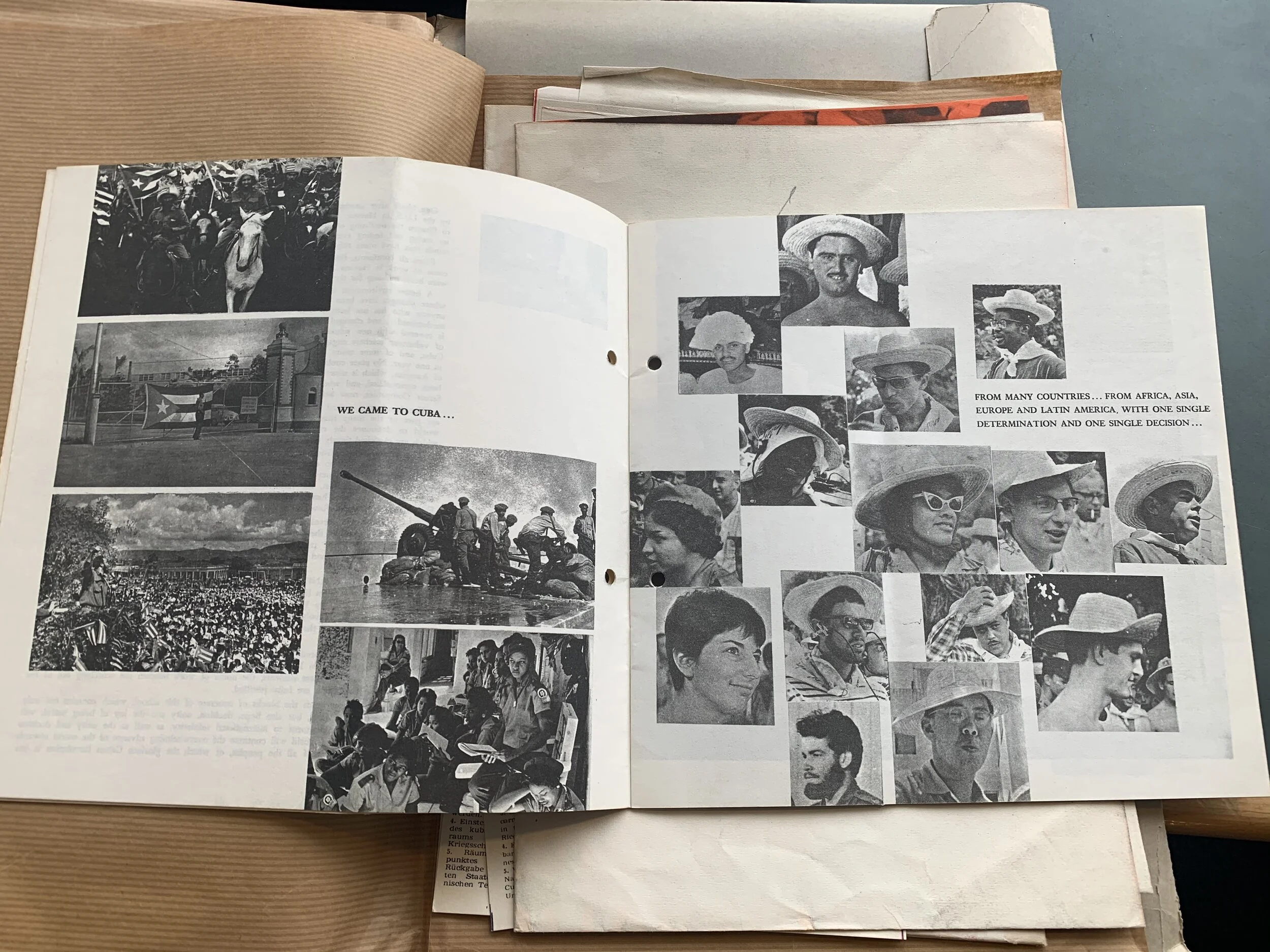
These historic practices of optimistic anticolonial solidarity may appear alien to a contemporary world not imagined or accounted for by the revolutionaries of the 1960s and 1970s, a world characterised by political languages and frameworks that have undoubtedly changed. But the traces of an earlier worldmaking remain in the institutional memories and intergenerational revivals of revolutionary forms and horizons. Researching this history, retrieving its traditions, and tracing its afterlives – of collaboration, friendship, and mutual exchange – offers lessons for the meaning of worldmaking today, as a collective practice of transformative solidarity, grounded in a shared belief in the possibility of alternative futures.
Read More
Decolonizing Capital: A Politics of the Present — In Conversation with Samita Sen
“In the 1980s, the focus of women’s history was on nationalism (women’s role and/or participation in anti-colonial struggles) and women’s writing (to recover their agency and subjectivity). I have always found it somewhat paradoxical and ironical that Subaltern Studies, which gave us such a trenchant critique of elitism in nationalist histories, ended up justifying, even shoring up elitism in other ways. By designating women as subalterns and the recovery of their voice as the primary agenda, we limited the scope of women’s history to middle-class and upper-caste women. The bhadramahila became the focus of women’s history. We told and re-told stories of social reform. I was not convinced by this argument”.
Read More
The Lost Life Stories of Mahari-Devadasis in Postcolonial India (1947-2015)
“Although our rituals of worship and traditions of religiosity are now performed worldwide on dance stages, we have largely remained excluded from this reconstruction of ‘respectable’ dance.” Such were the viewpoints of the last living Mahari Sashimani Devi, prior to the extinction of this matrilineal community in 2015. Reliant on the experiential perspectives of stigmatized subjects from the marginalia, this article critically analyses the effects of Devadasi abolition laws on the legal status and socio-political positioning of Mahari-Devadasis, who were temple-dancers in the Jagannath Temple of Orissa, and the historical creators of the classical Indian dance-form Odissi.
Read More
Histories of the Enslaved in the Indian Ocean World: In Conversation with Nira Wickramasinghe
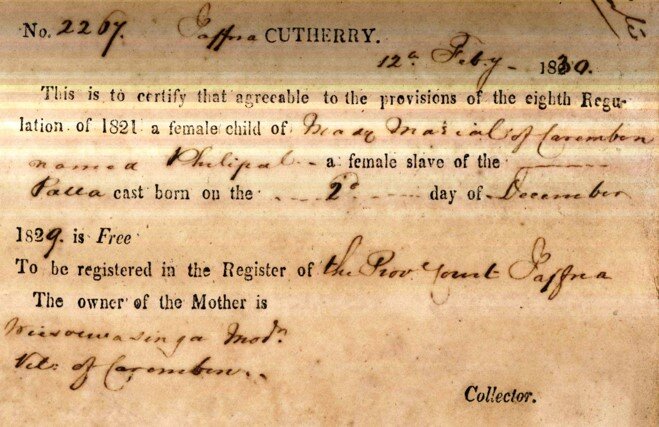
In popular memory, Sri Lanka has no history of slavery. Nira Wickramasinghe's latest book, Slave in a Palanquin, challenges this using Dutch and British archival records to point to the lives of thousands of enslaved persons including men and women from across the Indonesian archipelago, local Sinhalese, Muslims, and Tamils. In the following conversation, conducted over email, Nira Wickramasinghe speaks to historians Kalyani Ramnath and Tamara Fernando.
Read More
Economies, life and otherwise: Elizabeth Povinelli in conversation with Amit Baishya
Liberalism could no longer claim that it was ravaging and destroying worlds based on any good. So what happens? And that's what we start looking at — late liberalism. Liberalism says, in terms of its cultural logics, does this amazing thing. What a great trick! And it's what I and my colleagues at Belyuen were in the middle of in 1984.
Read More
The Lost Archive: An Interview with Marina Rustow
I stared at the documents long enough to realize that some of them had as many as five different hands on them, crammed onto a tiny tax receipt for instance, or the top segment of an archival copy of a decree—it’s quite amazing. There are hundreds or thousands of these documents now, and there were probably hundreds of thousands of them back then, and they have multiple personnel and predictable structures and layouts, but those structures and layouts differ by genre and function. All this suggests that there’s a complex system of trained people—that they’re not running a state by the seat of their pants. They’re doing it in a deliberate and elaborated way, and with detailed technical skill.
Read More
Call for Pitches: The Final Frontier? Bilad al-Sudan in African and Middle Eastern Studies
Borderlines seeks thoughtful and innovative contributions that help us rethink the historical construction and transformation of racial difference in Sudan, its entanglement with other axes of social, economic, and cultural politics and its contemporary manifestations and implications. We are particularly interested in studies that take on a transregional focus connecting Ottoman, Arab-Afro and trans-Saharan African borderlands, and that engage with recent debates situated at the intersection of African and Middle Eastern Studies. Works on contemporary as well as historical phenomena and developments tied to questions of slavery, revolution, and artistic production are particularly welcomed. We are also interested in publishing translations of literary texts that engage with cinema and art as well as studies of primary-sources that interrogate the vicissitudes and production of racial difference in the borderland region of Bilad al-Sudan and beyond.
Read More
Call for Pitches: Another Worldmaking? Art, Culture and Thought
How did anticolonial worldmaking offer “strategies to mitigate, circumvent, and undo the hierarchies that facilitated domination”, and how did these strategies work in the intellectual, artistic and spiritual realm?
Read More
Lost Opportunities: Housing Crisis and Urban Non-Governance in Egypt
“Rationalising the complicated mesh of conflicting ownership and usufruct claims is likely impossible without acknowledging ‘adverse possession’ and claims-in-place. But doing so raises a different sort of problematic: that of the fait accompli and the creation of ‘facts on the ground’ by the local centres of power found in both elite and subaltern neighbourhoods. The underlying dilemma is thus the lack of public authority with sufficient ‘reach’ and competence to negotiate competing demands.”
Read More
Shelter as Capital: Housing and Commodification: Lessons from the Global South
“But labor immobility is not always the motivating factor in housing projects. Other possibilities abound. The slum must also (unlike the prison) be an active source of a reserve army of labor. Or, as in my study of Delhi, housing projects might emerge quite apart from the question of labor. Here the establishment of a Delhi Improvement Trust (in 1937, nearly 40 years after the BIT) was initiated by a piece of bad press.”
Read More
Protest, Politics, and Panjab
“At the level of historical analysis, there is a long history of conflict… For “ruler” and “ruled” within Panjab, much of the literature, poetry, and aphorisms point to widespread irreverence and even contempt of common people toward authority. This resonates through Sikhi and its philosophy of empowering the most exploited and excluded to confront their oppressors. Even at a broader level, it is not merely a colonialist fantasy to acknowledge that the legitimacy of rulers in Panjab and its environs was quite precarious.”
Read More
On Touch, Intimacy, and Difference: Quarantine Exchanges with Santanu Das
The mother’s body is usually our first memory. In situations of crisis, people revert to these primal moments: we crave once more for the maternal embrace. I work on the First World War, and I am reminded of young men in the trenches who, in their final moments, would often ask for their mother. Two scenes, in particular, come to mind…
Read More
Worldmaking and Empire: Humanity and Universals Not Sought
Even though we're differently positioned disciplinarily, we're all kind of interested in—the ways that ideas and institutions are mobile, that they can be reconfigured. You can't make anything and everything with them—but they are available for recapture and repurposing. To get at this, we are also all looking at moments in which a certain form of transformation is possible or these moments of repurposing are available to certain kinds of actors.
Read More
“Where is the working class? It’s all over the world today”: Jairus Banaji in conversation with Sheetal Chhabria and Andrew Liu
“My problem was how do we write a history of capitalism, if you call yourself a Marxist, you have all these categories before you, how do you use them to write a history of capitalism? And it always struck me as paradoxical that Marxists above all should have been writing a history of capitalism but weren't. I mean, whereas you had the Annales school and the various continental historians and so on writing histories of capitalism. Whenever a Marxist attempted to write a history of capitalism…”
Read More
“Where is the working class? It’s all over the world today”: Jairus Banaji in conversation with Sheetal Chhabria and Andrew Liu
“I avoided the word “origins” of capitalism because this wasn't a substantial cognitive claim. It was a looser agenda, namely the rise of capitalism. I hope you see the point of a distinction between talking about the origins of something as putatively specific and the rise of something as more flexible and potentially more fertile. So that was the essay where I argued that it made no sense to transplant Marx's strictly methodological remarks in Capital about the relationship between commercial and industrial capital to a history of capitalism…”
Read More
Revolution and Disenchantment: An Interview with Fadi Bardawil
I do think that there is simultaneously too much authority that's granted to theory and too little. Let me spell out what I mean by that. There are some thinkers who attribute a lot of what happens in the world— radical transformations of the world, ontological violence—to the discursive assumptions of particular theories? How does it sometimes move from being a critical theory to becoming a political ideology? How does a work of critique, like Edward Said’s Orientalism, become appropriated by certain political forces, be they Arab nationalists or Islamists, for example, and included in their ideological arsenal that is marshaled against the West.
Read More
Transcript: Columbia University Ambedkar Initiative Podcast
We want to think about how Ambedkar's own intellectual formation might open up new ways to understand the history of the University, ways to turn the University inside out, if you will, to open up the University to novel gaze, to rethinking its relationship with its neighbors. For instance, with Harlem, but also the links between the University and the world and the ways in which the figure of Ambedkar might allow us to do so.
Read More